Money transfer app conversion redesign
The install cost is paid the moment somebody downloads it. Everything after that, from the OTP to the payout choice, decides whether that spend ever becomes a first transfer.
Remittance only · KYC steps left intact · Every change tested first

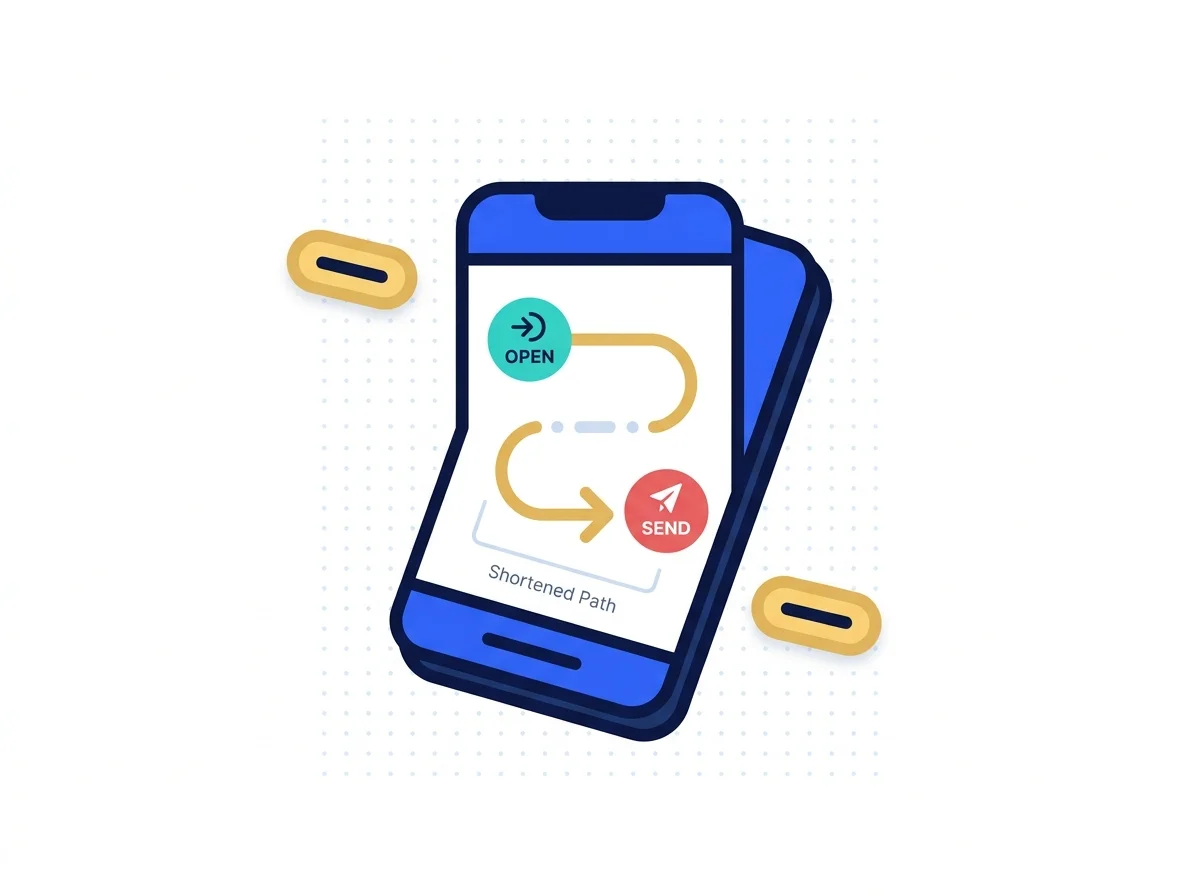
App conversion redesign for remittance companies rebuilds the eight screens between install and send: registration, the OTP, the KYC upload, the beneficiary, the quote, the payment and the confirmation. The compliance steps stay exactly where they are, so what changes is the wording, the order, the error recovery and the number of taps, all of it tested against the funnel before it ships.
What changes in the app
Most remittance apps get redesigned screen by screen, and the funnel is checked afterwards. Four things change.
OTP then a wall
The sender verifies a number and lands on an empty home.
OTP then a quote
Verification ends on a rate, with the corridor already chosen.
KYC with no help
The document upload fails and the screen just says try again.
KYC with a way back
The error names the problem and offers a retry that works.
Every send from scratch
The repeat sender retypes the account number every month.
Repeat send in two taps
Recent recipients, saved amount and the same corridor, ready.
Shipped on opinion
The loudest person in the room picks the screen order again.
Shipped on evidence
Each change runs as a test against the actual funnel numbers.
What the redesign covers
Four rows of work, run in order. The compliance steps are never the thing that gets moved.
The goal, stated quite plainly
The brief is short, and it is not about the visual design. The goal is not merely: Make the app prettier. The goal is: Reduce unnecessary friction between intent and successful transaction.
- Mobile funnel audit done first
- App analytics reviewed as well
- Store reviews read for the causes
The eight steps, taken in order
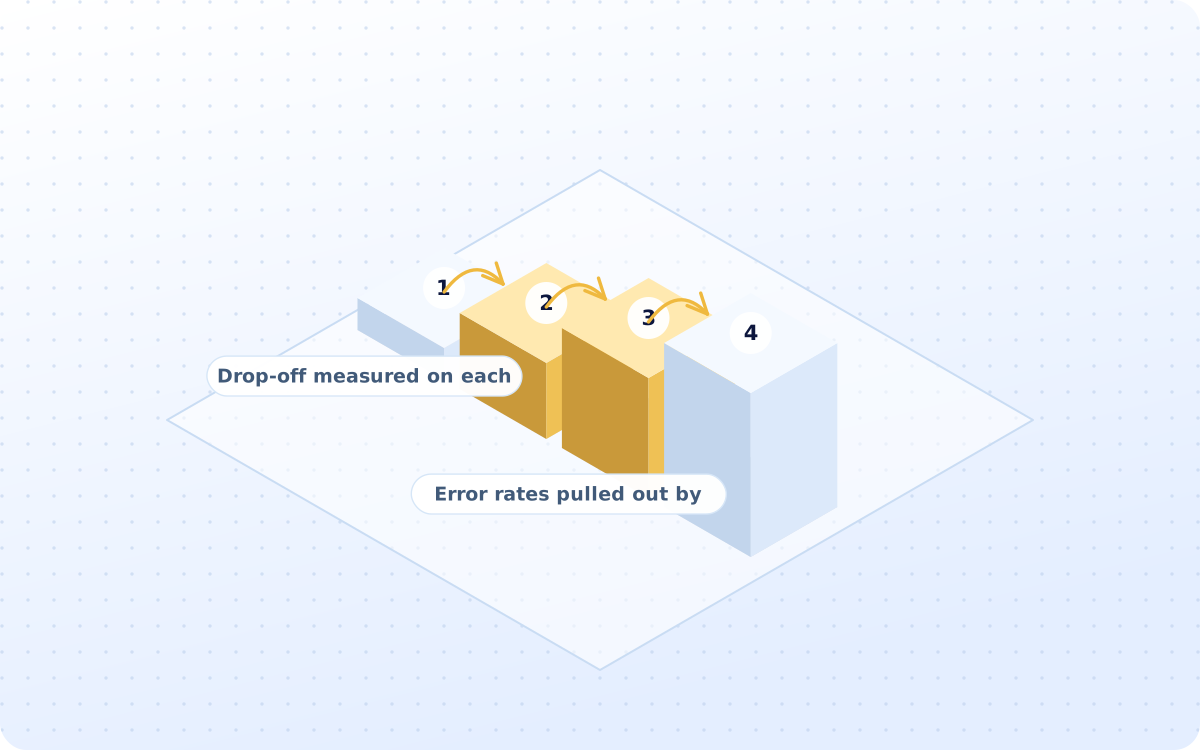
Eight numbered steps sit between the installation and the send, and every one loses somebody along the route. Analyse: Install → Open → Register → Verify → Add Recipient → Quote → Pay → Send
- Drop-off measured on each screen
- Error rates pulled out by step
- Cohorts split by their first send
The KYC screens, left untouched
The KYC screens get better wording and a way back in, but not one step less. Compliance requirements should remain intact. First-time customers often need more guidance than repeat customers.
- Upload instructions all rewritten
- Camera permission asked for later
- Pending status explained clearly
The second send, and the testing
Recent recipients, saved methods and a two tap repeat send are the screens that decide whether a first transfer ever becomes a second one. Every change ships behind a proper test, never an opinion.
- Recent recipients on the home screen
- Saved payment methods get reused
- Every change tested, not argued
What you actually receive
Six artefacts, all of them yours to keep. The funnel audit will outlive any redesign we do.
Mobile funnel audit
Every one of the eight funnel steps, with the drop-off between each pair measured and recorded.

Screen by screen map
What every individual screen has to accomplish, and what it must not ask the sender for yet.
Redesigned KYC flow
The very same steps, with better instructions, better errors and a retry that actually works.
Error state library
Every single failure a sender can hit, with the wording and the route back both written out.
Prototype for testing
One clickable version of the new flow, put in front of real senders before any build starts.
Test and result log
What exactly was tested, what won, what lost, and what had to be reverted straight afterwards.
How the app redesign runs
Four stages, run in order. No screen changes at all before the funnel audit has been finished.
Where the app is actually losing senders
Install to open, registration to verification, and verification through to the send itself are measured, then the store reviews explain them.
- 01All eight funnel steps measured
- 02Screen progression fully tracked
- 03Error rates pulled out per screen
- 04Store reviews grouped by theme
- 05Crash-free sessions checked too
The screens between install and send
Onboarding, registration, the KYC uploads, the beneficiary and the quote are redrawn in that order, because each one feeds the next one.
- 01Onboarding gets to the point fast
- 02Registration fields all cut back
- 03KYC instructions made much clearer
- 04Beneficiary details saved once
- 05Quote shows rate, fee and time
What happens when something goes wrong
Failed payments, rejected documents, expired sessions and changed rates each gets a screen that explains what happened and what to do next.
- 01Failed payment has a next step
- 02Rejected documents get explained
- 03Rate changes shown, not hidden
- 04Session expiry keeps your data
- 05Confirmation given at every stage
Whether the change has actually worked
Screen order, step count, CTA wording and trust messaging are each tested on their own, because two alterations at once explain nothing.
- 01One change per test, and always
- 02Onboarding order tested first too
- 03CTA wording tested very properly
- 04Losers reverted in the same week
- 05Winners kept inside the codebase
What the work actually does
Fifteen groups of work sit behind the service, and these twelve are what actually changes in the app.
Funnel audit
Eight steps, install to send
Analytics review
Activation, drop-offs and cohorts
Review analysis
What senders complain about most
Onboarding work
Value shown before permissions
Registration flow
Fewer fields and a clear OTP
KYC experience
Same steps, better instructions
Beneficiary flow
Bank, wallet or a cash pickup
Quote screen
Rate, fee and delivery estimate
Payment flow
Funding, confirmation and recovery
First transfer
More guidance the first time
Repeat transfer
Recent recipients, saved methods
The experimentation
One change per test, measured
Three ways to buy this
One of these will fit, whether the whole app moves or only the KYC screens actually move.
Complete flow redesign
The audit, the redesign, the prototype and the tests, all run once across the whole send flow.
- Fixed fee, agreed before we start
- The KYC steps left exactly alone
- Measured against the first audit
Registration flow rebuild
Only the screens sitting between the install and the first quote, shipped as a single release.
- One fixed fee, six weeks total
- Usually registration and the KYC
- The prototype is handed over too
Comprehensive app audit
Where the app loses senders, all ranked, with each fix priced against what it would recover.
- Two weeks, priced before we start
- No obligation to redesign after
- Every fix costed against recovery
Comparison. A general agency will redesign the screens. App conversion redesign for remittance companies redesigns the eight steps and leaves the compliance ones alone.
Position. Most apps need the KYC screens and the repeat send fixed, not a new design system, and it costs less.
- Licensing and AML questions go to a qualified adviser. We handle advertising and marketing compliance.
Audit line. If none of the three fits, a fixed-fee growth audit will say which one should.
Four steps to the change
Two weeks of audit, and then the rebuild. App store review adds a week before anything ships.
Measure the flow
WEEK 1-2Eight steps, the crash rate and the store reviews, all read at exactly the same time.
Redraw the screens
WEEK 3-6Onboarding, registration, KYC and the quote redrawn, with the steps left fully intact.
Test on senders
WEEK 7A clickable prototype in front of real senders before any code gets written at all.
Ship and compare
MONTHLYOne change per release, with the nine indicators compared against the original audit.
How results get reported
No client figure appears without written permission. These three are facts about how the work is run.
Services that pair with this
The app is only one surface of it. These three cover the web side and the traffic into it.
The continuous testing work that keeps the funnel improving long after the redesign has shipped.
Learn moreWebsite Conversion RedesignThe same work on the web, where most senders decide before they ever download anything at all.
Learn moreApp Install & User AcquisitionThe paid installs that start getting cheaper the moment the funnel stops leaking quite so badly.
Learn moreQuestions operators ask first
Answers come first. Where the honest answer is no, it says no and explains what to do instead.
Apps mostly. An agent-led operator with an app gets the same funnel work, though the branch locator matters more than the payment screen there.
Yes. Firebase, your MMP and the product analytics supply the baseline, using the event names you already have rather than a new set.
Yes. Payout method, delivery time and limits differ per route, so the quote screen and the beneficiary form change with the corridor.
Yes. App conversion redesign for remittance companies is all that gets done, so the KYC step is treated as a constraint rather than an obstacle.
Compliance requirements should remain intact. Wording, ordering and error recovery improve. Licensing and AML questions go to a qualified adviser.
Store console and analytics access, your MMP, the current build, the corridor list, and whoever signs off the customer-facing wording.
Two weeks to audit, then six to twelve weeks depending on how much of the flow moves. Store review adds about a week on top.
Yes. The nine indicators run from install through to repeat transfer, so a screen that helps registration but hurts KYC shows up immediately.
Yes. The screens stay one set, with corridor differences handled as data, so a new route needs no separate redesign work.
Directly. Recent recipients, saved payment methods and a two tap repeat send are the features that move send frequency more than any campaign.
Install-to-registration, KYC completion and first-transfer conversion are compared against the audit baseline, so the gain is counted in transfers, not taps.
Monthly: install-to-registration, registration completion, KYC completion, beneficiary creation, quote-to-transfer, payment success, crash-free sessions, first transfer and the repeat transfer rate.
By ending verification on a quote rather than an empty home screen, and by giving every failed step a message that says what to do next.
First transfers gained against the fee. App conversion redesign for remittance companies also lowers the cost per first send on every paid install.
Saved recipients and a two tap repeat do most of it. A second send that takes twenty seconds rarely goes to a competitor instead.
Operators, remittance apps and payout platforms on the roster
Marks appear once written permission is on file for each operator.
Measure the funnel before you draw
Most operators cannot say which of the eight steps loses the most senders. A fixed-fee growth audit will name it, and then price the whole fix.
You keep the funnel audit whether or not we redesign.