Signup and KYC funnel optimisation
The people who abandon verification were already paid for. Nothing in this work removes a required check, and the drop still moves once the wording and the retry improve.
Remittance only · No control ever removed · Every step measured first

KYC funnel optimization for remittance companies is conversion rate optimization pointed at the one funnel that decides everything: signup, verification and the first transfer. Every step is measured, the failures are rewritten so a sender knows what to fix, and the retry is built properly. No required check is removed, because that is not what loses the customer in the end of it.
What changes in the funnel
Most operators treat verification as a fixed cost and never once look inside it. Four things change.
Twelve fields at signup
Everything gets asked up front, before anybody sees a rate.
Asked when needed
Required regulatory information must still be collected when required.
Verification failed.
Two words, no reason given, and no idea what to do next.
Errors that explain
Glare, expiry or wrong document, each named on the screen.
Abandoned and forgotten
The half-verified customer never hears from anybody at all.
Recovered on purpose
A reminder that names the exact document that is still missing.
Channels judged on cost
The cheapest installs win, and none of them ever verify.
Channels judged on verified
Cost per verified customer, split by channel and country.
What the funnel work covers
Four rows of work, run in order. Not a single one of them removes a required control at all.
What the whole job actually is
It is a fix, and not a way to skip it. Identify and reduce avoidable friction between customer signup, identity verification and first-transfer readiness while preserving all regulatory requirements.
- Signup funnel audit done first
- KYC funnel mapped from end to end
- Step level events all in place

What the word better actually means
That is the whole brief. The objective is to make required compliance processes: Clearer, Easier to understand, Easier to complete, Better measured, Better supported, Easier to recover when something fails
- Instructions written for people
- Every failure explained on screen
- Recovery built into every step
The eight stages sitting inside KYC
Eight stages sit inside that step. Map: KYC Start → Customer Data → Document → Selfie/Liveness → Address → Submission → Review → Approved. Actual stages will depend on the provider and market.
- Document capture made much clearer
- Selfie instructions all rewritten
- Provider integration reviewed too
Verification is not the end of it
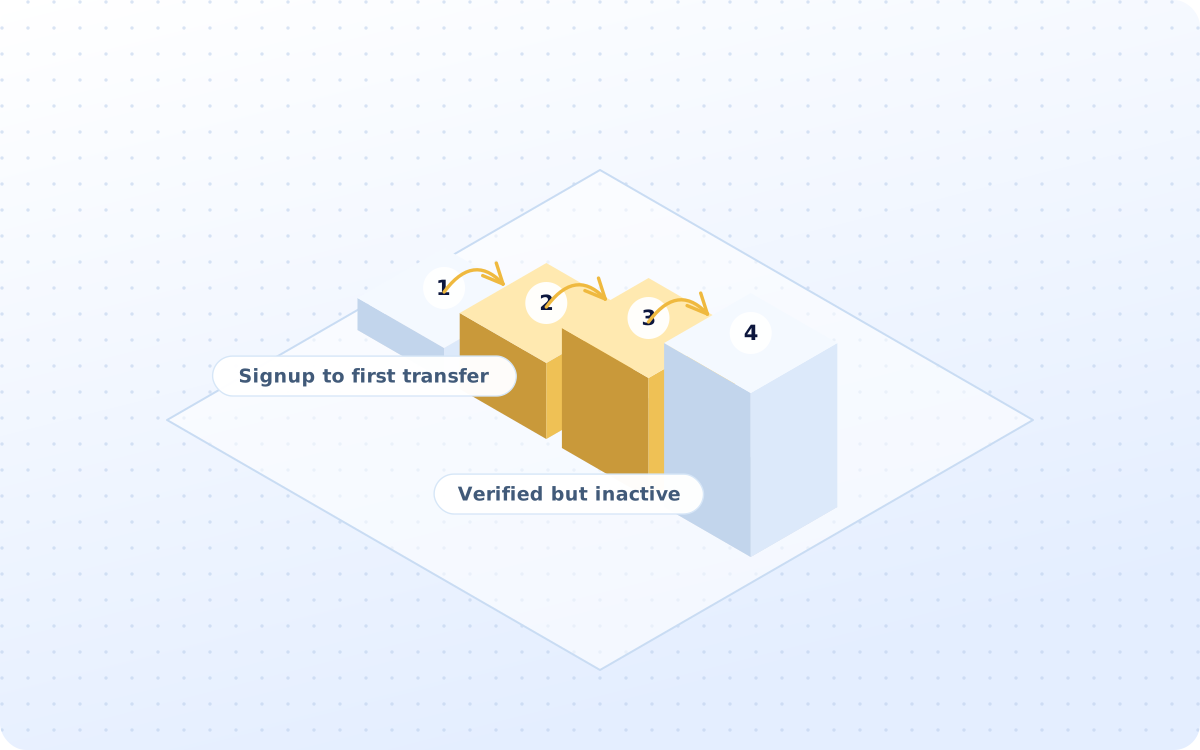
KYC should not be optimized in isolation. A higher verification rate that does not improve customer activation may indicate another downstream problem. Measure: Signup → Verification → First Transfer
- Signup to first transfer tracked
- Verified but inactive users flagged
- Channel quality read every month
What you actually receive
Six artefacts, all of them yours to keep. The event map is the one that keeps on paying.
Step level event map
Every single event from signup started through to KYC approved, named and defined just once.

Drop-off analysis
Which stage loses the most people, all split by device, country and acquisition channel too.
Rewritten error set
Every single failure a sender can hit, with the reason and the correction written for them.
Retry and recovery flow
What the failing sender sees next, and how the recovery message is meant to find them again.
Channel quality report
The cost per verified customer, split by channel, by country and by the device type as well.
Test and result log
What precisely was tested on the funnel, what won, and what got reverted straight afterwards.
How the funnel work runs
Four stages, run in order. The event map is agreed before a single screen ever gets changed.
Which step is actually losing people
Every step from signup started to KYC approved gets an instrumented event, because a funnel with merely four events cannot show leakage.
- 01Signup steps are all instrumented
- 02KYC stages measured one by one
- 03Drop-off split by the device type
- 04Country differences pulled out
- 05Provider errors counted properly
Why the sender is being asked at all
It has to say why. Replace vague failures such as: Verification Failed. with appropriately informative guidance where compliance rules permit.
- 01Why verification is required, said
- 02Which documents are actually accepted
- 03What happens with the sender data
- 04Glare and cropping guidance given
- 05No timeline that cannot be held
What happens when the whole check fails
Somebody whose verification fails needs to know whether a retry is permitted, exactly what to change, and where the support actually sits.
- 01Retry allowed, and clearly said so
- 02The exact change is spelled out
- 03Pending status kept honest too
- 04Support reachable from that screen
- 05Recovery messages with consent
Whether any of it reached a transfer
Verification rate on its own proves nothing, so signup, verification and first transfer are read as one number rather than three reports.
- 01Signup to first transfer joined
- 02Verified but inactive users counted
- 03Ten indicators reported monthly
- 04One test at a time, and always
- 05Controls never weakened by tests
What the work actually does
Seventeen groups of work sit behind the service, and these twelve are what actually changes on it.
Signup audit
Fields, OTP, consent, completion
The KYC mapping
Eight stages, start to approval
Step level events
Every step gets its own event
Form improvement
Fewer fields, asked in order
Verification education
Why, what and how long roughly
Document capture
Glare, cropping and retry help
Liveness experience
Lighting, position and permissions
Error messages
Named causes, not failed again
Retry and recovery
Reminders that name the actual fix
Channel analysis
Which channels verify, not install
Funnel experiments
One change, controls untouched
Three ways to buy this
One of these will fit, whether the whole funnel moves or only the document capture step does.
Continuous funnel work
Measure, explain, recover and then prove, all run every month against the same event map itself.
- Monthly fee, agreed before we start
- No control ever removed or weakened
- Reported through to first transfers
Document capture rebuild
Only the stage that loses the most, rebuilt, remeasured and shipped inside a single release.
- One fixed fee, four weeks total
- Usually the document capture step
- The event map is handed over too
Verification funnel audit
Where the funnel leaks, ranked, with each fix priced against the verified customers it adds.
- Two weeks, priced before we start
- No obligation to continue after
- Every leak costed per customer
Comparison. A general agency runs conversion rate optimization on landing pages. KYC funnel optimization for remittance companies runs it on the verification steps instead.
Position. Most operators need the document step and the error wording fixed, nothing else, and it costs less.
- Licensing and AML questions go to a qualified adviser. We handle advertising and marketing compliance.
Audit line. If none of the three fits, a fixed-fee growth audit will say which one should.
Four steps to the whole fix
Two weeks of measurement, and then the rewriting. Verification numbers usually move within a month or so.
Instrument it all
WEEK 1-2Every step from signup started to KYC approved gets an event of its own from the start.
Find every leak
WEEK 3Drop-off is ranked by stage, by device, by country and by acquisition channel as well.
Rewrite the steps
WEEK 4-8Instructions, errors and the retry all rewritten, with the controls left completely alone.
Test and report
MONTHLYOne change at a time, with the ten indicators reported every single month afterwards.
How results get reported
No client figure appears without written permission. These three are facts about how the work is run.
Services that pair with this
Verification is only one step out of several. These three cover what sits either side of it.
The wider testing work that keeps every other page and screen improving along with it as well.
Learn moreWebsite Conversion RedesignThe website pages that decide whether a sender ever reaches the signup form in the first place.
Learn moreApp Install & User AcquisitionThe paid installs that only start paying back once the verification has actually completed.
Learn moreQuestions operators ask first
Answers come first. Where the honest answer is no, it says no and explains what to do instead.
Both. An agent-led operator verifies at the counter as well as in the app, so the same stages get measured in two places rather than one.
Yes. The events are defined in your own analytics and passed to the CRM, so the recovery messages fire from the tools you already run.
Yes. Document types and approval rates differ by country and corridor, so the instructions and the accepted document list change with the market.
Yes. KYC funnel optimization for remittance companies is all that gets done, and it is conversion rate optimization applied to verification rather than landing pages.
The objective is not to bypass or weaken compliance. Tests must not weaken mandatory verification controls. Licensing and AML questions go to a qualified adviser.
Analytics access, the KYC provider name, your current completion rate, the corridor list, and whoever signs off customer-facing verification wording.
Two weeks to instrument and measure, then changes ship in your normal release cycle. Verification numbers usually move inside the first month.
Yes. The provider callbacks, the approval statuses and the first transfer all join in one view, which is usually where the tracking gaps show up.
Yes. Any sensitive personal data analysis must follow applicable privacy and regulatory requirements, so corridor comparisons stay at market level.
Partly. Recovery campaigns run by email, SMS and push, subject to appropriate customer consent and communication rules, and they bring back abandoned verifications.
This helps determine whether low-cost acquisition channels actually produce verified customers. Cost per verified customer, and then per first transfer, is the number.
Monthly: signup start, signup completion, OTP completion, KYC start, document completion, submission, approval, abandonment, recovery and the time to verification.
Ten thousand registrations at 50% verification give 5,000 customers; at 60% they give 6,000. That worked example, not a client result, is the case.
Verified customers gained against the fee, then first transfers. KYC funnel optimization for remittance companies is conversion rate optimization with a transfer count attached.
Indirectly. A sender who got through verification without a fight is more likely to come back, and support hears from them far less often.
Operators, remittance apps and payout platforms on the roster
Marks appear once written permission is on file for each operator.
Measure the funnel before you fix
On the standard worked example, ten points of verification completion is a thousand more customers. A fixed-fee growth audit will say where those points are.
You keep the event map whether or not we do the work.