

Your cost per install is lying to you
Installs look healthy in a platform dashboard while the business quietly loses money. Here is what a remittance account should actually be bidding toward, and why fixing it usually makes one number worse before everything else gets better.
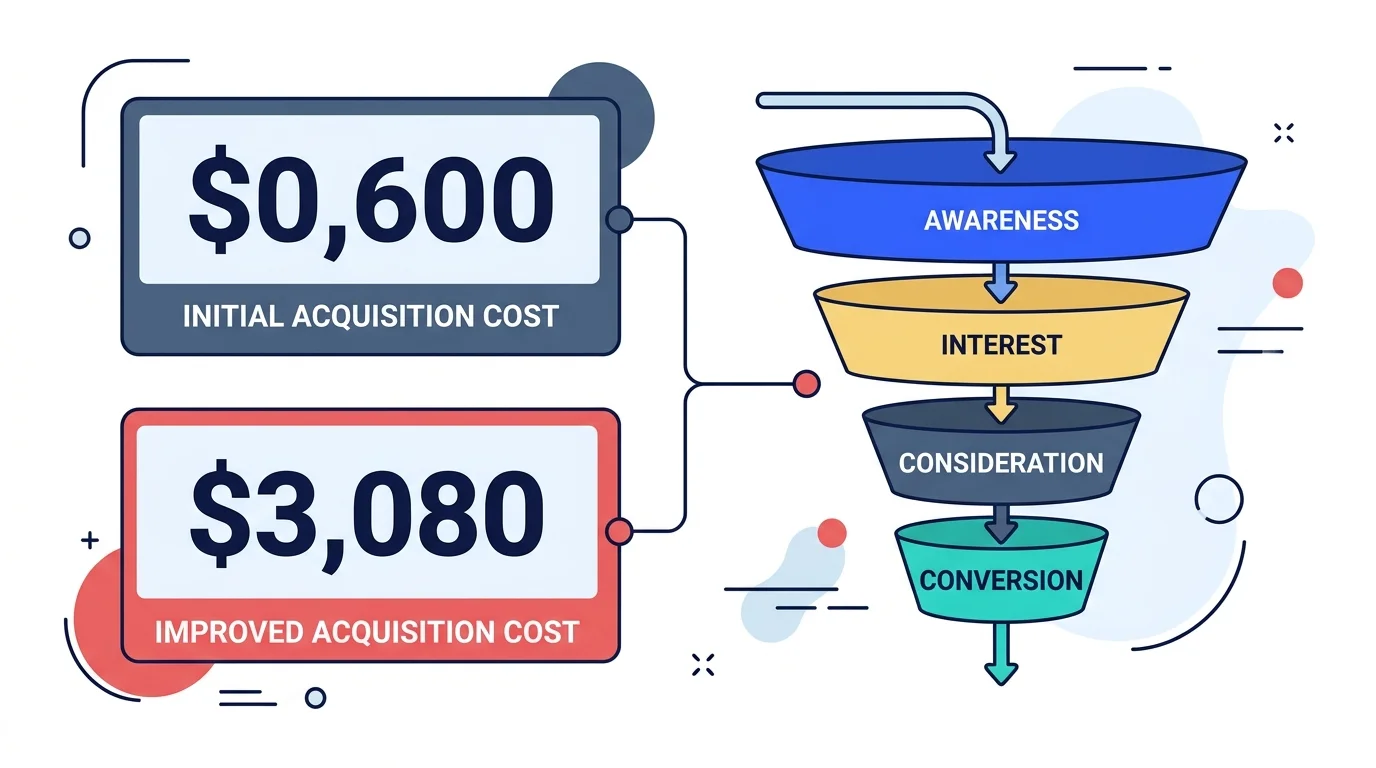
Cost per install is the most reported number in mobile acquisition and one of the least useful in remittance. It is not wrong, exactly. It measures precisely what it says. The problem is that in a business where money is earned three steps later, it measures the wrong thing confidently.
We have audited accounts with genuinely excellent install economics that were losing money on every cohort. Clean structure, refreshed creative, competitive cost per install, and a board asking why acquisition spend was growing faster than transfer volume.
What cost per install actually measures
It measures how cheaply you can persuade someone to download an app. That is a real skill and it is not the same skill as persuading someone to complete identity verification and then send money to another country.
In a consumer app where the install is close to the value event, the two correlate well enough that the distinction rarely matters. In remittance they diverge sharply, because between the install and the revenue sit three steps with meaningful drop-off at each.
| Step | What it costs you | What it earns you |
|---|---|---|
| Install | Media spend | Nothing |
| Signup | Nothing additional | Nothing |
| KYC completion | Verification fees, review time | Nothing |
| First transfer | Payout and processing cost | Revenue, finally |
Three of the four rows cost money and earn none. An install that stops at row three has cost you media spend and a verification fee, and it will continue costing you in support and storage.
An install that never completes verification costs you twice: once to acquire it and again to service it.
The three steps nobody bids toward
Install to signup is usually fine. Signup to KYC completion is where the loss concentrates, and KYC to first transfer is where momentum is lost during manual review. Together these three steps commonly turn 100 installs into fewer than 25 senders.
That ratio is the thing that varies between operators. Two companies with identical cost per install can have install-to-sender rates of 38% and 17%, which means one is paying roughly twice as much per actual customer as the other, invisibly.
Why the algorithm learns the wrong thing
This is the part that does real damage. Ad platforms optimise toward whatever event you send them. If the only event flowing back is an install, the algorithm becomes efficient at finding people who install readily.
People who install readily and people who complete financial verification are not the same population. Over a few weeks of learning, a campaign optimised to installs will systematically find more of the first group and fewer of the second. Cost per install improves. Cost per sender gets worse. Both trends are the algorithm doing exactly what it was told.
Optimised to installs, the algorithm gets better at finding people who never verify. That is not a failure. That is the instruction working.
Fixing it requires feeding post-KYC and first-send events back to every platform you spend on, then allowing a full learning cycle before judging the result. On iOS this means designing SKAdNetwork conversion values around verification rather than around session count, which is a real piece of work and is usually skipped.
The reconciliation problem
There is a second, quieter version of this problem. Three ad platforms will each claim credit for the same sender, and nobody checks.
In most accounts we audit, the sum of platform-reported conversions exceeds the number of transfers the business actually recorded, sometimes by forty percent or more. This is not deception. Each platform reports what it can see under its own attribution window, and no platform is responsible for reconciling against the others.
The consequence is that every channel looks profitable, the media budget grows on the strength of numbers that overlap, and finance eventually asks a question nobody can answer. Building a reconciliation layer above the platforms, and reporting the gap rather than absorbing it, changes that conversation permanently.
What to bid toward instead
1. Instrument the funnel through to first completed transfer, split by corridor, device tier and document type.
2. Feed post-KYC and first-send events back to every platform you spend on.
3. Design SKAdNetwork conversion values around verification, not around installs or sessions.
4. Rebuild campaign structure by corridor rather than by creative theme, so budget can follow corridor margin.
5. Report cost per completed first send as the headline number and cost per install as a diagnostic.
6. Reconcile platform-claimed conversions against your own data monthly, and state the gap.
Do this in order. Feeding post-KYC events back to the platforms before fixing a broken verification flow teaches the algorithm to avoid exactly the sender segment your business depends on.
The conversation with your board
Here is the uncomfortable part. When you make this change, cost per install goes up. Usually by fifteen to twenty-five percent, and it stays up.
That is the expected and correct outcome of bidding toward a harder event. You are asking the platform to find people who will complete identity verification and send money internationally, which is a smaller and more valuable population than people who will tap install.
Have the conversation before you make the change rather than after. A board watching cost per install rise for three weeks without context will intervene, and they will be right to, because from where they are sitting the only visible number got worse.
What you are trading is a metric nobody banks for a metric finance recognises. Cost per completed sender, payback period, and eventually corridor margin. Those are the three numbers that decide whether acquisition spend is an investment or a leak.
Key takeaways
- Cost per install measures a real thing that is three steps away from revenue in remittance.
- An algorithm fed only install events becomes efficient at finding people who never verify.
- Three platforms will each claim the same sender unless you build a reconciliation layer above them.
- Fixing the bidding target usually raises cost per install by fifteen to twenty-five percent, deliberately.
- Have the board conversation before the change, not during the three weeks it takes to relearn.
Frequently asked questions
No. It remains a useful diagnostic for creative and audience performance. It just should not be the number a budget decision rests on.
Plan on a full learning cycle, typically two to four weeks depending on conversion volume. Judging it earlier produces the wrong conclusion.
Then optimise toward the deepest event with sufficient volume, usually KYC completion, and move deeper as volume grows.
Yes, and it is usually easier on web because you are not constrained by SKAdNetwork.
Compare platform-reported conversions to your own recorded first transfers for the same period, monthly, and report the gap as a number rather than absorbing it.
Umair Sajid · Growth Partner, Bussinesstan
Umair has spent over a decade running growth across fintech, remittance and payments, including work with money transfer operators across UK, Gulf and West African corridors. He writes about the operational side of cross-border growth, mostly the parts that do not appear in a platform dashboard.
Find your leak before you scale spend.
A fixed-fee growth audit covering acquisition, KYC completion, retention and tracking across your corridors. You keep the roadmap whether or not we work together.