

Getting financial services ad accounts verified: the 14-day path
Verification stalls most remittance launches for six to eight weeks. Almost none of that is processing time. Here is where the weeks actually go, and how to get all three platforms cleared in a fortnight.
There is a conversation we have had more times than any other in this category. A remittance business has a corridor launch date, a media plan, approved creative and no ad accounts. Verification was submitted eight weeks ago. Two applications were rejected without a stated reason and one is pending. The launch has quietly become a hope.
The assumption underneath it is almost always the same: that platforms are arbitrary and verification is a matter of waiting. Neither is true, and both beliefs are expensive.
Where the six weeks actually go
Break down a typical eight-week verification and the processing time is a small fraction of it. The rest divides into three buckets.
| Where the time goes | Typical share | Recoverable |
|---|---|---|
| Sequential filing rather than parallel | 3 to 4 weeks | Almost entirely |
| Preparing evidence after the first rejection | 1 to 2 weeks | Almost entirely |
| Fixing the landing page after it is cited | 1 to 2 weeks | Entirely, if done first |
| Actual platform processing | 5 to 10 days | No |
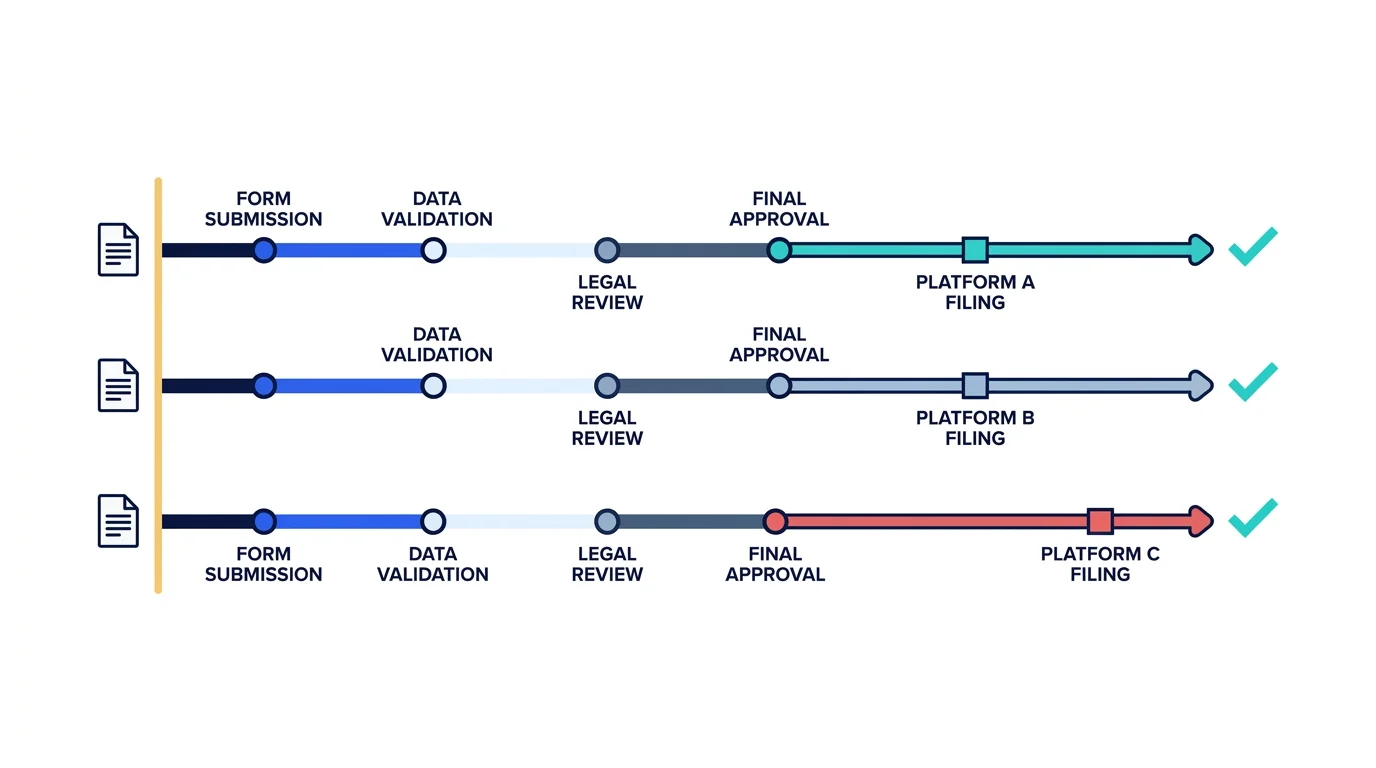
That first row is the one that hurts. Filing Google, waiting, then filing Meta when Google stalls, then filing TikTok after Meta is rejected, buys you in eight weeks the information that a single week of parallel filing would have produced.
Nine weeks of sequential filing buys the same information as one week of parallel filing. That is the whole problem in one sentence.
The three mistakes
1 · Treating a rejection as a signal to resubmit
A rejection means a specific requirement was not met. Resubmitting the same file unchanged does not address it, and repeated identical submissions count against the account rather than being neutral.
2 · Sending one generic document bundle to three platforms
Each platform asks for evidence in a different form. Two of the three will frequently want something the business already has and has not supplied, because nobody read the requirement past the first paragraph.
3 · Submitting before the landing page is compliant
This is the most common cited reason when a reason is given at all, and it is entirely within your control. More on it below.
What each platform is really asking for
All three want to establish the same three things: that the entity is real, that it is permitted to do what it says it does, and that the advertising does not make claims it cannot support. They just ask in different ways and accept different evidence.
– Entity: registration document, verifiable address, a phone number that answers. Platforms do call.
– Permission: licensing or registration evidence for each market you intend to advertise in, which is not the same as evidence for the market you are incorporated in.
– Claims: the destination page, reviewed as part of the application whether or not anyone tells you so.
The single most common silent failure is a mismatch between your legal entity name, your trading name and the name on your licensing evidence. Three variations of the same company read as three companies to a reviewer working from documents.
The landing page problem
Advertisers consistently underestimate this. In a restricted financial category the destination page is part of the application, and an unsubstantiated rate or fee claim on it is sufficient grounds for rejection on its own.
Substantiation has to be visible on the page. Holding the evidence internally does not help a reviewer who is looking at what a consumer would see.
Fix the destination page before you submit anything. It is the most commonly cited rejection reason and it is the one entirely within your control.
Practically, that means every rate, fee and delivery claim carries a basis on the page, comparison claims name what they are comparing against, nothing implies a guaranteed outcome, and the operating entity and its regulatory status are stated in plain language rather than buried in a footer.
One further point that catches people: a page compliant at submission and changed a week later will trigger a re-review. Lock the destination page before you file and treat changes to it as a controlled release until you are through.
Filing in parallel
The sequence that recovers the weeks is not complicated. It is preparation followed by simultaneous submission.
1. Day 0. Evidence pack complete, one document set per platform in the form each asks for. Landing page compliant and locked. Nothing is submitted before this point.
2. Day 1. All three platforms submitted the same day. A named person owns each application.
3. Day 3. Prepared responses drafted for the two most likely objections: documentation format and claim substantiation.
4. Day 7. Follow up where no acknowledgement has been received.
5. Day 11. Objections answered with the specific evidence requested. Never a resubmission of the same file.
6. Day 14. Typical clearance point where the preparation was complete.
Fourteen days is not a trick. It is what happens when the preparation that should precede a first submission actually precedes it.
If you have already been rejected
– Read the stated reason literally rather than interpretively. Reviewers do not use metaphor.
– If no reason was given, request one through the support channel before doing anything else. Resubmitting blind wastes a submission.
– Identify which specific requirement was not met, fix that, and only then resubmit.
– Document the objection and its resolution. You will meet it again in the next market, and next time it will take an afternoon.
The cost of getting this wrong is rarely the verification itself. It is the corridor. A competitor holding a corridor uncontested for two months while you wait is the real bill, and it does not appear in any account.
Key takeaways
- Actual platform processing is five to ten days. The rest of an eight-week verification is sequencing and rework.
- File all three platforms on the same day with three separate evidence sets, not one bundle sent three times.
- The destination page is part of the application. Unsubstantiated rate claims on it are a common rejection reason.
- Never resubmit an unchanged application. Fix the specific requirement that was cited.
- The real cost of a verification delay is the corridor a competitor holds uncontested while you wait.
Frequently asked questions
Five to ten days of processing per platform when preparation is complete. Six to eight weeks is what happens when it is not, and that gap is almost entirely sequencing and rework.
Requirements vary by the country of the advertiser and of the audience. Check each target market separately rather than assuming one clearance covers all.
An agency can prepare and manage the application, but the business manager and the entity must be yours. Filing under an agency entity creates problems later.
A material change to claims can trigger a re-review. Treat the destination page as a controlled release while an application is in progress.
Repeated identical resubmissions count against you. A single rejection followed by a corrected application does not.
Umair Sajid · Growth Partner, Bussinesstan
Umair has spent over a decade running growth across fintech, remittance and payments, including work with money transfer operators across UK, Gulf and West African corridors. He writes about the operational side of cross-border growth, mostly the parts that do not appear in a platform dashboard.
Find your leak before you scale spend.
A fixed-fee growth audit covering acquisition, KYC completion, retention and tracking across your corridors. You keep the roadmap whether or not we work together.