

How to launch a new remittance corridor in 90 days
Most corridor launches take ten to twelve weeks and most of that is waiting rather than working. The fix is not working faster. It is running four workstreams in parallel and starting the longest one first.
Ask an operator how long their last corridor launch took and you will usually get an answer around eleven weeks, delivered without any particular concern. It is what launches take. Everyone's launches take that.
Then ask how much of that eleven weeks involved somebody actively working on the corridor. The answer is normally four to five.
Why launches take eleven weeks
Almost every corridor launch we have audited ran as a sequence. Research, then positioning, then content, then verification, then campaigns, each phase starting when the previous one finished.
That structure guarantees the total duration is the sum of the parts. It also guarantees that verification, which has the longest external dependency and the least control, starts around week six.
| Phase | Sequential timing | Could start |
|---|---|---|
| Research and sizing | Weeks 1-2 | Day 1 |
| Positioning and pricing | Weeks 3-4 | Day 1, refined at checkpoint |
| Content production | Weeks 5-7 | Day 3, from template |
| Verification | Weeks 6-10 | Day 1 |
| Campaign build | Weeks 9-11 | After checkpoint |
Look at the verification row. Five weeks of elapsed time, starting in week six, ending in week ten, blocking campaign launch throughout. That single sequencing decision accounts for most of the difference between eleven weeks and five.
Platforms do not care whether your positioning is agreed. Start verification on day one, before the website exists.
The four parallel workstreams
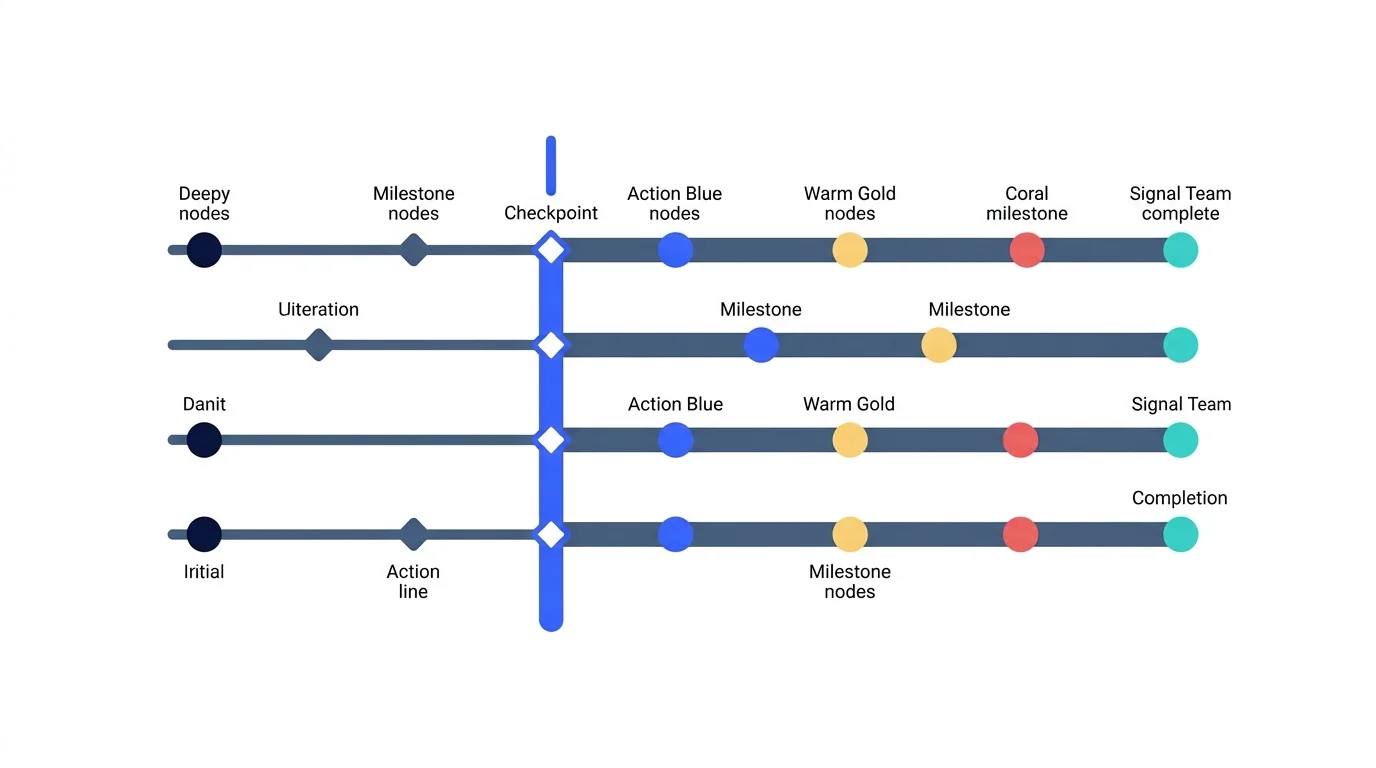
The alternative structure runs four streams simultaneously with a single checkpoint. It is the same total work in a different order.
| Workstream | Starts | Blocks |
|---|---|---|
| Verification and accounts | Day 1 | Campaign launch |
| Research and sizing | Day 1 | Pricing and positioning |
| Product and payout readiness | Day 1 | First transfer |
| Content and pages | Day 3 | Organic and paid landing |
Three of the four start on day one. None depends on a decision that has not been made yet, because none of them requires the positioning to be final.
Days 1 to 12: the parallel start
Verification and accounts
Evidence pack prepared for all three platforms in the form each asks for. Landing page claims substantiated before submission. All three filed the same day with a named owner tracking each. This is the workstream that most often decides the launch date.
Research and sizing
Diaspora concentration mapped in the send market. Search and social demand verified rather than assumed. Competitor pricing documented. The corridor scored against a prioritisation framework, honestly, including if it has already been decided.
Product and payout readiness
Corridor configured. Payout partner tested end to end with a real transfer, not with a test flag. Fees and margin set. Limits and document requirements confirmed. Support briefed on corridor-specific questions before any traffic arrives.
Content and pages
Built from the existing corridor template, changing only country-specific detail and payout methods. If you are writing a corridor page from scratch for the fourth time, the problem is not the launch timeline.
The checkpoint that can say no
Day twelve. Four streams have produced enough for a real decision, and the decision is whether to proceed.
This is the part most launch plans have in name only. A checkpoint that cannot stop the launch is a status meeting, and everyone in the room knows it. The whole value of running research in parallel is that it arrives early enough to change the outcome rather than to justify it.
A checkpoint that cannot say no is a status meeting. Give the day-twelve review the authority to stop the launch, or do not hold it.
What gets agreed at the checkpoint: whether demand justifies the plan, the positioning in one sentence, the pricing posture, the month-one target, and the budget release. Everything downstream flows from those five.
Days 12 to 34: build and launch
With verification progressing and positioning agreed, the build phase is short because the template already exists. Corridor page, creative in the corridor language written natively, campaign structure by corridor, tracking verified through to first transfer.
Then launch on verified accounts at a controlled budget, with daily monitoring for the first week. The milestone is not campaign live. It is first completed transfer, confirmed end to end including payout, because that is the only proof the whole chain works.
Thirty-four days to first completed transfer is achievable when verification started on day one. It is not achievable when it started in week six, regardless of how hard anyone works in between.
Choosing the corridor in the first place
Worth saying plainly, because it is the decision that precedes all of this and it is frequently made badly.
The most common reason a corridor gets chosen is that a payout partner is available and enthusiastic. Partner availability is one criterion among several and it is not the most important one.
Score corridors on diaspora concentration, verified search and social demand, expected send frequency, average transfer value, competitive intensity, payout cost and margin headroom, operational friction, and channel availability. Weight them for your business. Then look at what the scoring says rather than at what you had already decided.
Expected send frequency deserves particular attention. A corridor with high volume and low frequency produces a customer base of one-time senders, which given the economics of this category is a corridor full of losses.
What to measure
| Metric | When | Set against |
|---|---|---|
| Days to first completed transfer | Launch | The plan |
| Cost per first completed transfer | Day 34 onward | Corridor economics |
| KYC completion, this corridor only | Day 20 onward | Your existing corridor baseline |
| Corridor page indexation | Day 34 onward | Pages published |
| Repeat send rate | Day 90 | Your existing corridor baseline |
| Corridor gross margin | Day 90 | Finance |
Split KYC completion by corridor from the start rather than after something looks wrong. Verification behaviour varies enormously between corridors, and a blended number will hide a problem in the new one behind the performance of the established ones.
At day ninety, make a decision: scale, hold or exit. Then document what was learned, because the real return on getting a launch down to thirty-four days is that the next one takes twenty-eight.
Key takeaways
- Most of an eleven-week corridor launch is waiting, not working. The fix is sequencing, not effort.
- Start ad account verification on day one. Platforms do not require your positioning to be agreed.
- Run four workstreams in parallel with a single day-twelve checkpoint that has authority to stop the launch.
- Choosing a corridor because a payout partner is enthusiastic is the most common and most expensive selection error.
- Split KYC completion by corridor from the start, or the new corridor's problems hide behind your established ones.
Frequently asked questions
No. It assumes payout partnership and licensing are already in place and that a corridor page template exists. A first-ever corridor takes considerably longer.
The checkpoint proceeds anyway, since it decides whether to continue rather than whether to launch. Campaign launch waits, everything else does not.
It varies with market and channel mix. The larger point is that a controlled learning budget for the first thirty days beats a scaling budget applied to an unproven corridor.
Yes. Organic takes longer to produce results, so starting it later means waiting twice. The corridor page should be live before campaigns point at it.
Ninety days is enough to know whether it works. It is not enough to scale it. Anyone promising profitability at day ninety is describing something nobody controls.
Umair Sajid · Growth Partner, Bussinesstan
Umair has spent over a decade running growth across fintech, remittance and payments, including work with money transfer operators across UK, Gulf and West African corridors. He writes about the operational side of cross-border growth, mostly the parts that do not appear in a platform dashboard.
Find your leak before you scale spend.
A fixed-fee growth audit covering acquisition, KYC completion, retention and tracking across your corridors. You keep the roadmap whether or not we work together.