

SEO 9 min read
Generative engine optimization for fintech: getting named when senders ask AI
Generative engine optimization for money transfer brands: how assistants pick sources, the entity fact sheet, answer-ready pages and honest monitoring.
On this page
Quick answer
Generative engine optimization (GEO) is the practice of making a brand's facts clear, consistent and well corroborated so that AI assistants can find, trust and quote them when they write an answer. For a money transfer business, that means corridors, fees, payout methods and delivery times that match everywhere they are published. GEO improves the odds of being cited. No provider can guarantee inclusion.
Key takeaways
- GEO is the work of being quoted correctly by assistants, while SEO is the work of being ranked by search engines, and most of the groundwork is shared.
- Assistants lean on sources that agree with each other, so conflicting corridor counts and fee statements are the first thing to fix.
- An entity fact sheet, answer-ready corridor pages and third-party corroboration do most of the heavy lifting.
- Monitoring is a fixed prompt panel checked monthly, read as a direction of travel rather than a precise number.
- Nobody controls what an assistant says, so any promise of a guaranteed citation should end the conversation.
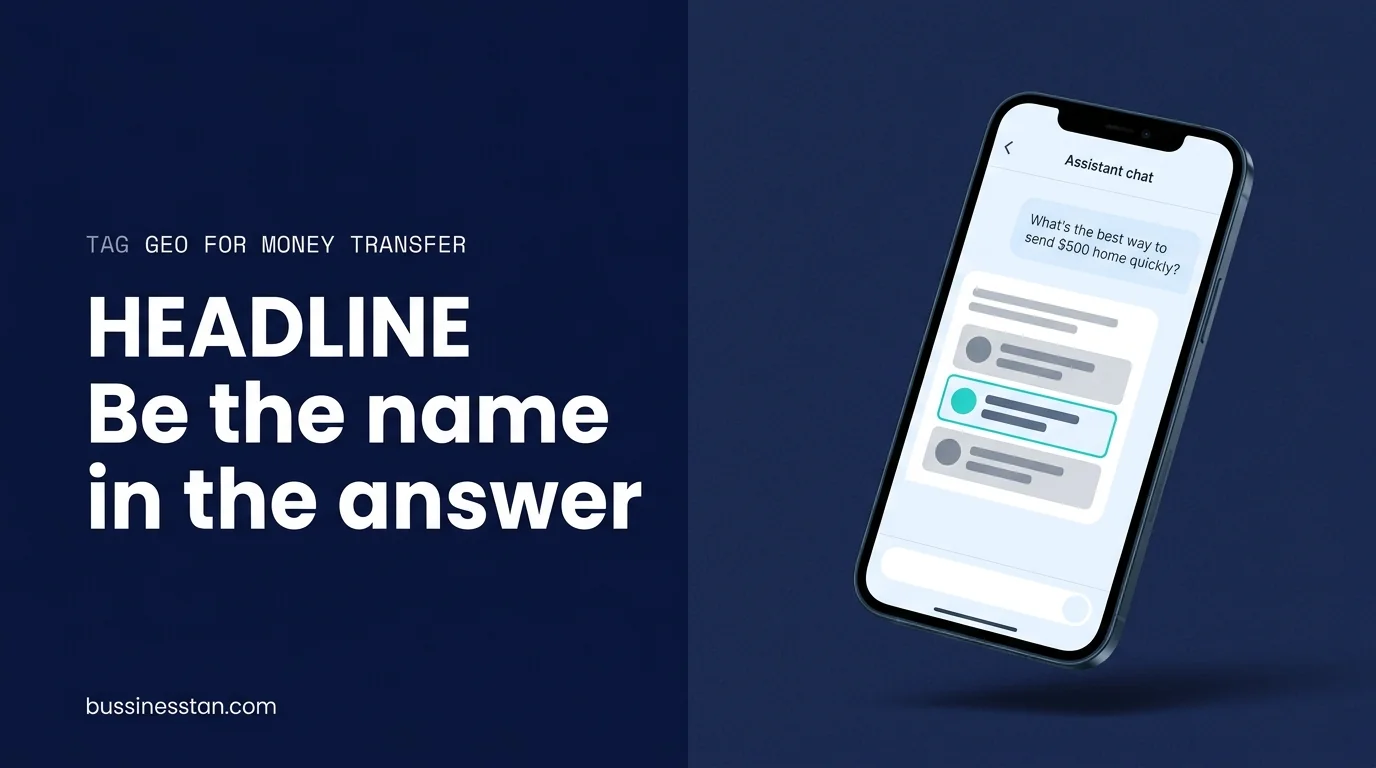
A sender in Birmingham types "cheapest way to send money to Lagos" into an assistant instead of a search box. The answer names 3 providers. Yours is not one of them, even though you serve that corridor and your rate was competitive that morning. That is the problem generative engine optimization exists to address, and for money transfer operators it is now a board-level question rather than an SEO footnote.
Operators put it in one sentence: we are invisible in AI answers. The cause is rarely a missing trick. Usually the business describes itself 6 different ways across its site, app listings and directories, and no assistant can quote a company that contradicts itself.
This guide covers the definitions, how assistants appear to choose sources, the programme that makes a remittance brand quotable, and the limits to hold any provider to.
What is generative engine optimization, and how does it relate to SEO and AEO
The term comes from a 2023 academic paper that framed it as a way for creators to improve visibility in generative engine responses. The industry now uses 3 overlapping labels.
Generative engine optimisation (GEO) is the work of being cited, summarised or recommended inside answers written by large language model assistants.
Answer engine optimisation (AEO) is the work of structuring content so that a direct answer can be lifted from it, whether by an assistant, a voice interface or a search feature.
Search engine optimisation (SEO) is the work of being crawled, indexed and ranked in search results.
GEO vs SEO: what actually differs
| Dimension | SEO | GEO |
|---|---|---|
| Output you want | A ranked link the sender clicks | Your brand named, correctly, inside a written answer |
| Unit of work | The page | The fact (corridor, fee, payout method, delivery time) |
| Main signals | Relevance, links, technical health | Consistency across sources, clarity, third-party corroboration |
| Measurement | Rankings, clicks, organic first transfers | Mentions across a prompt panel, accuracy, assistant referrals |
| Timeline | Months, fairly observable | Months, less observable, never on a fixed schedule |
| Failure mode | Page ranks for the brand name only | Assistant quotes an old fee or names a rival for your corridor |
The overlap is larger than the difference. Google's own guidance says there are no additional requirements or special optimisations needed to appear in its AI Overviews or AI Mode beyond sound search practice. GEO for a money transfer brand is mostly SEO done with unusual care about facts, plus deliberate work on how other sites describe you.
How assistants appear to choose which providers to name
Nobody outside the model builders knows the exact selection logic, and it changes. Repeated prompts show a pattern with 4 parts.
- Retrieval. Many assistants fetch live pages for money questions. A corridor page that blocks crawlers, renders its rate table late or hides fees behind a login is hard to retrieve.
- Agreement. When 5 sources say you serve 40 corridors and 2 say 25, the answer either hedges or skips you. Consistency is a trust signal.
- Corroboration. Assistants appear to favour brands described by others: comparison sites, reputable press, regulator registers, app store listings and review platforms.
- Extractability. A page that answers "how long does a transfer to Ghana take" in one plain sentence is easier to quote than one that buries it in marketing prose.
Why remittance is more exposed than most categories
Sending money is a compare-and-decide choice with factual inputs: rate, fee, speed, payout method. Loyalty before the first transfer is weak. An assistant's answer lands exactly when a new sender picks a provider. A wrong fee there costs the first transfer, not a click.
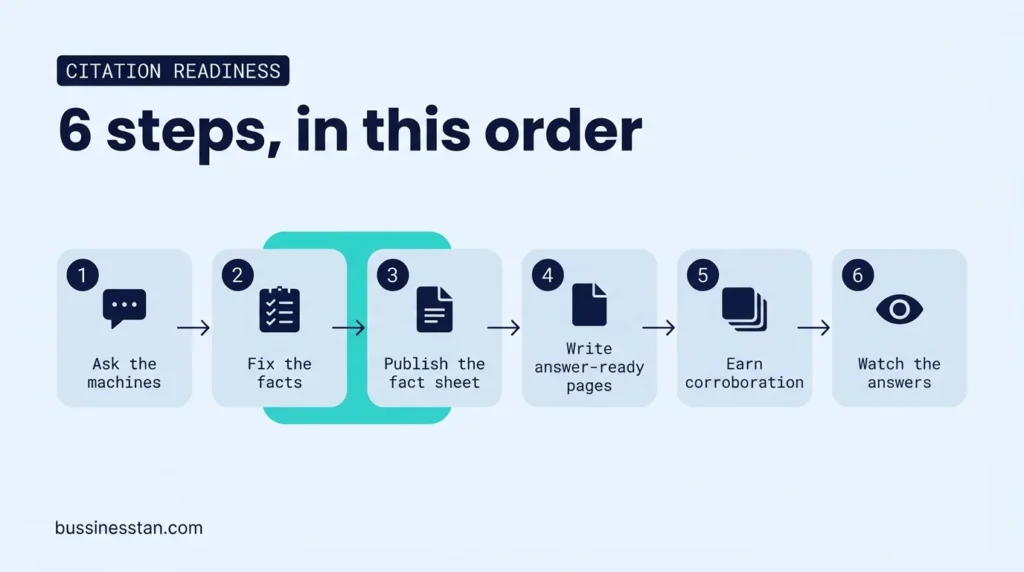
The GEO programme: 6 parts in order
We run the work in this order because each part makes the next cheaper. We call it the citation readiness programme.
| Step | What it produces | Owner on your side |
|---|---|---|
| 1. Ask the machines | A baseline of what assistants say about you today, per corridor | Growth |
| 2. Fix the facts | One approved set of corridors, currencies, payout methods, limits and delivery times | Product and compliance |
| 3. Publish the fact sheet | An entity fact sheet page plus corrected directory and app store profiles | Marketing |
| 4. Write answer-ready pages | Corridor, fee and payout pages with standalone answer blocks | Content |
| 5. Earn corroboration | Mentions on comparison sites, trade press and partner pages | Marketing and partnerships |
| 6. Watch the answers | A monthly prompt panel and mention log | Growth |
What goes in an entity fact sheet
An entity fact sheet is a single public page that states who you are in plain, dated facts. For a money transfer operator it should carry: legal entity name and registration numbers, send countries, receive countries, corridors live today, payout methods by corridor (bank deposit, mobile wallet, cash pickup), typical delivery time ranges with their conditions, how fees and FX spread are shown, support channels and hours, and the date of the last update.
The most common finding in step 1 is disagreement. Directories list 3 different corridor counts. The app store listing mentions a retired payout method. Fix those before writing a single new page. It costs less than new content and removes the reason an assistant hedges.
Answer-ready pages: what an assistant can actually quote
An answer-ready page leads with the conclusion, keeps one idea per paragraph, states definitions as standalone sentences, and puts numbers next to their scope. Our earlier article on being the answer when a sender asks an assistant covers the sender prompts themselves. Here the focus is the page pattern.
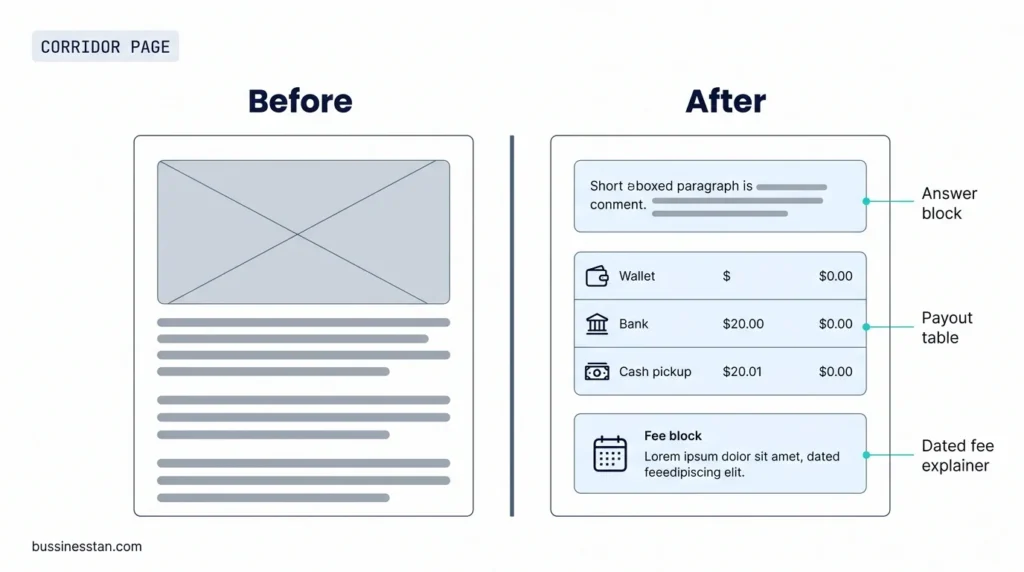
For corridor pages, the structure that tends to survive extraction is:
- A 60 to 70 word answer block at the top that names the corridor, payout methods and how the fee is shown.
- A short table of payout methods with delivery time ranges and conditions.
- A fee and rate section that explains total cost, including FX spread, without superlatives such as "cheapest" unless you can evidence them.
- A verification section that says what documents a new sender needs.
- An FAQ that repeats the questions senders actually type.
The 2 jobs share a backlog with classic search. See corridor pages are the organic engine for the SEO side.
Schema and crawler access
Structured data should describe what is visible on the page, nothing more. Organisation, FinancialService and FAQPage markup help machines parse facts, but they do not force a citation. Check that robots rules do not block the crawlers you want, and that rate tables render in HTML rather than only after a client-side script runs.
Google also says you do not need AI text files to appear in its AI features. An llms.txt file is cheap housekeeping, not strategy.
Monitoring GEO without fooling yourself
AI search for fintech is hard to measure because answers vary by user, location, time and model version. The workable method is a fixed prompt panel.
| What to log monthly | How | Why it matters |
|---|---|---|
| Mentions per prompt | Same 20 to 40 prompts, same assistants, same week each month | Direction of travel |
| Accuracy | Does the answer state your fee, corridors and payout methods correctly | Wrong facts cost first transfers |
| Rivals named | Which competitors appear for each corridor prompt | Shows who holds the corroboration |
| Sources cited | Which URLs the assistant links | Tells you where to earn mentions |
| Assistant referrals | Sessions tagged from assistant domains in analytics | Weak but real signal |
| Branded search | Branded query volume in Search Console | Indirect effect of being named |
Tie it back to money where you can. If your events are clean, sessions from assistant referrals can be followed through registration, KYC and first transfer. That depends on the tracking work described in analytics event tracking for remittance apps. Expect attribution here to be directional, not exact. One month of data tells you almost nothing.
What GEO will not do, and the limits to hold a provider to
GEO will not make an assistant recommend you. It will not rescue an uncompetitive rate. Facts that change weekly need an owner.
Hold any GEO provider to 3 tests: they refuse to promise citations or dates, they start with a fact audit rather than new content, and they report accuracy alongside mentions. This is the work our AEO and GEO team does, and it sits on top of the technical and corridor work in full stack SEO. The pages themselves are written by our content marketing and blog writing team, with claims agreed before drafting.
Comparison content needs particular care. "Cheapest" and "fastest" are claims that need evidence and qualification. Licensing and AML questions go to a qualified adviser. We handle advertising and marketing compliance.
Frequently asked questions
What is generative engine optimization in simple terms?
It is the work of making your business easy for AI assistants to find, trust and quote accurately. For a money transfer operator, that means consistent facts about corridors, fees, payout methods and delivery times across your site, app listings and third-party profiles, plus pages that answer sender questions in plain sentences. It raises the odds of being named. It does not guarantee it.
GEO vs SEO: do I need both?
Yes, but they are not separate budgets. Most GEO groundwork is good SEO: crawlable pages, clear structure, corridor coverage and authority. GEO adds a stricter focus on fact consistency, third-party corroboration and monitoring what assistants say. If your corridor pages do not rank or render properly, fix that first. Assistants that fetch live pages hit the same problems search engines do.
What should generative engine optimization services include?
A fact audit across your site, app stores and directories, a corrected entity fact sheet, answer-ready rewrites of priority corridor pages, schema that matches visible content, a plan for earning third-party mentions, and a monthly prompt panel. Be wary of anyone who leads with new content volume or promises that a named assistant will recommend you by a date.
How does AI search for fintech treat compliance-sensitive claims?
Assistants repeat what sources say, including errors. If an old page claims a fee you no longer charge, that can resurface in an answer. Keep fee, rate and speed claims evidenced, dated and consistent, and retire outdated pages properly. Qualify comparisons. Your compliance team should approve the fact sheet, because it becomes the version of your business that machines repeat.
How long before we see results from GEO?
Fact corrections can be done in weeks. Changes in what assistants say move slowly and never on a fixed schedule, often over one or more quarters, and some prompts may not move at all. Judge progress on a fixed prompt panel over several months, alongside accuracy and assistant referral sessions, rather than on a single check.
Where to start
Start with what assistants already say. Pick 20 sender prompts across your top 3 corridors, run them this week, and log every wrong fact and every rival named. That list is your first backlog, and most of it will be consistency fixes rather than new pages.
If you want a second pair of eyes on it, a Book a Growth Audit session covers site, tracking and corridor economics in 2 weeks for a fixed fee, and you keep the roadmap whether or not we work together.

Written by
Founder & CEO, Bussinesstan
Owns the commercial side of every engagement: fixed-fee scoping, corridor economics, and the reporting that ties spend to completed first transfers rather than to installs.
Meet the team
Local SEO for exchange houses: branches, agents and corridors
Local SEO for exchange houses, explained: location pages, a locator that ranks, Business Profiles and reviews, measured on calls, directions and transfers.

App store optimization for fintech apps: from remittance listing to first transfer
App store optimization for fintech apps, built for remittance: keyword fields, screenshots, localised listings and reviews measured to first transfer.

CRM for money transfer companies: design the data model first
CRM for money transfer companies, built on the data model: one record per sender, 9 lifecycle stages, B2B pipelines, consent rules and a 10-week rollout.