

Paid Growth 10 min read
Google Ads for money transfer companies: structure the account by corridor
Google Ads for money transfer companies, structured by corridor: brand defence, intent groups, post-KYC imports and a sample account you can copy.
On this page
Quick answer
Google Ads for money transfer companies works best when the account is organised by corridor, meaning one send country to one receive country, rather than by country or product. Each corridor gets its own brand, generic and competitor coverage, its own budget, and bidding that learns from verified senders and funded first transfers imported from the operator's own records, not from registrations.
Key takeaways
- Build one campaign set per corridor, because a UK to Nigeria sender and a UK to India sender search, convert and pay back differently.
- Bid toward a post-KYC event or a funded first transfer, never toward registration alone.
- Import offline conversions from your transfer records so Google learns which clicks became senders.
- Read the search terms every week and keep a shared negative list, since job seekers and rate checkers burn corridor budget.
- Hold Performance Max back until conversion signals are clean and reconciled.
"Our search account is one big bucket bidding on signups." It is one of the most common things a head of growth at a money transfer operator says about search. The account was built in a hurry for launch, one national campaign carries every corridor, and the conversion Google optimises toward is a registration that may never pass the KYC screen.
That set-up spends money without complaint. It also teaches the algorithm the wrong lesson. Google Ads for money transfer companies needs a different shape from Google Ads for almost any other advertiser, because a click is worth nothing until a sender verifies, funds and completes a first transfer, and that value changes sharply from one corridor to the next.
This guide sets out the corridor structure we build, the conversion plumbing underneath it, and the weekly habits that keep it honest.
Why one national campaign fails in Google Ads for money transfer companies
A national campaign treats every search as equal. Your transfer records say otherwise. A sender in Birmingham searching "send money to Ghana" and a sender in Toronto searching "transfer money to India" differ in average send value, send frequency, FX spread, payout method and the competitors bidding against you.
Put them in one campaign and 3 things go wrong:
- Budget follows cheap clicks, not corridor margin. The algorithm spends where conversions are cheapest to record, which is rarely where you earn most per sender.
- Ad copy goes generic. One ad cannot state the rate, fee and payout method for 6 corridors at once, so it says nothing specific.
- Reporting blurs. Nobody can produce cost per first send by corridor, so nobody can defend moving budget.
The fix is structural rather than creative. Separate the corridors first, then write for them.
The corridor account structure for Google Ads for remittance
A corridor structure gives each send and receive route its own campaigns, budget and reporting line. Inside each corridor, the campaigns split by intent, because brand searchers, generic searchers and competitor searchers behave differently and deserve different bids.
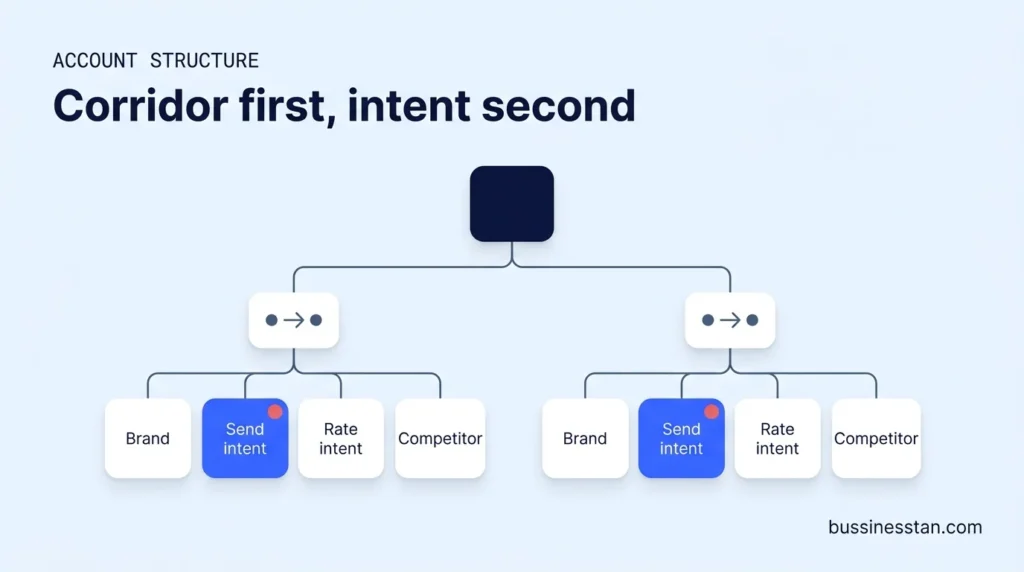
What does a sample corridor structure look like?
The table below is an illustrative structure for an app-led operator sending from the UK. Names follow one pattern so any report can be filtered by corridor.
| Campaign | Corridor | Intent group | Example remittance keywords | Bid target |
|---|---|---|---|---|
| UK-NG_Brand | UK to Nigeria | Brand | [brand] Nigeria, [brand] app | Verified sender |
| UK-NG_Generic_Send | UK to Nigeria | Send intent | send money to Nigeria, transfer money to Nigeria | Funded first transfer |
| UK-NG_Generic_Rate | UK to Nigeria | Rate intent | pound to naira rate today | Funded first transfer, lower bid |
| UK-NG_Payout | UK to Nigeria | Payout method | send money to Nigerian bank account, mobile wallet Nigeria | Funded first transfer |
| UK-NG_Competitor | UK to Nigeria | Competitor | [competitor] alternative | Funded first transfer, capped budget |
| UK-IN_Brand | UK to India | Brand | [brand] India | Verified sender |
| UK-IN_Generic_Send | UK to India | Send intent | send money to India from UK | Funded first transfer |
| ALL_Brand_Defence | All corridors | Brand plus fee and review terms | [brand] fees, [brand] reviews, [brand] login | Impression share |
This structure needs 2 rules. First, one naming convention everywhere, so UK-NG means the same thing in Google Ads, GA4 and your transfer ledger. Second, start with the 2 or 3 corridors that carry most of your volume. As a rule, 3 corridors built properly beat 8 sharing one budget.
Brand defence
Brand terms are the cheapest senders you will ever buy, and competitors know it. A brand defence campaign covers your name, your app name, and the fee, rate, review and login queries that sit around it. The goal is coverage, not volume. Report brand separately so it never flatters generic performance.
Competitor terms
Competitor campaigns can work in corridors where a rival has a large installed base and a weak rate. They also carry trademark and claims risk. Keep them on a capped budget, never use a rival's name in ad text, and make sure every comparison claim has evidence your compliance approver has already signed off.
Intent groups and remittance keywords
Within a corridor, split generic search into intent groups: send intent, rate intent, payout method and speed. Rate searchers convert less often and many are checking a rate board with no plan to switch provider, so they get lower bids and a landing page that leads with the live rate. Send intent searchers get the corridor page with the fee, rate and delivery time above the fold.
Tell Google what a sender is worth
Google optimises toward whatever conversion you send it. Send registrations and it will find more people who register. A large share of them will stop at document capture or never fund.
Which conversion should Google bid on?
Set up a conversion ladder, then choose the highest step that fires often enough per corridor to learn from:
| Step | Event | Use in Google Ads |
|---|---|---|
| 1 | Registration | Secondary, observation only |
| 2 | KYC submitted | Secondary |
| 3 | Verified sender (post-KYC event) | Primary for low-volume corridors |
| 4 | Funded first transfer | Primary once volume allows |
| 5 | Repeat transfer within 30 days | Value signal, later |
The post-KYC event is the bridge. It fires far more often than a first transfer and correlates with it far better than a registration does.
Offline conversion import
Most first transfers complete in your core platform, not on the website, so Google never sees them. Offline conversion import closes that gap. Store the click identifier at registration, match it to the sender record, and upload verified and funded events on a schedule. Enhanced conversions add hashed first-party data to improve the match rate, within your consent and privacy obligations.
This is where most accounts break. The click ID is lost at the app store hop, or the upload file is built by hand once a month. Our app and web analytics setup work fixes the event chain first, and our Google account and conversion setup work builds the import feed and access structure around it.
Sensitive financial data does not belong in an ad platform. Send the event and, where agreed, a modelled value. Do not send balances, document data or the transfer amount by default.
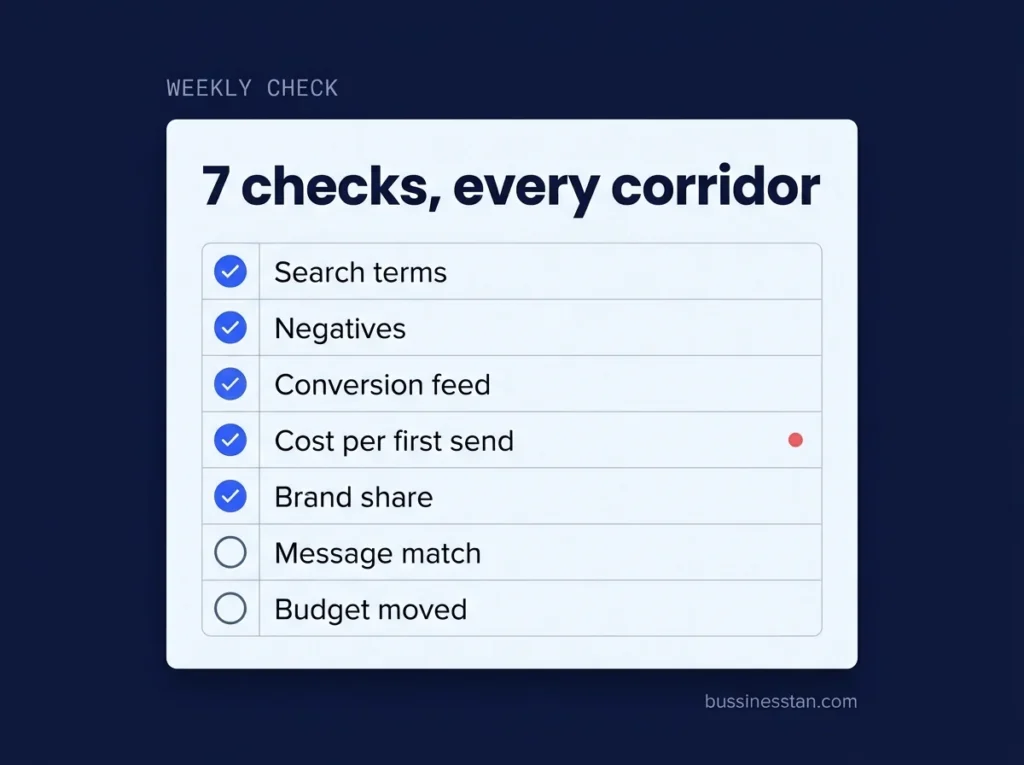
The corridor account check: 7 points every week
A corridor account decays without a weekly routine. This is the checklist we run, and the one we hand to in-house buyers.
- Search terms read. Every corridor's search term report, top spend first.
- Negatives added. Job seekers ("money transfer jobs"), education queries ("how does remittance work essay") and wrong-direction corridors go on a shared list.
- Conversion feed checked. The last offline upload ran, and the match rate has not dropped.
- Cost per first send by corridor. Pulled from reconciled data, not from the platform column alone.
- Brand impression share. Any drop is investigated, because a competitor has usually moved.
- Landing page message match. The rate and fee in the ad still match the corridor page.
- Budget moved. Money shifts toward corridors where cost per first send sits inside payback, and away from those that do not.
When Performance Max earns a place
Performance Max bundles search, display, video and other inventory into one automated campaign. It learns only from the conversions you give it and shows you less of what it bought. Fed registrations, it will find registrations wherever they are cheapest.
Our rule is simple: Performance Max comes after the corridor search campaigns are stable and the offline import has run cleanly for several weeks. Then it gets a corridor-specific asset group, a funded first transfer goal, brand exclusions where available, and a budget small enough to compare against search. If reconciled cost per first send does not hold up, it is switched off.
We argue against more spend until the funnel holds. That applies to automated campaign types more than anywhere else.
Financial services verification for Google Ads comes first
Google requires advertisers to complete financial services verification before running financial services ads in a number of countries. For the UK, Google's policy page states that advertisers showing financial services ads of any kind in the UK need to be verified by Google. Requirements differ by country, and they change, so check the current policy page for each send market before you build.
Verification is a common reason a new corridor account sits idle. Prepare the documents, the landing pages and the disclosures before the campaigns, not after a rejection. Our earlier piece on financial services ad verification sets out the order of work. Approval stays with Google, and nobody can promise a date.
Licensing and AML questions go to a qualified adviser. We handle advertising and marketing compliance.
Frequently asked questions
Is Google Ads for remittance worth it for a small operator?
Usually, if you pick one corridor and do it properly. Search captures senders who already intend to send, which makes it the most efficient first channel for most operators. The mistake is spreading a small budget across every corridor. Fund one route enough to learn, prove cost per first send, then add the next.
How is Google Ads fintech marketing different for money transfer?
Most fintech accounts optimise toward a signup or an application. A money transfer business earns nothing until a verified sender funds a transfer, and value differs by corridor. That means corridor-level structure, post-KYC conversion imports and reporting on cost per first send rather than cost per lead.
How do I find the right remittance keywords for a corridor?
Start with how senders phrase the route: "send money to" plus the receive country, the currency pair rate, and the payout method they need. Add diaspora language and city modifiers where volume exists. Then let the weekly search term report correct your list, because real queries always differ from planned ones.
Does financial services verification for Google Ads apply to money transfer apps?
It can, depending on the country and how Google classifies your service. For the UK, Google says any advertiser showing financial services ads needs verification. Check the current policy for each send market, prepare your evidence early, and treat the approval timeline as outside your control.
How long before a rebuilt corridor account performs?
Expect a relearning period after the bid target changes, and allow a full month of clean conversion data before judging cost per first send by corridor. Cost per click often rises when you bid on verified senders instead of registrations. That is normal. Judge the account on reconciled first transfers, not on clicks.
Where to start
Separate the corridors, fix the conversion ladder, import what happens after the click, and read the search terms every week. Performance Max and competitor campaigns come later, once the numbers can be trusted.
If your account still bids on registrations, the Google Ads rebuild is usually live in week 4. Most operators should start one step earlier, with a written view of where the spend leaks. Book a Growth Audit: 2 weeks, a fixed fee, and a roadmap you keep whether or not we work together.

Written by
Founder & CEO, Bussinesstan
Owns the commercial side of every engagement: fixed-fee scoping, corridor economics, and the reporting that ties spend to completed first transfers rather than to installs.
Meet the team
Fintech customer acquisition cost for remittance apps: why blended CAC misleads
Fintech customer acquisition cost for remittance apps: measure cost per first transfer, split blended CAC by corridor and calculate CAC payback properly.
Meta ads for remittance apps: optimise for the first transfer, not the install
Meta ads for remittance apps that optimise for first transfers: Conversions API, event ranking, diaspora targeting and retargeting for KYC abandoners.
CRM for money transfer companies: design the data model first
CRM for money transfer companies, built on the data model: one record per sender, 9 lifecycle stages, B2B pipelines, consent rules and a 10-week rollout.