

Consulting 9 min read
Website audit checklist for money transfer companies
A website audit checklist for money transfer companies: technical, SEO, conversion, trust and tracking checks, scored and ranked by first transfers.

On this page
Quick answer
A website audit checklist for a money transfer company reviews 5 areas: technical health, search visibility, conversion, trust and tracking. Each finding is scored by its effect on registrations, verification and first transfers, then placed in a priority band from critical fix to strategic redesign. A useful audit ends by naming the few pages responsible for most of the loss, not a long list of small fixes.
Key takeaways
- A website audit checklist is only useful if every finding is ranked by its cost in first transfers.
- Audit 5 areas: technical, SEO, conversion, trust and tracking, in that order of dependency.
- Naming the three pages responsible beats a list of 200 fixes.
- Tracking comes first in practice, because without it no other finding can be sized.
- Most flat web funnels need the corridor page and registration path fixed, not a new site.
The site looks fine. Traffic holds. The brand team likes the new homepage. First transfers from web have not moved in two quarters, and every team has a theory.
This is the moment most operators reach for a website audit checklist, and most checklists fail them. They come from generic SEO tools, flag 200 issues of equal weight, and say nothing about the rate calculator, the KYC screen or the corridor page a sender lands on from a search for "send money to Ghana".
What follows is the checklist we use for a money transfer website audit, with a scoring table and 5 priority bands. Use it yourself, or use it to judge whoever you hire.
The website audit checklist: five areas in order
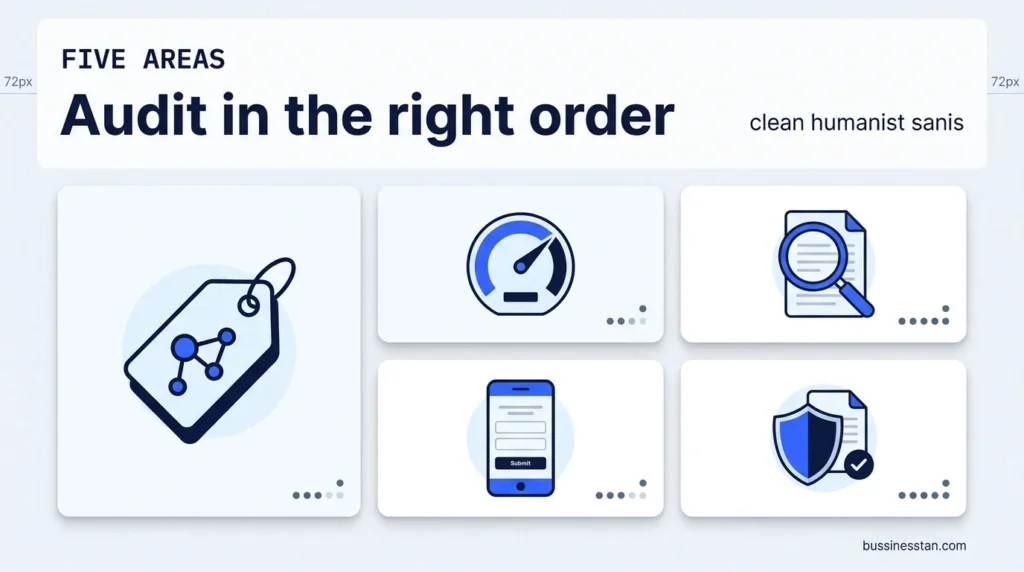
Every check below belongs to one of 5 areas. The order matters. You cannot size a conversion problem if tracking is broken, and you cannot fix search if the pages cannot be crawled.
Area 1: Technical health
This is the technical SEO audit fintech teams tend to hand to an agency and never read. Keep it short and specific.
- Every corridor, branch and landing page returns a 200 status and is in the XML sitemap.
- No important page is blocked by robots rules or a noindex tag left from staging.
- Core Web Vitals pass on mobile: Largest Contentful Paint within 2.5 seconds, Interaction to Next Paint of 200 milliseconds or less, Cumulative Layout Shift of 0.1 or less, measured at the 75th percentile of page loads.
- The rate calculator loads and returns a quote on a mid-range Android phone on a slow connection.
- Redirect chains from past redesigns are one hop, not four.
- Canonical tags point to the page you want to rank, not the campaign duplicate.
Area 2: Search visibility
- Each corridor has one page that owns its search, with no second page competing.
- Corridor pages state fee, rate source, speed and payout methods for that corridor.
- Title tags carry the corridor and the action ("send money from the UK to Nigeria"), not the brand alone.
- Location pages and the locator are crawlable, for operators with branches or agents.
- Help and FAQ content answers the questions senders ask before registering.
Corridor pages carry most of the organic weight in this category. The reasoning is in Corridor pages are the organic engine. If you run branches or agent counters, add the location checks from our guide to local SEO for exchange houses.
Area 3: Conversion
A website conversion audit follows the sender, not the sitemap: landing, understanding, trust, registration, verification, transfer.
- The rate, fee and delivery time are visible on the first mobile screen of every corridor page.
- The quote on the calculator matches the quote at checkout, including fees.
- Registration asks only for what the first step needs.
- The path from web to app, where there is one, keeps the corridor and amount the sender chose.
- Error messages on the registration and document capture steps say what to fix.
- The whole path has been walked on a real phone, with a real document, by someone outside the team.
Area 4: Trust
A sender deciding whether to send £500 to a family member reads the page differently from your brand team.
- The legal entity name and registered address are easy to find.
- The regulatory status wording is the version your compliance team approved, on every page that needs it.
- A complaints route is published and reachable in two clicks.
- Fee and rate wording avoids claims you cannot substantiate, such as "no fees" when a margin applies to the rate.
- Support hours and channels are stated, including languages.
Licensing and AML questions go to a qualified adviser. We handle advertising and marketing compliance.
Area 5: Tracking
- One event name per step: registration started, registration completed, KYC submitted, KYC passed, first transfer.
- Post-KYC events and first transfers reach the ad platforms, so paid media optimises on senders, not signups.
- Analytics numbers reconcile, within a stated gap, to your own transfer records.
- Consent is collected before tags fire where the law requires it.
Scoring: how to rank what you find
A finding without a score is an opinion. Score each one on 3 factors, then multiply.
| Factor | 1 | 2 | 3 |
|---|---|---|---|
| Impact on first transfers | Indirect | Affects one step for some senders | Blocks or loses senders on a main corridor |
| Reach | One page or edge case | A page type or one corridor | Every visitor or every corridor |
| Confidence | Suspected | Seen in analytics | Seen in analytics and on a real phone |
A score of 18 or above goes to the top of the list. A score of 4 or below goes into a backlog nobody should feel guilty about.

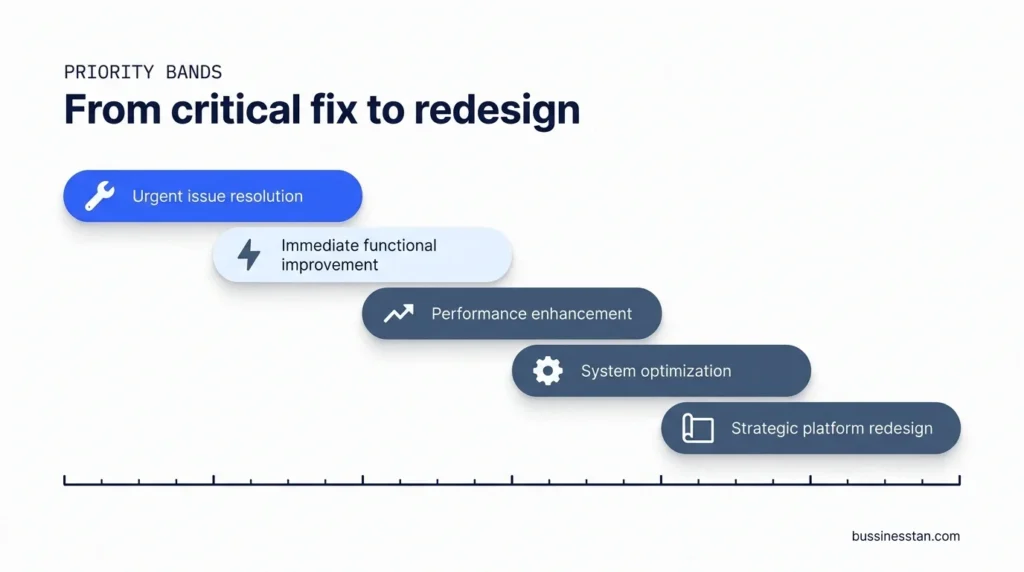
The five priority bands
Scores tell you the order. Bands tell you who does the work and how long it takes.
| Band | What goes in it | Typical owner | Typical timing |
|---|---|---|---|
| 1. Critical fixes | Broken calculator, quote mismatch, blocked pages, silent errors | Web developer | Within a fortnight |
| 2. Quick wins | Fee above the fold, title tags, error copy, trust links | Marketing and web | 2 to 4 weeks |
| 3. Growth improvements | Corridor page rewrites, registration path changes, new FAQ content | Growth and content | 1 to 3 months |
| 4. Technical projects | Tracking rebuild, server-side events, locator rebuild | Engineering | 1 to 3 months |
| 5. Strategic redesign | A new site or CMS | Leadership decision | A quarter or more |
Then write the finding the board will actually read: the 3 pages responsible for most of the loss, what each one costs in first transfers a month, and who fixes it by when. Naming the three pages responsible beats a list of 200 fixes, because a list of 200 gets split across teams and finished by none.
Most operators need bands 1 to 3 and never reach band 5. When a full rebuild is right, the audit becomes its brief: what ranks, what redirects and what fires must be mapped before anyone draws a screen. That is how our website redesign and rebuild work starts. When the problem is the decision path rather than the platform, it belongs in a website conversion redesign instead.
DIY, tool report or specialist audit: an honest comparison
You can run this checklist yourself. Whether you should depends on time and who will believe the result.
| Option | Good for | Weak on | Cost profile |
|---|---|---|---|
| In-house, using this checklist | Teams with an analyst and a developer free for a fortnight | Objectivity; the team that built the site audits itself | Staff time |
| SEO tool report | Crawl errors, broken links, speed flags | Conversion, trust and anything specific to transfers | Subscription |
| Generalist agency audit | Broad UX and SEO review | Corridor pages, KYC steps, rate and fee wording | Often priced to lead into a retainer |
| Remittance-specialist audit | Findings ranked by first transfers, with owners | Costs a fixed fee up front | Fixed fee |
Our website audit covers 17 areas, benchmarks 3 competitors and ends in a 30/60/90-day plan with an owner and cost on each line. It runs for 3 weeks at a fixed fee. If your team has the time and the analyst, this checklist gets you most of the way, and that is a fine outcome.
On agency pricing more broadly, see fixed fee or percentage of ad spend. We do not price on a percentage of spend, so we earn less as budgets grow.
Frequently asked questions
What should a money transfer website audit cover?
A money transfer website audit should cover technical health, search visibility, conversion, trust and tracking. The difference from a generic audit is the path it walks: corridor page, rate calculator, registration, document capture and first transfer. Every finding should be scored by its effect on first transfers and placed in a priority band with an owner.
How is a fintech website audit different from a normal SEO audit?
A fintech website audit adds trust and compliance-sensitive wording to the usual technical checks. It reads fee and rate claims, legal entity details, regulatory status lines and complaints routes. For money transfer sites, it also tests the calculator against checkout and walks verification on a real phone.
What is a website conversion audit?
A website conversion audit follows a visitor through each step to a completed goal and records where and why they stop. For a remittance site, the steps are landing, understanding the rate and fee, trust, registration, verification and first transfer. It uses analytics, session recordings and a real device walk, not opinion.
What belongs in a technical SEO audit for fintech?
Crawlability of every corridor and location page, indexation rules, canonical tags, redirect chains, sitemap accuracy and Core Web Vitals on mobile. For money transfer sites, add a check that the rate calculator renders and returns a quote on a mid-range Android phone over a slow connection.
How long does a website audit take?
A focused in-house pass using this checklist takes about 2 weeks with an analyst and a developer. Our website audit takes 3 weeks at a fixed fee. Critical fixes usually ship within a fortnight of the findings. A full redesign, if one is justified, takes a quarter or more.
Where to start
Start with tracking, because every other finding depends on it. Then walk the path from corridor page to first transfer on a real phone. Score what you find, band it, and name the 3 pages responsible for most of the loss.
If you would rather have it done and ranked for you, Book a Growth Audit. Two weeks and a fixed fee, covering paid media, tracking, site conversion and corridor economics. You keep the roadmap whether or not the work continues.

Written by
Founder & CEO, Bussinesstan
Owns the commercial side of every engagement: fixed-fee scoping, corridor economics, and the reporting that ties spend to completed first transfers rather than to installs.
Meet the team
Remittance corridor analysis: how to score a corridor before you spend
Remittance corridor analysis with a seven-dimension scorecard: demand, competition, pricing, payout, channels, economics and fit, graded before spend.

Stablecoin cross border payments: what money transfer operators should plan for
Stablecoin cross border payments explained for remittance operators: what the rails change, what they do not, and the questions to ask a payout partner.

What a paid ads audit for a remittance company should find in 14 days
What a paid ads audit for a remittance company should find in 14 days: 18 areas, the timeline, the deliverables and when the answer is spend less.