

Tech 9 min read
What are cross-border payments? A plain guide for remittance operators
What are cross border payments, how they work and which rails move the money: a plain guide for remittance operators on speed, price, payout and trust.
On this page
Quick answer
Cross-border payments are transfers of money where the payer and the payee are in different countries. The money usually changes currency and passes through more than one institution before it arrives. For a remittance, that means a sender pays an operator in the send country, the operator converts the currency, and a payout partner delivers the funds to a beneficiary by bank, mobile wallet or cash pickup.
Key takeaways
- A cross-border payment is any transfer where payer and payee sit in different countries, usually with a currency conversion in between.
- A consumer remittance has 5 parts: sender, operator, FX, payout partner and beneficiary.
- The rails differ in speed, cost and reach: correspondent banking, card networks, local payout networks, mobile wallets, cash networks and newer stablecoin-based rails.
- Every marketing promise about speed, price, payout choice or trust depends on a specific part of that chain.
- Growth teams that understand the chain write claims the operation can keep.
New teams mix up rails, partners and marketing promises. Someone in a launch meeting says "we are on Swift", someone else says "we pay out through a local partner", and the landing page says "arrives in minutes". All three can be true at once, or none of them can.
So before the corridor pages, the ad copy and the rate board, it helps to answer a basic question clearly: what are cross border payments, and what actually happens between the sender pressing "send" and the beneficiary receiving the money?
This guide is written for founders, growth leads and new operations hires at money transfer businesses. It stays at the level you need to make good commercial decisions, not the level a treasury team needs to run settlement.
Cross border payments meaning, in one definition
A cross-border payment is a transfer of value where the payer and the payee are located in different jurisdictions. Most involve a change of currency, and most pass through at least one intermediary between the two ends.
That definition covers very different businesses:
| Type | Who pays whom | Typical size | Example |
|---|---|---|---|
| Consumer remittance | A person to a family member or friend abroad | Small, frequent | A nurse in Birmingham sending money to Lagos each payday |
| Business payment | A company to a supplier or contractor abroad | Larger, less frequent | A UK importer paying a manufacturer in India |
| Payroll and payouts | A platform to workers or sellers in many countries | Small, batched | A marketplace paying sellers across Africa |
| Card and ecommerce | A shopper to a merchant abroad | Small, one-off | A card payment to a foreign online shop |
This guide focuses on the first row: cross border payments remittance, the flow that money transfer operators, remittance apps and exchange houses run every day.
The public sector treats these payments as a known problem area. The G20 Roadmap for Enhancing Cross-border Payments, coordinated by the Financial Stability Board, targets 4 long-standing frictions: cost, speed, access and transparency, with targets set for 2027. Those same 4 words are what your senders compare you on.
How do cross border payments work for a remittance?
A consumer remittance has 5 parts. Each one is a place where speed, price or trust is won or lost.
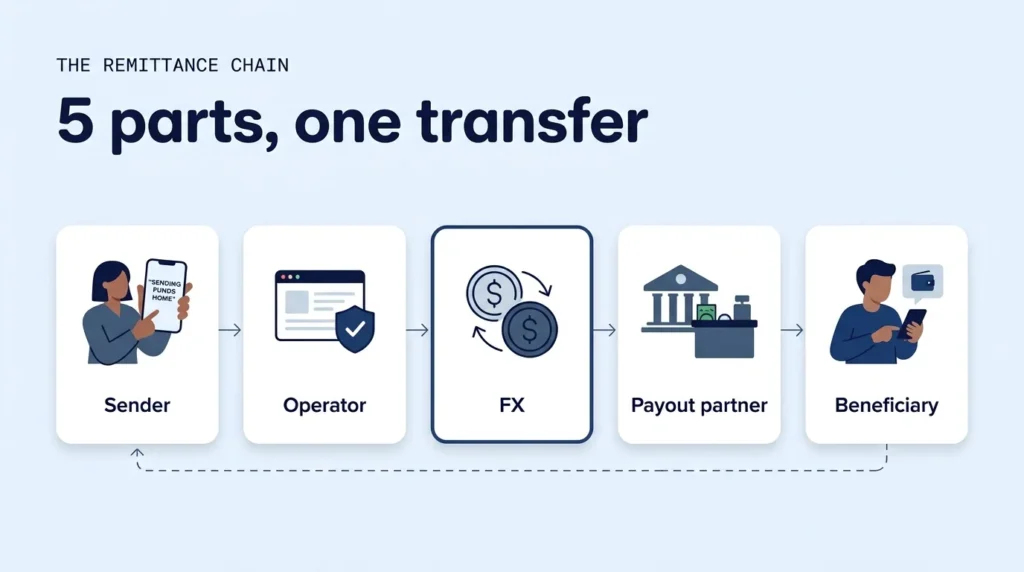
The 5-part remittance chain
- The sender. A person in the send country who registers, passes identity checks (KYC), adds a beneficiary and funds the transfer by bank transfer, card or cash at an agent counter.
- The operator. The licensed money transfer business that quotes the rate and fee, screens the transfer, takes the funds and records the transfer. This is your platform, your app and your agents.
- The FX step. The send currency is converted into the receive currency. The operator earns on the fee and on the FX spread, the gap between the rate it obtains and the rate it gives the sender.
- The payout partner. A bank, wallet provider, cash network or payment company in the receive country that delivers the money locally. Operators often hold a pre-funded balance with this partner so payouts do not wait for the international leg to settle.
- The beneficiary. The person who receives the money in a bank account, a mobile wallet or as cash at a pickup location.
What happens in order
| Step | What happens | Who owns it |
|---|---|---|
| Quote | Rate, fee and receive amount shown | Operator (rate and fee rules) |
| Verify | Identity checks and screening | Operator, with KYC and screening providers |
| Fund | Sender pays by bank, card or cash | Sender and payment provider |
| Convert | Send currency becomes receive currency | Operator treasury or FX provider |
| Deliver | Local payout to account, wallet or cash | Payout partner |
| Confirm | Status sent to sender and beneficiary | Operator platform |
| Settle | Operator and partner balance their books | Operator finance and payout partner |
Notice that the sender only sees the first 3 and the sixth. Settlement happens later and out of sight, but it decides how much pre-funding you need per corridor, and therefore how fast you can grow a corridor without tying up cash.
Cross border payments systems: the rails, at a high level
"Rails" is shorthand for the systems that move the money or the payment instruction. Most operators use more than one, often a different mix per corridor.
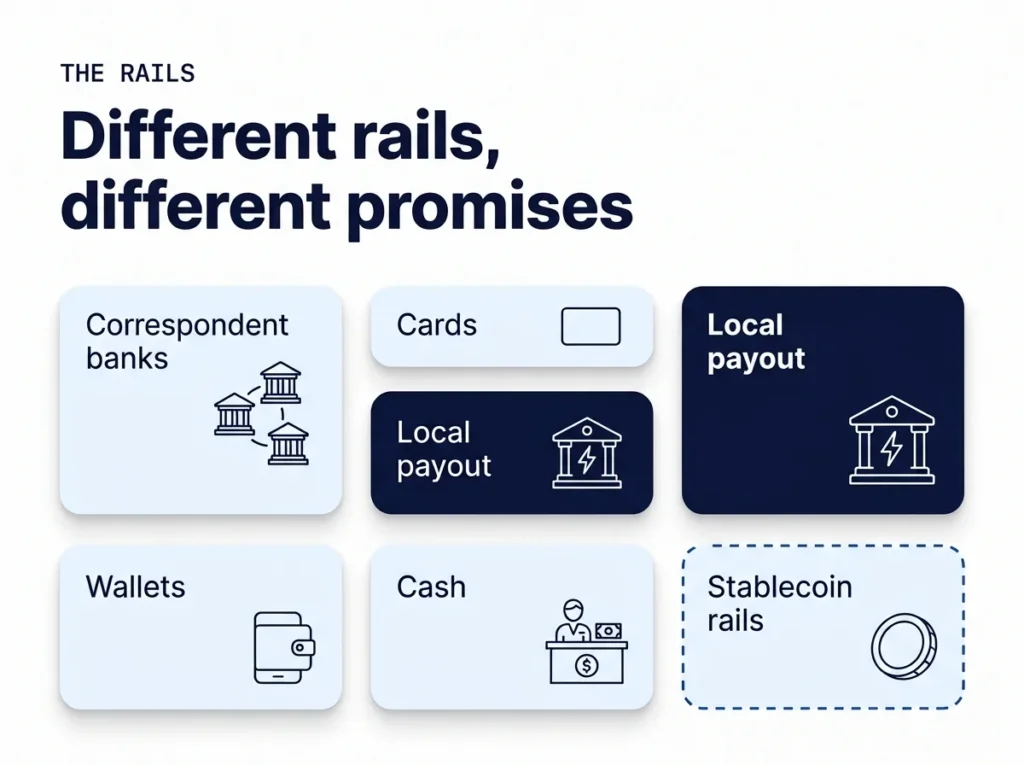
| Rail | How it works, simply | What the sender notices | What it means for growth |
|---|---|---|---|
| Correspondent banking | Banks hold accounts with each other and pass payment instructions along a chain | Bank-to-bank delivery; timing depends on the chain and cut-offs | Wide reach, but speed claims need care |
| Card networks | Card schemes handle funding and, on some routes, push payments to cards | Fast funding with a card; card fees | Easy first transfer, margin pressure |
| Local payout networks | A partner in the receive country pays out over domestic systems | Often quick local bank credit | Speed depends on the partner, not the brand |
| Mobile wallets | Funds credited to a wallet the beneficiary already uses | Money on the phone | Strong in wallet-heavy corridors |
| Cash networks | Agents or branches hand over cash against a reference | Collect in person | Matters where bank access is thin |
| Stablecoin-based rails | A dollar-linked token moves value between partners, then converts locally | Usually invisible to the sender | Emerging; regulation still settling by market |
What is correspondent banking, and where does Swift fit?
Correspondent banking is an arrangement where one bank holds deposits for other banks and provides payment services to them. Swift carries the payment messages between banks; the money moves through the accounts banks hold with each other. For cross-border payment instructions, Swift ended its coexistence period between the older MT messages and the ISO 20022 standard in November 2025, which means richer, more structured payment data travels with each instruction.
For a growth team, the practical point is narrower. "We use Swift" says little about how fast your UK to Ghana bank payouts arrive. The payout partner and its cut-off times usually say more.
Where stablecoin rails fit today
Some operators and payout partners use stablecoins to move value between their own balances before converting to local currency. It can reduce the time money sits in transit on certain routes. Treatment differs by market and is still developing, so it is a question for your partners and your regulatory adviser, not a line for your ad copy.
What each part means for growth: the 4-promise test
Every remittance brand sells some mix of 4 promises: speed, price, payout choice and trust. Each promise lives in a specific part of the chain, and a marketing team that does not know which part is writing cheques the operation may not cash.
This is where the remittance management system matters to marketing. If rates, fees and payout status do not live in one place with an audit trail, nobody can promise anything with confidence.
Promise by promise
| Promise | Where it is decided | What breaks it | Check before you claim it |
|---|---|---|---|
| Speed | Payout partner, cut-offs, verification queue | Manual review, bank holidays, partner downtime | Median time to payout by corridor and payout method |
| Price | Fee rules and FX spread | Rate shown on the ad differs from checkout | Rate source shared by site, app and ads |
| Payout choice | Partner coverage in the receive country | A pickup location or wallet not live yet | Live payout methods per corridor |
| Trust | Status updates, support, licensing disclosures | Silent transfers and slow replies | Status events sent at every stage |
Claims about speed, fees and security are also where advertising rules bite. Licensing and AML questions go to a qualified adviser. We handle advertising and marketing compliance.
The 3 things new teams mix up
The pain in most launch meetings is vocabulary. Three words get used as if they meant the same thing.
- Rail versus partner. A rail is the system. A partner is the company that uses it for you. Two partners on the same rail can deliver at very different speeds.
- Partner versus brand promise. Your partner's coverage map is not your marketing claim. A payout method is only a promise once it is live, tested and visible in the app for that corridor.
- Corridor versus country. UK to Nigeria and US to Nigeria share a receive country but can have different partners, prices and senders. Plan, price and report by corridor. How money transfer businesses make money sets out why corridor margin differs so much.
If you are still choosing which corridors to enter, that choice deserves evidence rather than opinion. Our corridor and market research grades each corridor on demand, competition and payout options, and refers the regulatory side to specialists.
Frequently asked questions
What are cross border payments in simple terms?
They are payments where the person paying and the person being paid are in different countries. The money usually changes currency and passes through one or more institutions on the way. A remittance from London to Accra, a UK company paying a supplier in India and a card purchase from a foreign website are all cross-border payments.
How do cross border payments work for a money transfer app?
The sender registers, passes identity checks, gets a quote and funds the transfer. The operator screens and records it, converts the currency and instructs a payout partner in the receive country. The partner credits a bank account or mobile wallet, or makes cash available for pickup. The operator then settles its balance with the partner.
What are the main cross border payments systems?
Correspondent banking, card networks, local payout networks in the receive country, mobile wallet systems, cash agent networks and, more recently, stablecoin-based arrangements between partners. Most operators combine several, and the mix usually differs by corridor and payout method.
Is a remittance the same as a cross-border payment?
A remittance is one type of cross-border payment: a person sending money to someone abroad, usually family. Cross-border payments also include business-to-business payments, platform payouts and card purchases. Remittances tend to be smaller and more frequent, which is why send frequency matters so much to the economics.
Why are some cross-border transfers slow?
Common causes are manual compliance review, banking cut-off times and holidays in either country, a long chain of intermediary banks, and payout partner downtime. The rail matters, but for most consumer transfers the verification queue and the payout partner decide the time the sender actually experiences.
Where to start
Cross-border payments are a chain: sender, operator, FX, payout partner and beneficiary. Every promise your brand makes lives somewhere in it. Map each claim to the part of the chain that decides it before the claim goes on a page.
Start with shared definitions: the growth metrics glossary above. If you are planning a platform, Build or buy: choosing an RMS is the next read. If you already have spend and want to know which parts of your chain cost you first transfers, Book a Growth Audit. More on how we work is on the Bussinesstan homepage.

Written by
Founder & CEO, Bussinesstan
Owns the commercial side of every engagement: fixed-fee scoping, corridor economics, and the reporting that ties spend to completed first transfers rather than to installs.
Meet the team
Remittance software: what your platform must do before marketing can scale
Remittance software checklist: 9 capabilities your platform needs, from corridor rules to reconciliation and marketing events, before you scale spend.
CRM for money transfer companies: design the data model first
CRM for money transfer companies, built on the data model: one record per sender, 9 lifecycle stages, B2B pipelines, consent rules and a 10-week rollout.
UGC for financial services: creator marketing for money transfer brands without compliance risk
UGC for financial services, done safely: diaspora creators, 6 restricted claim areas, disclosure by market and a brief compliance can sign off.