

Tech 9 min read
Remittance software: what your platform must do before marketing can scale
Remittance software checklist: 9 capabilities your platform needs, from corridor rules to reconciliation and marketing events, before you scale spend.
On this page
Quick answer
Remittance software is the operational platform a money transfer business uses to record senders and beneficiaries, apply corridor rules, set rates and fees, route payouts, manage agents, queue compliance checks, reconcile with partners and report. It supports compliance work but does not make a business licensed or AML compliant. For growth, it must also send reliable events to analytics, CRM and ad platforms.
Key takeaways
- Every marketing promise about rate, fee, speed or payout reads from the platform, so the platform sets the ceiling on growth.
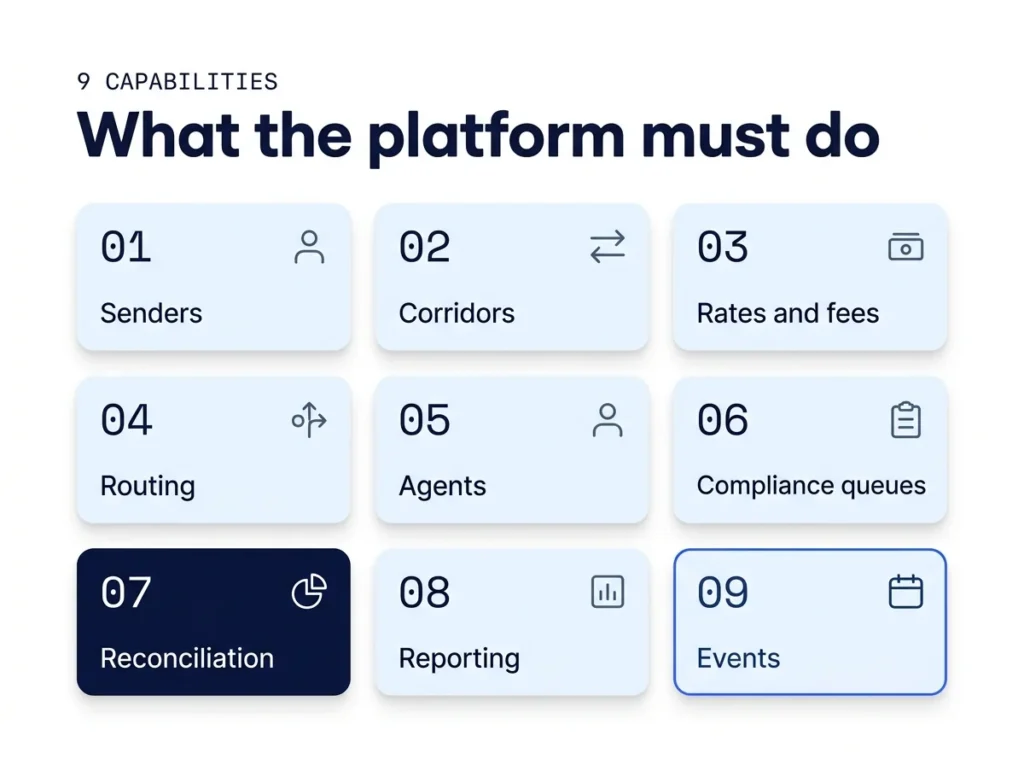
- 9 capabilities matter most: sender records, corridor rules, rates and fees, payout routing, agents, compliance queues, reconciliation, reporting, and events for marketing.
- Reconciliation by hand is the most common sign that the platform is behind the business.
- Software supports compliance operations. It never makes a business licensed or AML compliant on its own.
- Score what you have before you buy or build anything new.
Two people spend a week on reconciliation, and marketing cannot promise anything. The rate on the website is typed from a spreadsheet. Payout failures surface days later in an email from the partner. The growth team wants a UK to Nigeria rate alert and is told it would take a quarter.
That is not a marketing problem. It is a remittance software problem that shows up in marketing.
This guide sets out what your platform must do before paid spend, lifecycle messaging and new corridors can scale. It is a capability checklist, not a build or buy decision. That decision is covered in Build or buy: choosing an RMS.
Why remittance software sets the ceiling on growth
A remittance business earns on the first transfer, then on send frequency, then on corridor mix. Each of those depends on something only the platform can provide.
| Growth lever | What marketing wants to do | What the platform must provide |
|---|---|---|
| First transfer | Show the live rate on ads and corridor pages; chase KYC abandoners | A single rate source; KYC status as events |
| Send frequency | Rate alerts, two-tap repeat send, payday reminders | Saved beneficiaries; rate thresholds; transfer history |
| Corridor mix | Launch and price a new corridor quickly | Corridor rules as configuration, not code |
| Trust | Status updates at every stage | Payout status from partners, in near real time |
If the platform cannot provide these, the marketing team either waits or improvises. Improvised claims are where compliance problems start.
The 9-capability checklist for money transfer software
This is the checklist we use when a platform is being scoped. Each item has a plain test you can run this week.
1. Sender and beneficiary records
One record per sender, with verification status, limits, consent preferences and saved beneficiaries by payout method. Test: can you list verified senders who have never sent, by corridor, without a spreadsheet?
2. Corridor rules
Send and receive countries, currencies, payout methods, limits and availability set per corridor. Test: can operations switch a payout method on or off for one corridor without an engineer?
3. Rate and fee management
Base rates, margins by corridor and segment, fee rules, promotions and rate expiry, with an audit trail of who changed what. Test: do the website, the app and the ads read the same rate at the same moment?
4. Payout routing
Rules that send each transfer to a payout partner based on availability, cost and partner capability, with compliance and financial controls taking priority over optimisation. Test: when a partner goes down, how long before transfers route elsewhere, and who knows?
5. Agent management
Agents and branches, their limits, balances and commission, plus a portal so agents are not waiting for a monthly workbook. Test: can an agent see today's commission without calling head office?
6. Compliance queues
Screening hooks to your providers, policy-set limits, case queues, review states, role permissions and an audit log. The system routes the work. People make the decision. Test: can you see how many transfers are waiting in manual review right now, and for how long?
7. Reconciliation
Matching between your records, payout partner statements and bank settlement, so only exceptions reach a person. Test: how many hours a week does reconciliation take, and how old is the oldest open break?
8. Reporting
Volume, revenue, corridor profit, failure rates, reconciliation breaks and sender cohorts from the same source finance uses. Test: do finance and growth report the same number of first transfers for last month?
9. APIs and events for marketing
Webhooks and APIs that push sender states and transfer events to analytics, the CRM, messaging tools and ad platforms. Test: does "first transfer completed" reach your ad platforms and CRM automatically, and only once?
The checklist on one page
| # | Capability | Owner | What breaks without it |
|---|---|---|---|
| 1 | Sender and beneficiary records | Product | Lifecycle messaging, KYC recovery |
| 2 | Corridor rules | Operations | Fast corridor launches |
| 3 | Rate and fee management | Treasury and pricing | Accurate rate claims |
| 4 | Payout routing | Operations | Speed promises |
| 5 | Agent management | Network team | Agent growth, counter opt-ins |
| 6 | Compliance queues | Compliance | Predictable verification times |
| 7 | Reconciliation | Finance | Cash visibility, partner trust |
| 8 | Reporting | Finance and growth | One version of the numbers |
| 9 | APIs and events | Engineering and growth | Bidding on first transfers, triggered messages |
What marketing needs from the platform, specifically
Capability 9 is the one most platforms leave until last, and the one growth teams feel first. The events below are the minimum set a remittance app should emit with one agreed name each. The naming detail is in Analytics event tracking for remittance apps.
| Event | Used for |
|---|---|
| Registration completed | Funnel reporting |
| KYC started | Abandonment recovery |
| KYC passed | Ad platform optimisation, activation flows |
| Beneficiary added | First-send prompts |
| Quote created | Rate alert and reminder triggers |
| Transfer initiated | Payment failure recovery |
| First transfer completed | Cost per first send, bidding |
| Repeat transfer completed | Send frequency, reactivation |
| Payout status changed | Status messages by email, SMS or WhatsApp |
When these events exist, your WhatsApp status flows and paid campaigns read from the same truth. When they do not, every channel guesses.
What automated remittance software should automate, and what it should not
Good automated remittance software removes typing and waiting, not judgement.
- Automate: reconciliation matching, status messages from payout events, routing when a partner is unavailable, rate publication to site and app, agent balance updates.
- Keep with people: KYC approval, AML dispositions, sanctions decisions, transfer blocks, refunds above a set limit, pricing policy.
This is why a remittance management system build usually starts with reconciliation. It frees people first and produces the status data marketing needs second.
What software cannot do: the compliance boundary
No platform on its own makes a money transfer business licensed or AML compliant. Licensing depends on the regulator and the business. AML compliance depends on policies, people, controls and regulated providers. Software can route the work, keep the audit trail and enforce the limits you set. It does not replace any of those.
This affects how you describe your platform, internally and in marketing.
| Do not say | Say instead |
|---|---|
| "Our software makes you licensed" | "Software supports the operating model your licence requires" |
| "AML compliant platform" | "Compliance-ready workflows and integrations" |
| "Fraud-proof" or "risk-free" | "Screening hooks, limits and review queues you configure" |
| "Fully secure" | Name the specific controls, such as role permissions and audit logs |
Technology can support compliance operations. Licensing and AML questions go to a qualified adviser. We handle advertising and marketing compliance.
How to score your current platform
Score each of the 9 capabilities from 0 to 2. 0 means it does not exist or lives in a spreadsheet. 1 means it exists but needs manual work. 2 means it works without intervention and is reported.
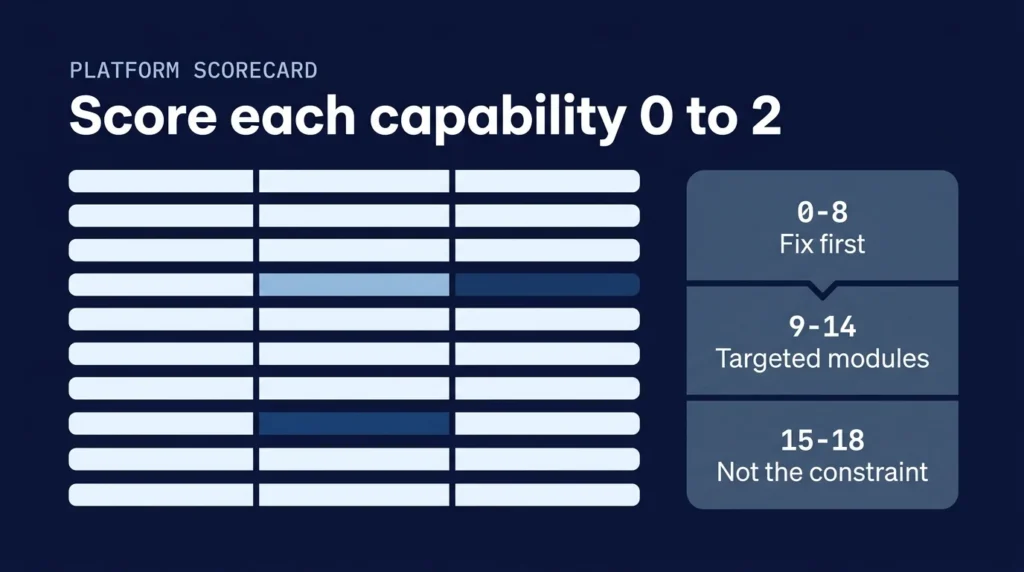
- 0 to 8: fix the platform before scaling spend. Start with reconciliation and payout status.
- 9 to 14: targeted modules. Usually agent management, events or rate management.
- 15 to 18: the platform is not the constraint. Look at the KYC screen, the second transfer or corridor mix.
Most operators do not need all 40 module groups at once. They need the 2 or 3 that are costing them the most this year, built in releases. If the gap is on the sender side, the app may be the place to start, which is where mobile app development comes in.
Frequently asked questions
What software for a money transfer business do I need first?
Usually reconciliation, payout status and a single rate source, because they free staff time and make accurate marketing claims possible. After that, agent management for network operators, or events and sender records for app-led operators. The right order depends on where your manual work and your lost first transfers actually sit.
What is a remittance management system?
A remittance management system is the platform that runs a money transfer business from quote to reconciliation: sender records, corridor rules, rates and fees, payout routing, agents, compliance queues, settlement and reporting. It sits behind the website and app, and it is where every transfer is recorded.
Does money transfer software make us compliant?
No. Money transfer software can support compliance operations with screening integrations, limits, case queues and audit logs. Licensing and AML compliance depend on your regulator, your policies, your people and your regulated providers. Any vendor claiming its software makes you compliant is making a claim it cannot support.
What should automated remittance software never decide?
KYC approval, AML dispositions, sanctions matches, suspicious activity reporting, transfer blocking and risk classification. Automation can prepare the case, gather the data and route it to the right person. The decision stays with trained staff under your compliance policy.
How long does it take to build remittance software?
For a full platform, our scoping runs 4 weeks and the build 4 to 9 months, delivered in releases. Most operators start with 1 module, often reconciliation, rather than the whole platform. Timelines depend mainly on the number of payout partners and providers to integrate.
Where to start
Remittance software decides what marketing can promise. Score your platform on the 9 capabilities, fix the lowest scores that cost money this year, and make sure first transfer and payout status events reach every channel.
See how we scope and build a remittance management system, or browse all technology services. If you want the platform gaps priced against lost first transfers before you commit to a build, Book a Growth Audit.

Written by
Founder & CEO, Bussinesstan
Owns the commercial side of every engagement: fixed-fee scoping, corridor economics, and the reporting that ties spend to completed first transfers rather than to installs.
Meet the team
What are cross-border payments? A plain guide for remittance operators
What are cross border payments, how they work and which rails move the money: a plain guide for remittance operators on speed, price, payout and trust.
CRM for money transfer companies: design the data model first
CRM for money transfer companies, built on the data model: one record per sender, 9 lifecycle stages, B2B pipelines, consent rules and a 10-week rollout.

UGC for financial services: creator marketing for money transfer brands without compliance risk
UGC for financial services, done safely: diaspora creators, 6 restricted claim areas, disclosure by market and a brief compliance can sign off.