

Brand 9 min read
Agency fee percentage of ad spend vs fixed fee: how to pay a growth agency
Agency fee percentage of ad spend, fixed fee, retainer or performance pricing: how each model shapes incentives for a remittance business, and how to choose.
On this page
Quick answer
An agency fee as a percentage of ad spend rises and falls with the media budget, whatever the results. A fixed fee is agreed in advance for a defined scope and does not change with spend. Retainers, project fees and performance-based pricing sit between them. For a remittance business, the right model is the one where the agency earns the same, or more, when cost per first send falls.
Key takeaways
- Every agency pricing model creates an incentive, so choose the incentive before you choose the agency.
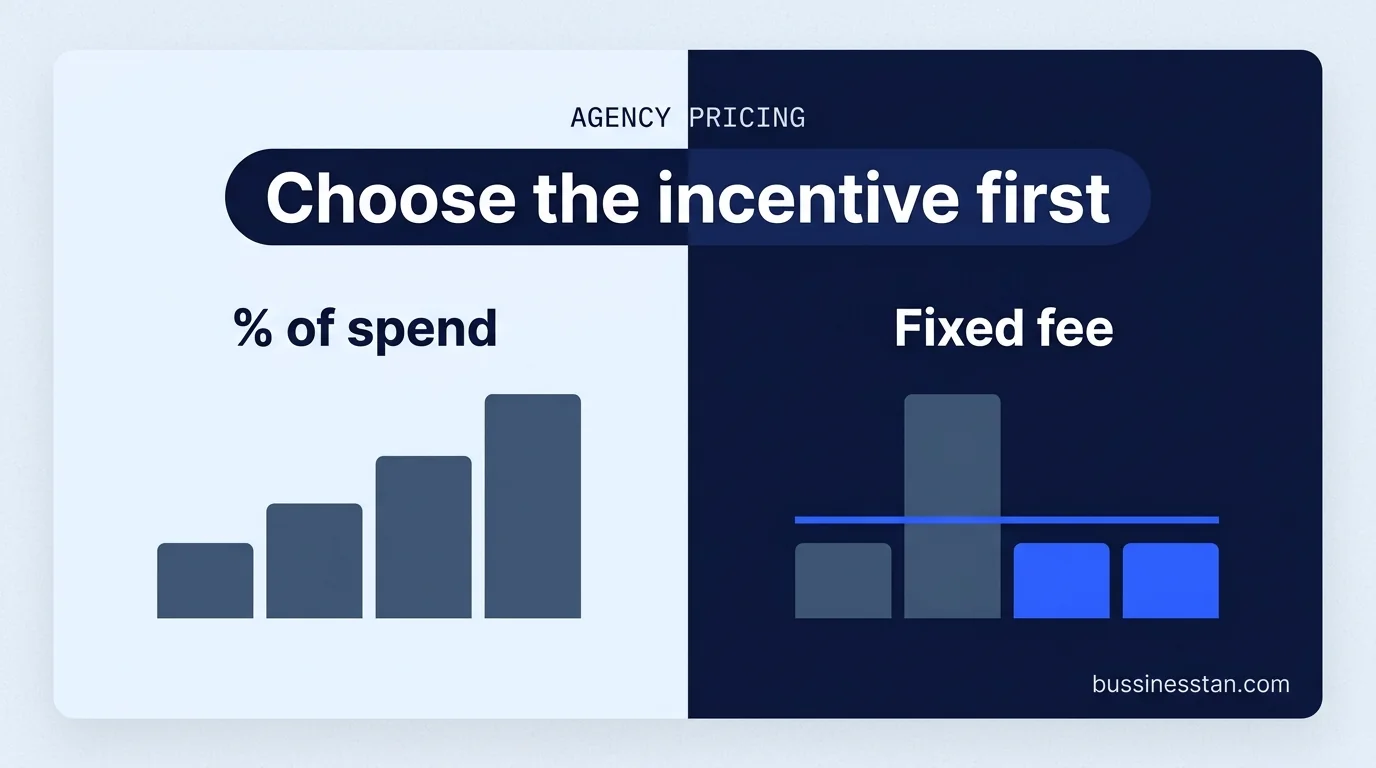
- A percentage of ad spend pays the agency more when you spend more, not when senders transfer more.
- Performance-based pricing only works when both sides agree the source of truth for first transfers.
- Fixed fees remove the spend incentive but need a written scope and regular review.
- Bussinesstan charges fixed fees only, never a share of spend or uplift, and earns less as budgets grow.
Agencies earn more when we spend more. Founders of money transfer businesses say it plainly, usually after a quarter where spend went up, installs went up, and first transfers did not.
The problem is rarely bad faith. It is the contract. When the agency fee is a percentage of ad spend, the person advising you on budget is paid more if the budget grows. That is a conflict even when the people involved are honest.
This guide compares the 4 common marketing agency pricing models, shows how each one behaves in a remittance business, and sets out 5 questions to ask before you sign. It also states our own position and what it costs us.
The 4 marketing agency pricing models
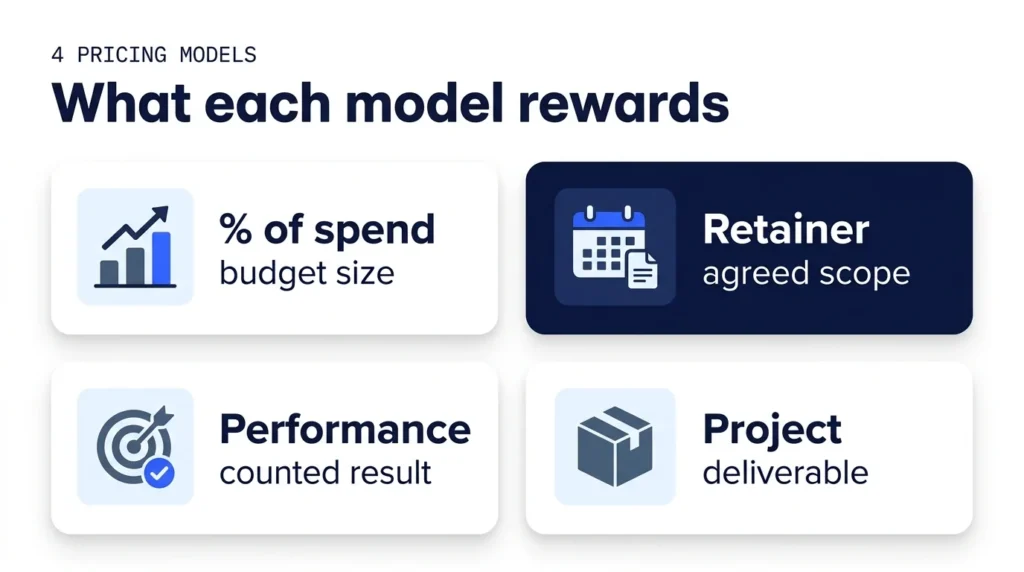
Most agency contracts use one of 4 models, or a blend.
| Model | How the fee is set | What the agency is paid for |
|---|---|---|
| Percentage of ad spend | A share of the media budget each month | The size of the budget |
| Fixed retainer | A set monthly fee for an agreed scope | Doing the agreed work, month by month |
| Performance-based | A fee per result, or a share of uplift or revenue | The result the contract counts |
| Project fee | A fixed price for a defined deliverable | Delivering that piece of work |
None of them is wrong in every case. Each one rewards something different, and in remittance the difference between "something" and "first transfers by corridor" is where money leaks.
Agency fee percentage of ad spend and the alternatives, in practice
Percentage of ad spend
The fee moves with the budget. It is simple to administer and common where buying is the main workload.
Where it works: large, stable budgets across many markets, where the effort of buying and optimising genuinely grows with spend.
Where it hurts a remittance business:
- An audit that finds the funnel leaking after the ad, at the KYC screen or before the first funded transfer, should recommend spending less. The agency's fee falls if it says so.
- Scaling a corridor with thin margin increases the fee while reducing your profit.
- The workload does not rise in line with spend. A campaign spending twice as much rarely needs twice the hours.
Fixed fee marketing agency retainers
A fixed fee marketing agency charges an agreed amount for a written scope. The fee does not change if you cut or raise the budget.
Where it works: when you want advice on budget that is independent of the budget, and when scope can be written down clearly.
Where it can go wrong:
- Vague scope leads to disputes, or to an agency quietly doing less.
- At very small budgets, a fixed fee can be large relative to spend.
- It needs a review rhythm, so that the scope changes in writing when your needs change.
Performance based agency pricing
Performance based agency pricing pays per result: per registration, per install, per first transfer, or a share of revenue or uplift.
Where it works: when the result is counted from your own records, the definition is exact, and there are caps.
Where it hurts a remittance business:
- Paying per registration or per install rewards cheap, unverified signups. Your cost per install is lying to you explains why those numbers mislead.
- Attribution disputes are routine. Google, Meta and the MMP can each claim the same first transfer. Whose count sets the invoice?
- A share of uplift can reward short-term promotions and rate discounts that lift volume and cut corridor margin.
- A share of uplift also depends on a baseline, and baselines move with seasons such as Ramadan and Christmas.
Project fees
A fixed price for a defined deliverable: an audit, a corridor landing page set, a tracking rebuild.
Where it works: one-off work with a clear finish line. It is also the lowest-risk way to test an agency before a retainer.
Where it can go wrong: projects handed over without anyone to run them afterwards, or scoped so tightly that the real problem sits outside the scope.
The models side by side
| Model | Incentive it creates | Main risk for a remittance business | Protect yourself by |
|---|---|---|---|
| Percentage of ad spend | Grow the budget | Scaling spend into a leaking KYC funnel | Separating budget advice from the fee |
| Fixed retainer | Keep the account, control hours | Scope drift, effort fade | A written scope and a quarterly review |
| Performance-based | Maximise the counted result | Paying for unverified senders or disputed attribution | Counting from your transfer records only |
| Project fee | Deliver the deliverable | Nobody owns what happens next | Handover documents and a named owner |
The incentive test: 5 questions before you sign
Ask these of any agency, including us. The answers tell you more than the credentials deck.
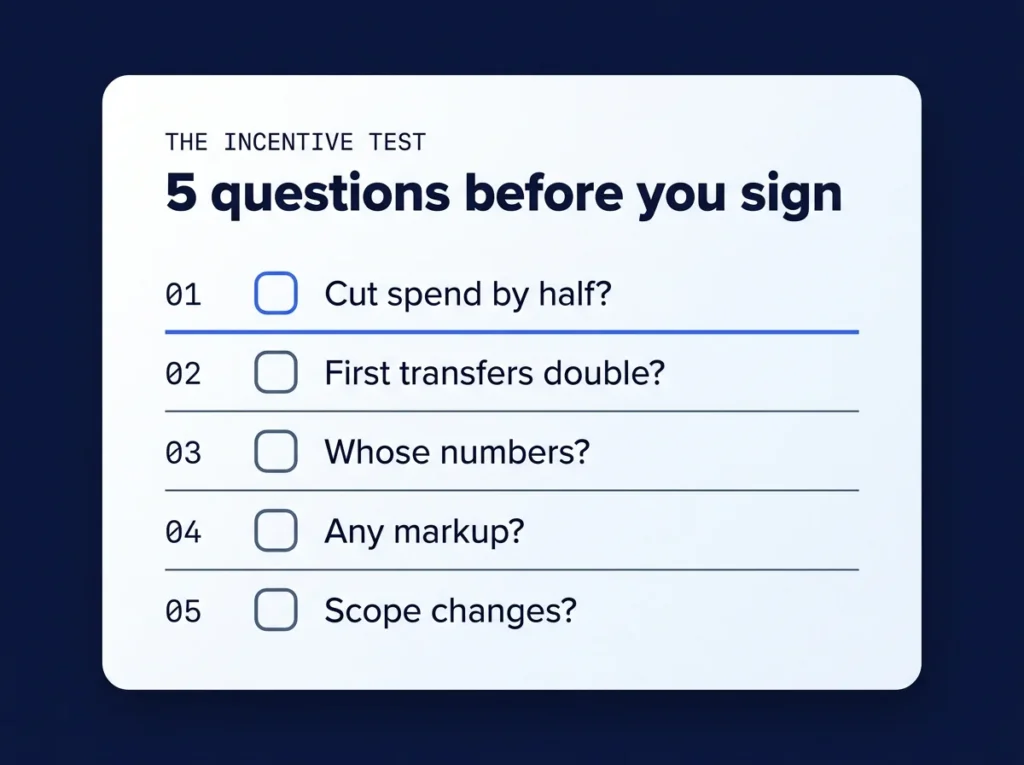
- What do you earn if we cut spend by half next month? If the answer is "less", budget advice and the fee are linked.
- What do you earn if first transfers double on the same spend? If the answer is "the same", check what else motivates the work. If the answer is "more", ask how first transfers are counted.
- Whose numbers set the invoice? Platform-reported conversions or your own transfer records. Only the second is safe.
- Is there any markup on media, tools or message fees? Markups are a second, less visible percentage.
- How does the fee change when scope changes? It should change only in writing, with your sign-off.
A good answer to question 1 is the most important. The best budget advice is the advice that costs the adviser nothing to give.
To check whether an existing agency's recommendations have been sound, a paid ads audit reads the accounts against your transfer records and says whether spend should rise, hold or fall. If the incumbent is doing the job well, the audit should say so. What it covers is set out in what a paid ads audit should find in 14 days.
Our position, and what it costs us
We charge fixed fees only. The audit is a single fee. Projects are priced per scope. Retainers run monthly with a stated minimum term. We never take a percentage of media spend or a share of uplift, and we add no markup to media, platform or message fees.
That has a cost. We do not price on a percentage of spend, so we earn less as budgets grow. When a client's budget triples, our fee does not. When an audit ends with "spend less until the funnel holds", we lose the follow-on media work a percentage model would have paid for. We accept both, because they keep our advice on budget independent of our income.
It also has limits. A fixed fee does not guarantee effort by itself. That is why the fee is agreed in writing, and why a fee that moves without your written sign-off reverts to the original. The details are on our why us page.
This is not the only honest model. An agency paid on spend can give good advice, and many do. The point is to know which incentive you are buying, and to design the contract so that the incentive points at first transfers, send frequency and corridor margin. Why blended CAC misleads covers the numbers that should sit in that contract.
Frequently asked questions
What is a typical agency fee percentage of ad spend?
It varies by market, channel, agency size and budget, and it is often tiered so the percentage falls as spend rises. Rather than benchmark the percentage, calculate what it pays per hour of real work at your budget, and what happens to it if the right answer is to spend less.
Is an agency retainer better than a percentage of spend?
For budget advice, usually yes, because an agency retainer does not change with spend. It is only better if the scope is written, reviewed quarterly and tied to outcomes you can measure, such as cost per first send by corridor. A vague retainer can drift just as a percentage can inflate.
Does performance based agency pricing work for remittance apps?
It can, if the counted result is a first funded transfer from your own records, the definition is exact, and there is a cap. It works badly when the result is an install or registration, or when platform-reported conversions set the invoice.
Which marketing agency pricing models suit a pre-launch money transfer business?
Project fees and short fixed-fee engagements. With little or no spend, a percentage model pays very little and attracts little attention, and performance pricing has no baseline. Fund the research, tracking and launch plan as projects, then decide on a retainer once there is data.
Can I switch pricing model with my current agency?
Often, yes. Ask for a fixed-fee proposal for the same scope and compare it with what you pay now at your current and planned budgets. If the agency will not separate its fee from your spend, that tells you something about where its advice comes from.
Where to start
Pick the incentive first, then the agency. Run the 5-question incentive test on your current contract, and model the pricing options against cost per first send with the calculator above.
If you want an independent view of whether your current spend should rise, hold or fall, start with one fixed-fee audit. Book a Growth Audit. The fee is agreed before we start, and you keep the roadmap whether or not we work together.

Written by
Founder & CEO, Bussinesstan
Owns the commercial side of every engagement: fixed-fee scoping, corridor economics, and the reporting that ties spend to completed first transfers rather than to installs.
Meet the team
Fintech marketing agency or remittance specialist: how to choose
Choosing a fintech marketing agency for a remittance business: 10 questions to ask, a fair comparison of 4 options, and when a generalist is fine.

CRM for money transfer companies: design the data model first
CRM for money transfer companies, built on the data model: one record per sender, 9 lifecycle stages, B2B pipelines, consent rules and a 10-week rollout.

UGC for financial services: creator marketing for money transfer brands without compliance risk
UGC for financial services, done safely: diaspora creators, 6 restricted claim areas, disclosure by market and a brief compliance can sign off.