

Brand 9 min read
Remittance growth audit: what you get in 14 days, and when you do not need one
A remittance growth audit in 14 days: 4 areas, 4 deliverables you keep, a fixed fee quoted in writing, and an honest list of when to wait instead.

On this page
Quick answer
A remittance growth audit is a fixed-scope review of a money transfer business's paid media, tracking, website conversion and corridor economics, read against its own transfer records. The Bussinesstan version runs for 14 days on read-only access, for a fixed fee quoted in writing, and ends with 4 deliverables: sized findings, a waste report, a tracking map and a 30/60/90 roadmap.
Key takeaways
- The audit reads 4 areas: paid media and spend, tracking and events, site and conversion, and corridor economics.
- It runs for 14 days from access to findings, on read-only access that is handed back at the end.
- You keep all 4 deliverables whether or not you work with us afterwards.
- The fee is fixed and quoted in writing within 1 business day, before any access is granted.
- It is not the right step if tracking has been live for under a month, there is no spend or traffic, a roadmap already exists, or the blocker is licensing.
"We know something is leaking, but not where." That is how most growth conversations with money transfer operators begin. Spend is rising. Registrations look fine. First transfers do not keep pace, and 3 dashboards give 3 different answers about why.
The growth audit is built for exactly that moment. It is the front door to working with Bussinesstan, and this page explains it plainly: what we read, how the 14 days run, what you receive, and when you should not book one yet.
What a remittance growth audit is, and what it is not
A growth audit reads your marketing against the number that pays: the funded first transfer, then the second. It is not a pitch deck with a discount attached, and it is not a compliance review.
| It is | It is not |
|---|---|
| A 14-day read of spend, tracking, site and corridor economics | A months-long discovery phase |
| Priced as a fixed fee, quoted in writing before access | A percentage of your media spend |
| Findings sized in money per month | A list of 200 unranked fixes |
| A roadmap you keep, whoever runs it | A trial retainer |
| Advertising and marketing compliance only | Legal, licensing or AML advice |
Licensing and AML questions go to a qualified adviser. We handle advertising and marketing compliance.
How is it different from a general marketing audit for fintech?
A general marketing audit for fintech usually scores channels on clicks, installs and cost per registration. This audit joins platform data to your own transfer records, so a campaign is judged on verified senders and first transfers. It also cuts across 2 deeper services: the paid ads audit (2 weeks, inside the ad accounts) and the website audit (3 weeks, across the whole site). If the growth audit points to either, it says so.
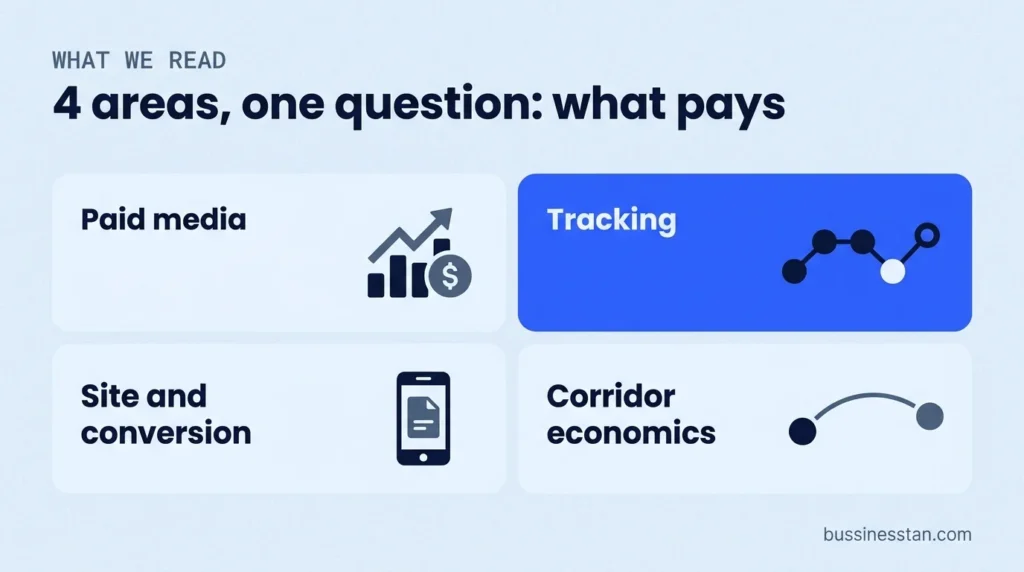
The 4 areas the growth audit reads
| Area | What we look at | The question it answers |
|---|---|---|
| 1. Paid media and spend | Corridor separation, bidding against first-transfer signals, budget split against corridor value, waste | Which spend produces senders, and which only produces registrations? |
| 2. Tracking and events | Registration, KYC start and completion, first and repeat transfer; GA4, MMP and CRM attribution; web-to-app handover; consent | Can you trust the numbers you optimise against? |
| 3. Site and conversion | Registration and app download paths, rate, fee and calculator clarity, trust content, mobile forms and document capture | Where do senders leave before they verify? |
| 4. Corridor economics | Cost per first send by corridor, send country versus receive country split, corridor page structure, send frequency by cohort | Which corridors earn their budget? |
Area 2 is where the surprises tend to sit. A common pattern is an ad account optimised against a registration that nobody has verified yet, which is the story told in your cost per install is lying to you. Area 3 often leads straight to the verification screen; our KYC drop-off audit shows what that part of the read looks like.
Area 4 is the one most teams have never seen on one page. Cost per first send split by corridor often shows that a budget spread evenly is funding one route that pays and another that does not. Send frequency by cohort then shows whether the senders you paid for came back for a second transfer.
The 14-day timeline, day by day
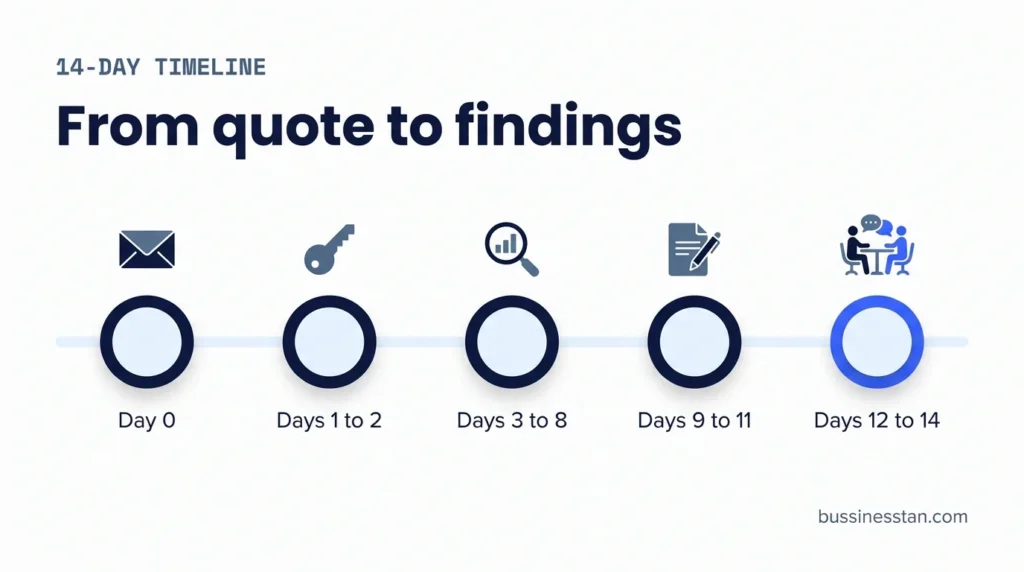
| When | What happens | What you do |
|---|---|---|
| Day 0 | Scope and fixed fee sent in writing, within 1 business day of your form | Read it; no call is required |
| Days 1 to 2 | Read-only access to ad accounts, GA4, MMP and the site | Grant access; share transfer records at aggregate level |
| Days 3 to 8 | The work: accounts, events, funnel and corridor numbers joined up | Answer occasional questions |
| Days 9 to 11 | Findings written up and sized by monthly cost | Nothing |
| Days 12 to 14 | 90-minute findings session with your team | Bring whoever owns the budget and the numbers |
Access is read-only and handed back at the end. Nothing in your accounts is paused or changed during the 14 days.
What to prepare before day 1
- A list of live corridors and the payout methods on each.
- Read-only logins for each ad platform, GA4, your MMP and the site's tag manager.
- A monthly export of registrations, verified senders, first transfers and repeat transfers by corridor, at aggregate level. No sender-level data is needed.
- The name of the person who approves marketing claims.
- The one number your board argues about most.
If some of this does not exist, say so on the form. A missing export is a finding in its own right.
The 4 deliverables you keep
- The findings. Each one sized by what it costs you per month, so the list ranks itself.
- The waste report. Spend that produced no verified senders or first transfers in the period reviewed, by campaign and corridor.
- The tracking map. Every event from registration to repeat transfer, what fires, what does not, and where the tools disagree.
- The 30/60/90 roadmap. What to fix first, what follows, and who should own each line.
All 4 are yours to run in-house, hand to another agency, or ignore.
Who the growth audit is for, and when you do not need one
Worth booking if
- Spend is rising and nobody can tell you cost per first send.
- Registrations are healthy but first transfers are not.
- A corridor has stalled and nobody agrees why.
- 2 teams report different numbers for the same month.
Not yet if
| Situation | Why the audit is premature | What to do instead |
|---|---|---|
| Tracking has been live for under a month | There is not enough clean data to read | Finish the tracking setup, then wait a month |
| No paid spend and almost no traffic | There is nothing to audit yet | Plan the launch first; see our go-to-market strategy for remittance startups |
| A roadmap already exists | A second one adds little | Run the one you have and measure it |
| The blocker is licensing | Marketing cannot fix it | Speak to a qualified licensing adviser |
We would rather tell you to wait than sell you a thin audit. That costs us some audits. It is still the right call.
What happens after the audit
Many teams run the roadmap themselves, and that is a good outcome. Some hand it to their current agency. Some ask us to run parts of it on a fixed monthly fee against an agreed scope.
Two positions shape what we recommend. Audits often end with a recommendation to spend less, which costs us follow-on work. And we do not price on a percentage of spend, so we earn less as budgets grow.
How to judge any remittance marketing agency after an audit
Whether you choose us or another money transfer marketing agency, ask 4 questions:
- Will they report first transfers and corridor margin, or only installs and clicks?
- Will they reconcile platform conversions against your transfer records and report the gap?
- How are they paid, and does the fee rise when your spend rises?
- Which claims do they agree with your compliance approver before writing, not after?
If you are weighing the wider picture first, our remittance corridor analysis guide covers how to score routes before spending on them, and the Bussinesstan homepage sets out the full range of work.
Frequently asked questions
How much does a remittance growth audit cost?
It is a fixed fee, quoted in writing within 1 business day of your form and before any access is granted. We do not publish a price because it depends on the channels, corridors and spend involved. It is never a percentage of your media spend, and no call is required to receive the quote.
What access do you need for the growth audit?
Read-only access to your ad accounts, GA4, your MMP and the website, plus transfer records at an aggregate level so campaigns can be judged on first transfers. Access is granted on days 1 to 2 and handed back at the end. Nothing is paused or changed.
Is this the same as a marketing audit for fintech or a paid ads audit?
No. A general marketing audit for fintech scores channels on platform metrics. Our paid ads audit goes deeper into ad accounts alone, and our website audit covers the whole site over 3 weeks. The growth audit cuts across both in 14 days and tells you whether either deeper audit is worth doing.
What if the audit finds nothing worth fixing?
Then the findings say so. A clean result is still useful: it tells you the leak is somewhere marketing does not control, such as pricing, payout coverage or licensing, and saves you paying an agency to look for it.
Do we have to hire you after the growth audit?
No. The 4 deliverables are yours whether or not the work continues. Many teams run the roadmap themselves. If you do want help, ongoing work is a fixed monthly fee against an agreed scope.
Book your growth audit
You already know something is leaking. Two weeks and a fixed fee to find out where, sized in money, with a roadmap you keep.
Book a Growth Audit. Tell us your volume band, your corridors and what worries you most. We reply within 1 business day with scope and a fixed price in writing.

Written by
Founder & CEO, Bussinesstan
Owns the commercial side of every engagement: fixed-fee scoping, corridor economics, and the reporting that ties spend to completed first transfers rather than to installs.
Meet the team
Agency fee percentage of ad spend vs fixed fee: how to pay a growth agency
Agency fee percentage of ad spend, fixed fee, retainer or performance pricing: how each model shapes incentives for a remittance business, and how to choose.
Fintech marketing agency or remittance specialist: how to choose
Choosing a fintech marketing agency for a remittance business: 10 questions to ask, a fair comparison of 4 options, and when a generalist is fine.

Go-to-market strategy for remittance startups: the first 90 days
A go-to-market strategy for remittance startups: readiness check, 1 or 2 corridors, tracking before spend, channel order and 30/60/90 milestones.