

CRO 9 min read
Cross border payments challenges: the five that stall remittance growth
Cross border payments challenges that stall remittance growth: verification, wasted spend, one-time senders, corridor risk and platform limits, with fixes.

On this page
Quick answer
The cross border payments challenges that most often stall remittance growth are commercial rather than technical: senders lost at verification, paid spend that buys installs instead of first transfers, senders who send once and leave, revenue concentrated in one corridor, and platforms that cannot support what growth needs. Messaging that stays within compliance limits runs across all five. Each has a visible symptom, a cause, a first fix and an owner.
Key takeaways
- Most cross border payments challenges that stall growth sit in the funnel, not in the payment rails.
- Five challenges recur: verification leakage, acquisition waste, one-and-done senders, corridor concentration and platform ceilings.
- Each one has a symptom you can see this week and a team that should own it.
- When growth stalls, every team blames a different cause; a shared metric set ends the argument.
- Fix in order: measure, then verification, then acquisition, then repeat sends.
Growth has stalled. Marketing says the product loses people at KYC. Product says marketing buys the wrong installs. Operations says nobody warned them about the campaign. Finance says the numbers do not reconcile. Every team blames a different cause, and every team is partly right.
The cross border payments challenges written about most are the industry-level ones: cost, speed, access and transparency. They matter. Target 10.c of the UN Sustainable Development Goals aims to cut average remittance costs to less than 3% of the amount sent by 2030, and to eliminate corridors costing more than 5%. That keeps pressure on every operator's pricing.
But the problems that stall an individual money transfer business are usually closer to home. Here are the five that recur, with what each looks like, why it happens, what to fix first and who should own it.
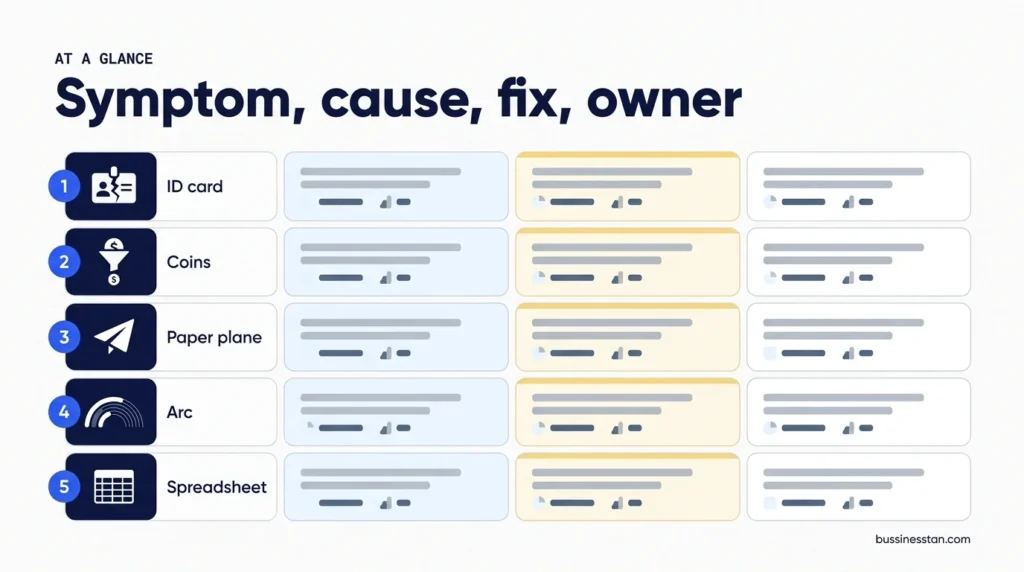
Cross border payments challenges at a glance
| Challenge | Symptom you can see | Usual cause | First fix | Owner |
|---|---|---|---|---|
| 1. Verification leakage | Registrations rise, first transfers do not | Document capture fails, manual review unreported | Measure each KYC step | Product and operations |
| 2. Acquisition waste | Cost per install looks fine, margin does not | Ads optimise for installs or signups | Send post-KYC events to ad platforms | Growth |
| 3. One-and-done senders | Most senders transfer once | No reason to return; rate changes never communicated | Trigger-based second-transfer messages | Lifecycle marketing |
| 4. Corridor concentration | One corridor carries most revenue | Budget spread evenly or by habit | Score corridors before spending | Leadership |
| 5. Platform ceilings | Marketing ideas die in the backlog | Rates, payouts and reconciliation run on spreadsheets | Fix reconciliation and rate management first | Operations and engineering |
The five challenges, one by one
Each challenge below follows the same pattern: the symptom a leadership team can see, the cause underneath it, the first fix worth funding and the team that should own it.
1. Verification leakage
Symptom. Registrations climb month on month. First transfers stay flat. People download and never verify.
Cause. Document capture fails on older Android phones. Liveness checks time out on weak connections. Senders referred to manual review wait with no message and give up. Often nobody reports on the verification queue at all, so the loss is invisible.
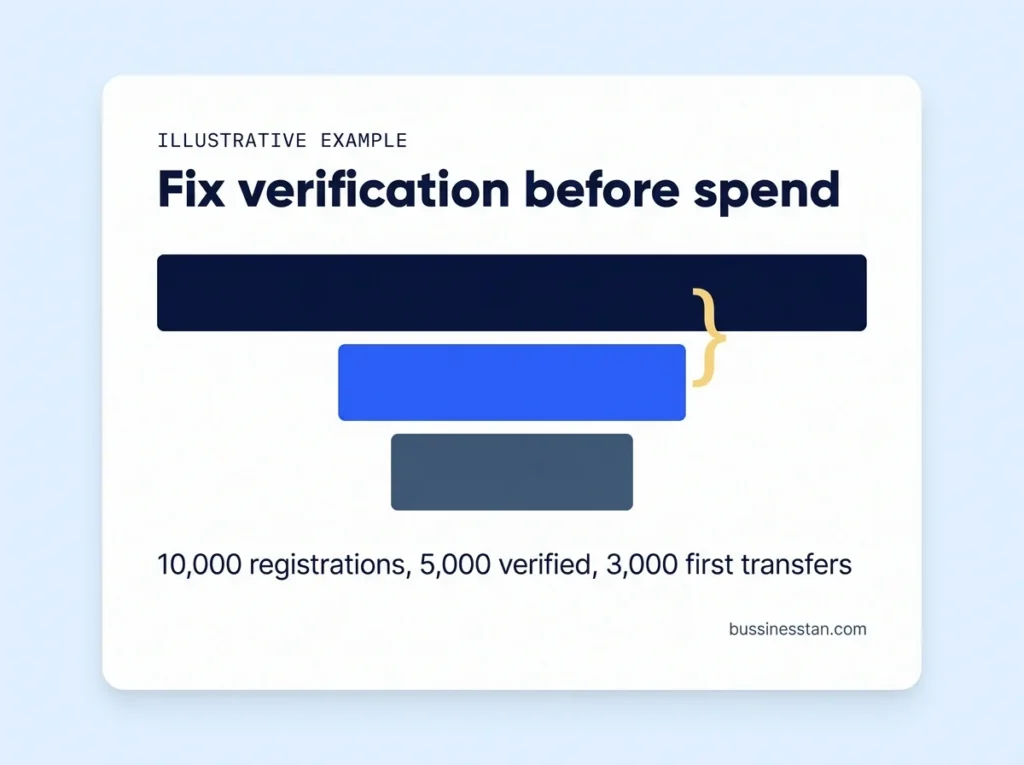
First fix. Instrument every step: KYC started, document submitted, liveness passed, referred, approved, first transfer. Then read the drop by device, corridor and acquisition source. The method is set out in our KYC drop-off audit.
Owner. Product, with operations for the review queue. The verification rules themselves stay with compliance. Improving the screens never means weakening the checks.
Licensing and AML questions go to a qualified adviser. We handle advertising and marketing compliance.
2. Acquisition waste
Symptom. Cost per install is stable or falling. Cost per first send is unknown or rising. Three platforms claim the same conversion.
Cause. Campaigns optimise toward installs or registrations because those are the events the platforms receive. The algorithms then find people who install and never send. Platform-reported conversions are taken on trust instead of being checked against transfer records.
First fix. Send post-KYC events and first transfers back to the ad platforms. Reconcile platform conversions against your own records and report the gap. Measure cost per first send by corridor. Your cost per install is lying to you explains why the headline number misleads.
Owner. Growth, with engineering for server-side events.
We argue against more spend until the funnel holds. Month one looks slower that way.
3. One-and-done senders
Symptom. A large share of senders make one transfer and are never seen again. Reactivation is a monthly email blast.
Cause. Nothing gives the sender a reason to reopen the app. Rate improvements and fee changes are never communicated. Seasonal occasions such as Eid, Christmas and school-fee months pass without a message. Dormant senders are treated as one list.
First fix. Build triggers, not calendars: a message after the first transfer, a rate alert for the sender's corridor, a reminder near the sender's usual send date, a two-tap repeat transfer. Our guide to customer retention for remittance apps covers the second-transfer windows in detail.
Owner. Lifecycle or CRM marketing, with product for the repeat-send flow.
Send frequency is where the business is.
4. Corridor concentration
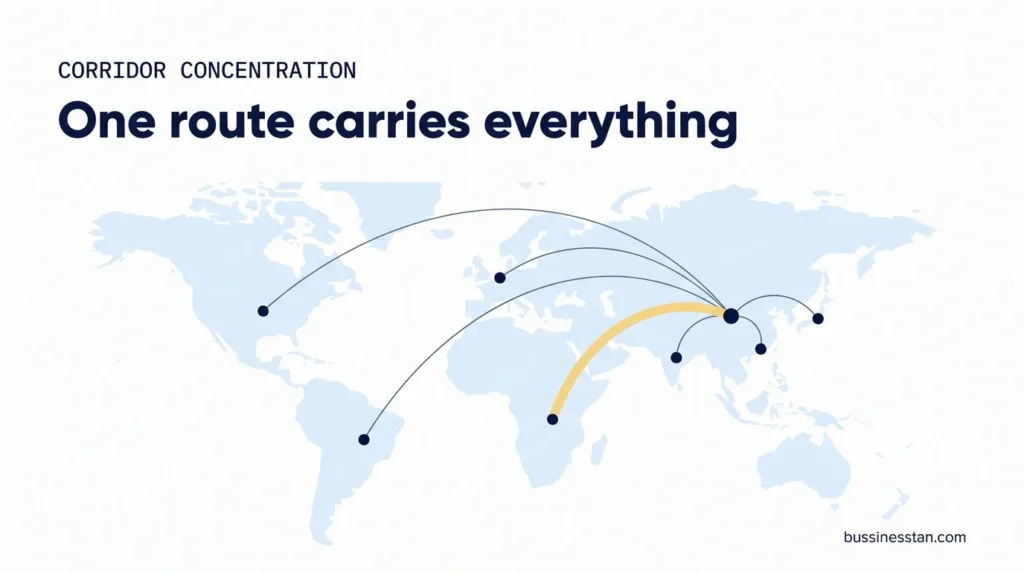
Symptom. One corridor carries most of the revenue. A pricing move by a competitor on that route, or a payout partner problem, hits the whole business.
Cause. Corridors were added by opportunity rather than evidence. Budget is split evenly across unequal corridors, or kept where it has always been. Nobody can say which corridor makes money after acquisition costs.
First fix. Score each live and candidate corridor on demand, competition, pricing visibility, payout reliability, channel opportunity, marketing economics and strategic fit. Grade them: priority, test, monitor or low priority. That is the work of corridor and market research, and it answers "we do not know which corridor to focus on" with evidence instead of opinion.
Owner. Leadership, because corridor mix is a strategy decision, not a campaign setting.
5. Platform ceilings
Symptom. Marketing wants corridor-specific rates, a referral offer or a faster repeat send. The answer is "the platform cannot do that". Reconciliation takes two people most of a week.
Cause. Rates live in a spreadsheet. Payout partners are chased by email. Agent balances sit in a monthly workbook. Every change is manual, so every change is slow and risky.
First fix. Start with reconciliation and rate management, not a full rebuild. Rates with an audit trail and reconciliation that surfaces only exceptions remove most of the manual load. A remittance management system is usually built module by module, and it usually starts there. No software on its own makes a business licensed or AML compliant.
Owner. Operations and engineering, with finance for the ledger.
The cross-cutting constraint: compliance-safe messaging
Every fix above runs into the same wall if the copy is wrong. Ads rejected for financial services policy. Claims such as "zero fees" or "instant" that the product cannot substantiate on every corridor. Compliance teams who see campaigns for the first time the day before launch.
The fix is procedural. Agree the claims library with compliance before anyone writes. A workable library has 4 parts:
- Fee wording, including how the FX margin is described when the transfer fee is zero.
- Speed wording by corridor and payout method, since cash pickup and bank deposit rarely arrive at the same time.
- Regulatory status lines, in the exact form compliance has approved.
- Banned phrases, such as "guaranteed", "risk-free" or "instant" where delivery is not instant on every corridor.
Then write inside it. Compliance blocks less when it is asked first. The same library feeds ads, landing pages, app store listings and support macros, so a claim is approved once rather than argued four times.
Where these challenges show up in your numbers
Growth stalls partly because each team reads a different number. One shared metric set settles most arguments.
| Challenge | Metric that exposes it |
|---|---|
| Verification leakage | Registration to KYC pass rate, by device and corridor |
| Acquisition waste | Cost per first send, by channel and corridor |
| One-and-done senders | Second-transfer rate within 30, 60 and 90 days |
| Corridor concentration | Revenue and corridor margin share, by corridor |
| Platform ceilings | Hours per week on manual reconciliation and rate updates |
This sequence, measurement first and verification second, is how our conversion rate optimisation services are ordered.
Frequently asked questions
Why are cross border payments difficult?
Cross-border payments involve two currencies, at least two regulatory regimes, identity checks on the sender, and a payout partner in the receive country. Each adds cost, time and a point of failure. For a money transfer business, the commercial difficulty is converting interested senders through verification into first and repeat transfers at an acquisition cost the corridor margin can carry.
What are the main cross border payments pain points for senders?
Senders mostly feel cost, speed and uncertainty: fees and FX spreads that are hard to compare, delivery times that vary by payout method, and not knowing where the money is. On the operator side, those same pain points show up as where-is-my-money support tickets and senders who do not return.
What are the biggest remittance industry challenges right now?
At industry level: pressure to lower costs toward the SDG 10.c target, compliance obligations, and competition from digital operators. At business level, the recurring ones are verification leakage, acquisition waste, one-time senders, corridor concentration and platforms that cannot support growth. The second group is usually more fixable within a quarter.
What causes money transfer growth problems when spend keeps rising?
Usually the funnel. Spend buys installs or signups, verification loses a large share, and first-time senders are not brought back. Adding budget scales the leak. The fix is to measure cost per first send, repair verification and send post-KYC events to the ad platforms before spending more.
Which team should own remittance growth?
No single team can. Product owns verification screens, operations owns the review queue, growth owns acquisition and lifecycle, and leadership owns corridor mix. What matters is that each challenge has one named owner and one agreed metric, so a stall produces a fix rather than an argument.
Where to start
Pick the challenge with the clearest symptom in your own numbers. For most app-led operators, that is verification leakage, because it wastes every pound spent above it. Agree the metric definitions first, then name an owner for each of the five.
Start with the glossary, so every team reads the same numbers. When you want the leaks sized by monthly cost, Book a Growth Audit. Two weeks, a fixed fee, and a roadmap you keep whether or not the work continues.

Written by
Founder & CEO, Bussinesstan
Owns the commercial side of every engagement: fixed-fee scoping, corridor economics, and the reporting that ties spend to completed first transfers rather than to installs.
Meet the team
KYC onboarding process: where remittance apps lose their first transfers
The KYC onboarding process for remittance apps, step by step: where senders drop, what it costs in first transfers, and fixes that keep every control.
Analytics event tracking for remittance apps: one name for every step
Analytics event tracking for remittance apps: an event map from install to repeat transfer, naming rules, MMP mapping and ledger reconciliation.
CRM for money transfer companies: design the data model first
CRM for money transfer companies, built on the data model: one record per sender, 9 lifecycle stages, B2B pipelines, consent rules and a 10-week rollout.