

CRO 9 min read
KYC onboarding process: where remittance apps lose their first transfers
The KYC onboarding process for remittance apps, step by step: where senders drop, what it costs in first transfers, and fixes that keep every control.
On this page
Quick answer
The KYC onboarding process is the sequence a regulated financial business uses to identify and verify a new user before they can use the service. In a remittance app it usually runs through personal details, document capture, selfie or liveness, address check, submission, review and approval. Each step protects the business, and each step is also a point where a sender who intended to send can abandon.
Key takeaways
- Verification in a remittance app has about 7 steps, and every one is a place where a paid install can stop short of a first transfer.
- Approval rate hides the real loss, because it ignores the senders who never submitted anything.
- Most improvements sit around the checks, not in them: guidance, error wording, retry paths, review expectations and recovery messages.
- Verification is not the finish line; the gap between approved and first transfer needs its own triggers.
- The verification number needs one named owner, or it stays between product, compliance and marketing.
"People download and never verify." I hear that sentence from heads of growth more than any other. The follow-up is usually quieter: nobody owns the number. Product owns the screens. Compliance owns the rules. The KYC provider owns the check. Marketing owns the budget that brought the sender in, and its reports stop at install.
That is why the KYC onboarding process deserves a growth reading as well as a compliance one. Every sender who abandons verification was already paid for. Every sender approved but never funded was paid for twice: once in media, once in verification cost.
This article walks through the process step by step, shows where first transfers leak, and lists what can be improved without weakening a single control. If you want the audit method itself, we covered that in the KYC drop-off audit.
What KYC onboarding is, and why growth teams should care
What is KYC onboarding?
KYC onboarding is the part of signup where a financial business confirms who a new user is. KYC stands for "know your customer". In money transfer, it happens before the first send, so it sits directly between acquisition spend and revenue.
What is digital KYC onboarding?
Digital KYC onboarding is the same process completed remotely, inside an app or website, using document capture, automated checks and, where required, a selfie or liveness step. Most remittance apps use a third-party provider for the checks and design the screens around them.
The checks themselves are set by your compliance team, your provider and your obligations in each market. This article is about the experience wrapped around those checks: the wording, the order, the guidance and the follow-up.
Licensing and AML questions go to a qualified adviser. We handle advertising and marketing compliance.
The KYC onboarding process, step by step
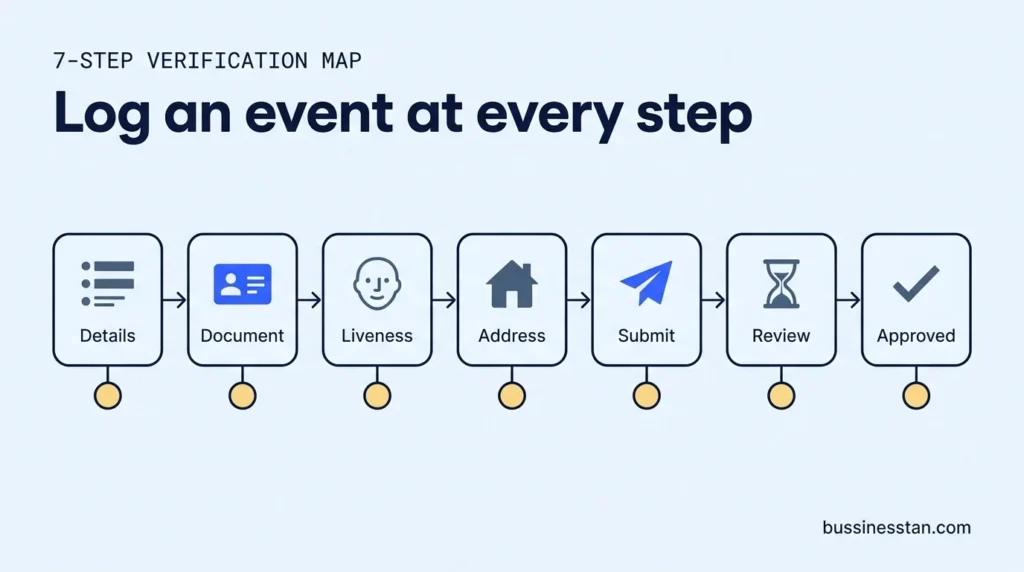
We map verification as 7 steps. Your provider and markets may merge or split some of them, so treat this as a map to check against your own flow, not a standard.
| Step | What the sender does | What commonly goes wrong | What growth can change safely | Event to log |
|---|---|---|---|---|
| 1. Personal details | Name, date of birth, address fields | Too many fields before the sender sees a rate | Ask only what this step needs; show the quote first | kyc_started |
| 2. Document capture | Photographs a passport, ID card or permit | Glare, blur, cropped edges on mid-range Android cameras | Capture guidance, auto-capture, clear retake prompt | kyc_document_submitted |
| 3. Selfie or liveness | Takes a selfie or completes a liveness check | Poor light, camera permission refused, unclear instructions | Explain why before asking; lighting tips; permission asked in context | kyc_liveness_passed |
| 4. Address check | Confirms or evidences an address | Wrong document type, name mismatch | Say which documents are accepted before the sender starts | kyc_address_submitted |
| 5. Submission | Confirms and submits | Unclear what happens next | State what happens next and roughly how updates arrive | kyc_submitted |
| 6. Review | Waits for automated or manual review | Silence; the sender assumes it failed | Status screen, notifications when status changes | kyc_review_entered |
| 7. Approval | Is approved, referred or declined | Generic "verification failed" messages | Specific, fixable reasons where policy allows | kyc_completed |
We call this the 7-step verification map. The final column matters most. If a step has no event, you cannot see its drop-off, and you will end up debating opinions instead of numbers.
Reading KYC drop-off: where the first transfers go
KYC drop-off is the share of senders who start verification and do not finish it. It is the most expensive leak in most remittance funnels, and it is usually reported in a way that hides it.
Why approval rate misleads
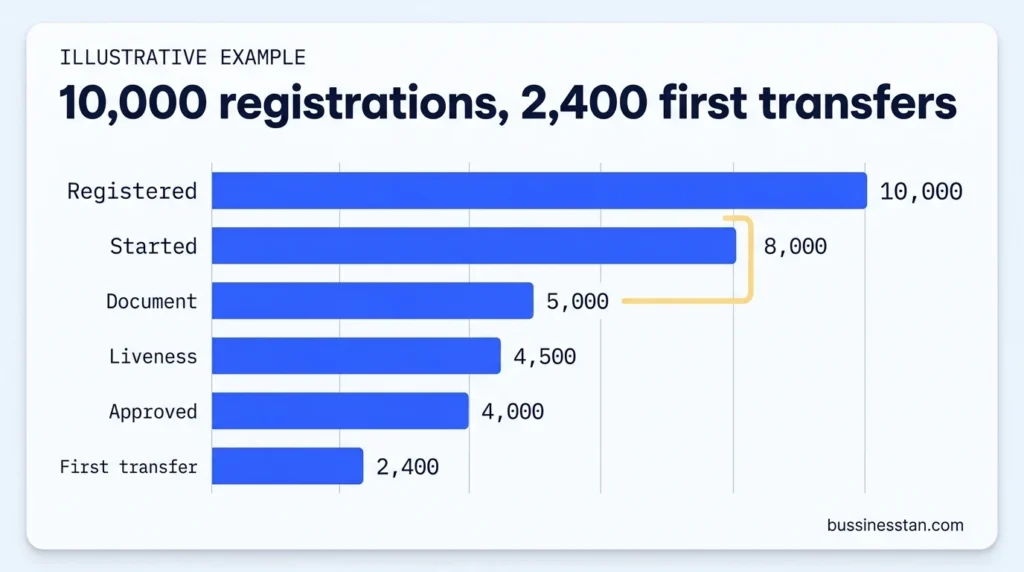
Approval rate counts approvals as a share of submissions. It says nothing about senders who opened the document screen, struggled with the camera and left. A high approval rate can sit on top of a poor completion rate.
In that example, the biggest single loss is between starting verification and submitting a document: 3,000 people. No approval report would show it.
3 splits that find the leak
- By corridor. Accepted documents and sender habits differ by send country and community.
- By device tier. Capture failures cluster on older and mid-range Android phones.
- By document type. Some documents photograph badly or fail more often.
Watch 10 real sessions of senders failing at the step with the biggest loss. It is the fastest way to see what the numbers mean.
Fixing each step without weakening controls
The rule is simple: no required check is removed or softened. Everything below changes the experience around a check, and every change should be agreed with compliance before it ships.
Control-safe fixes checklist
- Show the rate and fee before asking for identity documents.
- Ask for each piece of data at the step that needs it, not all at once.
- Tell senders which documents are accepted before the camera opens.
- Add a capture frame, glare warning and auto-capture where the provider supports it.
- Ask for camera permission at the moment it is needed, with one line on why.
- Replace "verification failed" with the specific, fixable reason where policy allows.
- Offer a retry path that keeps what the sender already entered.
- Show review status, and say how the sender will hear about a change.
- Send recovery messages to senders who stop mid-flow, with consent.
Error wording is often the quickest win. Compare these.
| Before | After |
|---|---|
| Verification failed. | The photo is blurred. Hold your document flat, in good light, and try again. |
| Document not accepted. | This document has expired. Please use a valid passport or national ID card. |
| Under review. | We are checking your details. We will notify you when this is done, and you do not need to resubmit. |
This is the work our signup and KYC funnel optimisation team does, and in apps it usually runs alongside an app conversion redesign that leaves the KYC steps themselves intact.
After approval: the gap before the first transfer
A verified sender who never sends is the most frustrating account in the business. They cleared every check. Something else stopped them: they were not ready to send yet, they forgot, or the next screen asked for too much.
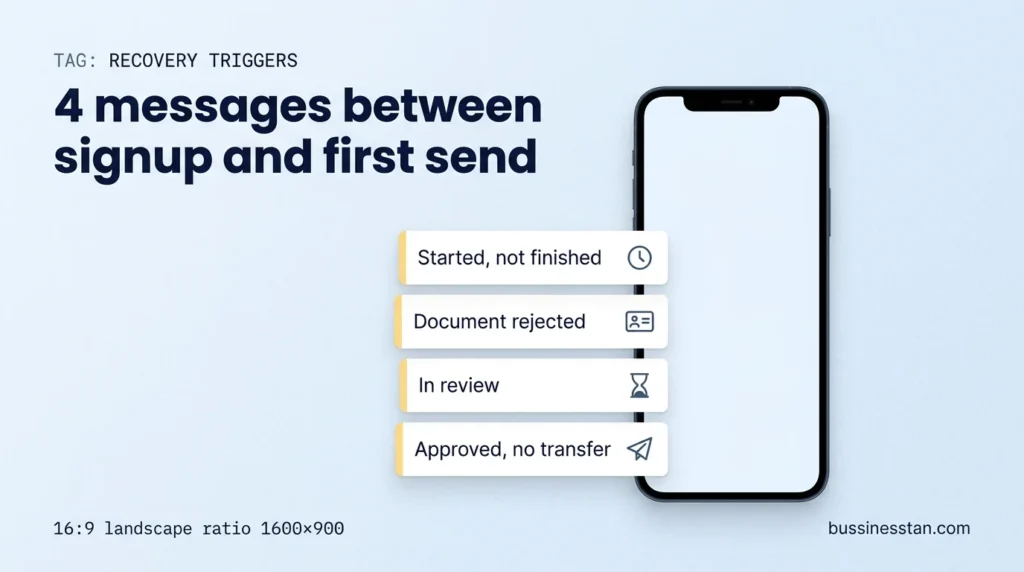
4 triggers cover most of this gap:
- Verification started, not finished. A reminder within hours that returns the sender to the exact step.
- Document rejected. A message with the reason and the retry link.
- In manual review. A status update, so the sender does not assume failure.
- Approved, no transfer. A prompt showing today's rate on the sender's corridor and how to add a beneficiary.
These run on platform events, not on a monthly calendar. Our SMS and email automation work builds them with consent rules and frequency caps set before launch. Transfer status messages must always match the system state.
Who should own the verification number
KYC completion stays unfixed when it belongs to everyone. A simple split works.
| Role | Owns |
|---|---|
| Growth | The verification completion target, the weekly report, recovery messages |
| Product | Screens, events, capture experience, release cycle |
| Compliance | The checks, the accepted documents, sign-off on every wording change |
| Support | Tagging verification contacts so their causes can be counted |
Growth should report verification completion by corridor next to cost per first send. That puts the leak in the same meeting as the budget, which is where it belongs. It also changes the order of work: fix the funnel before scaling spend, as we argue in our fintech marketing strategy for remittance companies.
Frequently asked questions
What is KYC onboarding?
KYC onboarding is the verification stage of signup, where a financial business confirms a new user's identity before they can use the service. In a remittance app it usually covers personal details, a document, a selfie or liveness check, an address check and a review. It sits between acquisition and the first transfer, so its completion rate directly affects cost per first send.
How long should the KYC onboarding process take?
It depends on the provider, the market and how many applications go to manual review. Rather than chasing a single benchmark, measure time to verification at the median and at the slow end, split by corridor. If a meaningful share of senders wait days in review without an update, the status communication needs work before anything else.
What is digital KYC onboarding?
Digital KYC onboarding is identity verification completed remotely in an app or on a website. The sender photographs a document, completes a selfie or liveness step if required, and submits for automated or manual review. For remittance apps it replaces the agent counter check, which makes screen design and camera guidance part of the conversion rate.
What causes KYC drop-off in remittance apps?
The most common causes are document capture failures on mid-range phones, unclear instructions before the camera opens, generic error messages, camera permission refused, and silence during manual review. Asking for too much before the sender sees a rate also raises drop-off. Splitting drop-off by corridor, device and document type usually points to the main cause quickly.
Can you improve KYC completion without weakening compliance?
Yes. Most gains come from the experience around the checks: guidance, clear accepted-document lists, specific error wording, retry paths, status updates and recovery messages. The checks themselves stay as compliance and the provider set them. Every wording or flow change should be agreed with compliance before release.
Where to start
The KYC onboarding process is where remittance apps quietly lose the senders they paid for. Log an event at every step, read drop-off by corridor, device and document, fix the experience around each check, and give the verification number a single owner.
Start with the KYC drop-off audit checklist. If you would rather have an outside team size the leak alongside your paid media and tracking, Book a Growth Audit: 2 weeks, a fixed fee, and a roadmap you keep either way.

Written by
Founder & CEO, Bussinesstan
Owns the commercial side of every engagement: fixed-fee scoping, corridor economics, and the reporting that ties spend to completed first transfers rather than to installs.
Meet the team
Cross border payments challenges: the five that stall remittance growth
Cross border payments challenges that stall remittance growth: verification, wasted spend, one-time senders, corridor risk and platform limits, with fixes.
Analytics event tracking for remittance apps: one name for every step
Analytics event tracking for remittance apps: an event map from install to repeat transfer, naming rules, MMP mapping and ledger reconciliation.
CRM for money transfer companies: design the data model first
CRM for money transfer companies, built on the data model: one record per sender, 9 lifecycle stages, B2B pipelines, consent rules and a 10-week rollout.