

Marketing 9 min read
Fintech marketing strategy for remittance companies: the 2026 playbook
A fintech marketing strategy for remittance companies built on first transfer, send frequency and corridor mix, with a channel map and 90-day plan.
On this page
Quick answer
A fintech marketing strategy is the plan a financial technology business uses to attract, activate and keep users, measured against the revenue event its model depends on. For remittance and money transfer companies, that event is the first completed transfer, followed by send frequency and corridor mix. The strategy is therefore planned corridor by corridor and measured past KYC, not on installs or signups.
Key takeaways
- A remittance business earns on first transfer, then send frequency, then corridor mix, so plans built for neobanks or lenders measure the wrong thing.
- The funnel runs from search to repeat send in 6 stages, and most of the money is lost between install and first transfer.
- Channels are chosen per corridor and sender community, not per country.
- Measurement comes before media: if you cannot produce cost per first send by corridor, more budget buys more noise.
- A sensible first 90 days fixes tracking and KYC screens before scaling anything.
Most founders I speak to have already been handed a fintech marketing strategy. It usually came from an agency that also serves a card company, a lender and a crypto exchange. Then the monthly report arrives full of installs, and the finance director asks why cost per install looks fine while the business is losing money.
The gap is structural. A neobank earns on balances and card spend. A lender earns on a loan book. A remittance business earns when a sender completes a first transfer, sends again next month, and does it on a corridor with a healthy margin. A playbook that ignores those 3 facts will optimise for the wrong event.
This guide defines fintech marketing, shows where remittance breaks the template, and ends with a 90-day sequence you can run.
What fintech marketing means, and where remittance breaks the template
What is fintech marketing?
Fintech marketing is the work of finding, converting and keeping users for a financial product delivered through software: an app, a web platform or an embedded service. It shares tools with other digital marketing, but it carries 2 extra weights: financial services ad policy, and a verification step (KYC) between interest and use.
The difference between fintech models is what happens after verification, which is why a generic plan transfers badly into remittance.
| Business model | Revenue event | Repeat pattern | Unit of planning | Where money leaks |
|---|---|---|---|---|
| Neobank | Card spend, balances, subscriptions | Daily or weekly use | Country and segment | Accounts opened but never funded |
| Lender | Loan drawn and repaid | One loan, then a gap | Credit band | Applications declined late |
| Investment app | Deposits and trading fees | Driven by markets | Age and wealth band | Funded once, then idle |
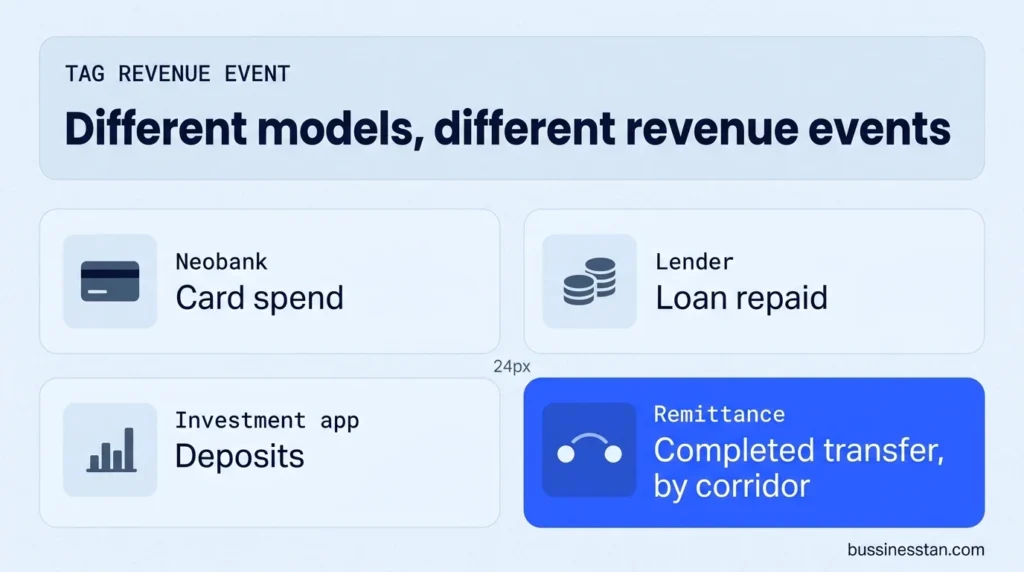
| Remittance app or MTO | Completed transfer (fee plus FX spread) | Driven by the sender's own cycle: payday, family needs, occasions | Corridor and diaspora community | Install to first transfer, then first send to second |
The last row is the whole argument. A sender in Birmingham paying school fees in Lagos behaves nothing like a sender in Dubai supporting a household in Kerala. Same app, same KYC screen, different corridor economics.
Why corridor is the unit, not country
A remittance business serves send country and receive country at once, with a different payout partner, FX spread and competitor set on each route. Budget, creative and reporting all belong to the corridor.
The 3 earnings levers behind a remittance marketing strategy
A remittance marketing strategy has 3 jobs, in this order.
- First transfer. Registered and verified accounts earn nothing. Revenue starts at the first completed transfer, so the acquisition target is cost per first send, not cost per install or cost per signup.
- Send frequency. One transfer rarely pays back acquisition. The second, fifth and twelfth do. Lifecycle messaging, rate communication and a two-tap repeat send matter more here than any new channel.
- Corridor mix. Corridors differ in FX spread, payout cost, transfer value and send frequency. Moving budget toward frequent, healthy-margin corridors beats a cheaper install.
That is why an even budget split across corridors is so expensive, and why send frequency deserves its own maths, set out in send frequency, not signups.
The 6-stage send funnel, from search to repeat send
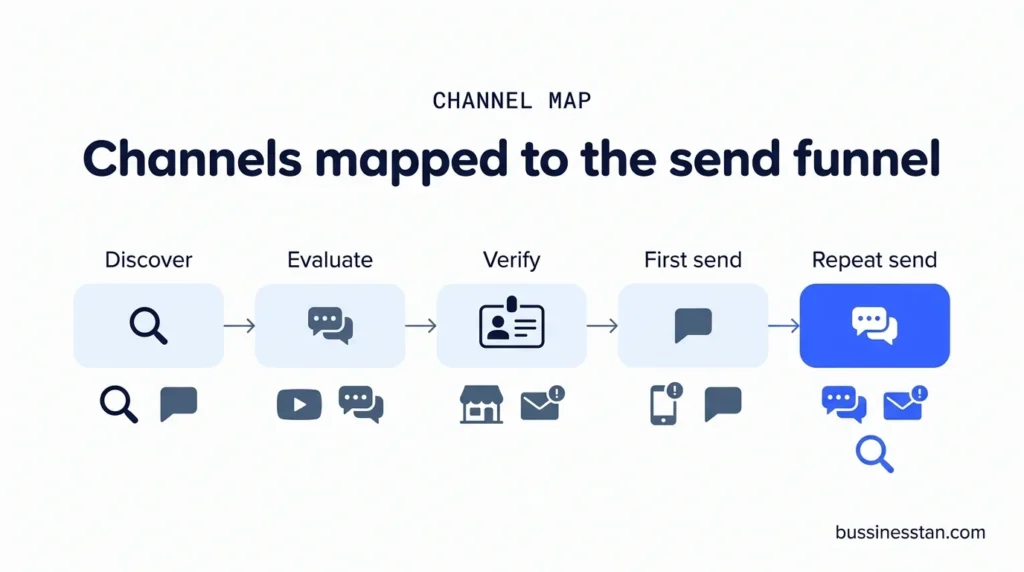
Draw every remittance marketing plan on one funnel. We use 6 stages because each has a different owner and a different leak.
| Stage | What the sender does | Metric to track | Usual owner | Common leak |
|---|---|---|---|---|
| 1. Discover | Searches a corridor, sees an ad, hears from a friend | Cost per visit or install by corridor | Marketing | Generic creative that ignores the corridor |
| 2. Evaluate | Checks the rate, fee, payout method and speed | Quote views per visit | Marketing and product | Rate calculator buried 3 clicks deep |
| 3. Register | Creates an account, confirms OTP | Registration completion | Product | Too many fields before any value is shown |
| 4. Verify | Document capture, liveness, address, review | KYC completion by corridor and device | Nobody, often | Glare, rejected documents, silent manual review |
| 5. First transfer | Adds a beneficiary, funds, sends | Verified to first transfer rate | Growth | Verified senders who never fund |
| 6. Repeat send | Sends again on their own cycle | Second transfer within 60 days | Retention | One monthly newsletter for everyone |
Stage 4 is where most paid money disappears, and it has the least clear owner. Product sees a compliance screen, compliance sees a control, and marketing never sees it, because ad platforms stop counting at install. Fixing the wording, error messages, retry paths and recovery messages around that screen, without removing a single required check, is the work our signup and KYC funnel optimisation team does.
Licensing and AML questions go to a qualified adviser. We handle advertising and marketing compliance.
Money transfer marketing channels, mapped by corridor
Money transfer marketing uses the same channels as other consumer finance. The difference is the job each channel does, and the corridor it does it on.
| Channel | Job in the funnel | Works best when | Measure it on |
|---|---|---|---|
| Google search | Capture existing corridor demand | Senders already search "send money to [country]" | Cost per first send by corridor |
| Corridor pages (SEO) | Own that demand without paying per click | You serve the corridor for years | Organic first transfers per corridor page |
| Meta (Facebook, Instagram) | Reach diaspora communities by city | The community is dense and active there | Cost per verified sender, via server-side events |
| TikTok and creators | Build trust with first-time senders | A creator from the sending community explains the product | Cost per first send per concept |
| WhatsApp and community groups | Word of mouth and support | The corridor runs on group chats | Assisted first sends, opt-in rate |
| Agent counter and local out of home | Convert walk-in senders to the app | You run an agent network in diaspora districts | App activations by location |
| Email, SMS and push | Recover KYC abandoners, drive the second send | Events from your platform can trigger messages | KYC recovery, second transfer rate |
| AI answer engines | Be named when a sender asks an assistant | Your corridor facts are clear and consistent | Citations checked on a fixed prompt set |
2 rules keep this table honest. Pick channels per corridor: a Gulf to South Asia route and a UK to Nigeria route rarely share the same best channel. And run paid and organic from one brief. Our paid growth services and remittance marketing services are briefed together for that reason.
Financial services ad verification sits in front of every paid channel. Plan for it before launch.
Measurement before media: the fintech marketing strategy checklist
A plan is only as good as the events underneath it. Platforms learn from the event you send them. Send installs and they find people who install. Send first transfers and they look for senders.
We call this the Measurement Before Media checklist. Run it before any budget increase.
- One event name per funnel step, identical across web, app, analytics and MMP.
- Post-KYC events (KYC completed, first transfer) sent to every ad platform, server-side where possible.
- SKAdNetwork conversion values designed around verification and first transfer, not app opens.
- Campaigns split by corridor, so cost per first send can be read per corridor.
- Platform-claimed conversions reconciled monthly against your own transfer records, with the gap stated.
- Verified to first transfer rate reported alongside KYC completion.
- Second transfer within 60 days tracked by acquisition cohort.
- One owner named for the verification number.
If 3 or more boxes are empty, the next pound belongs to tracking, not media. We argue against more spend until the funnel holds, which makes month one look slower than a rival agency's plan. The reasoning behind that is in your cost per install is lying to you.
A 90-day sequence for a remittance marketing plan
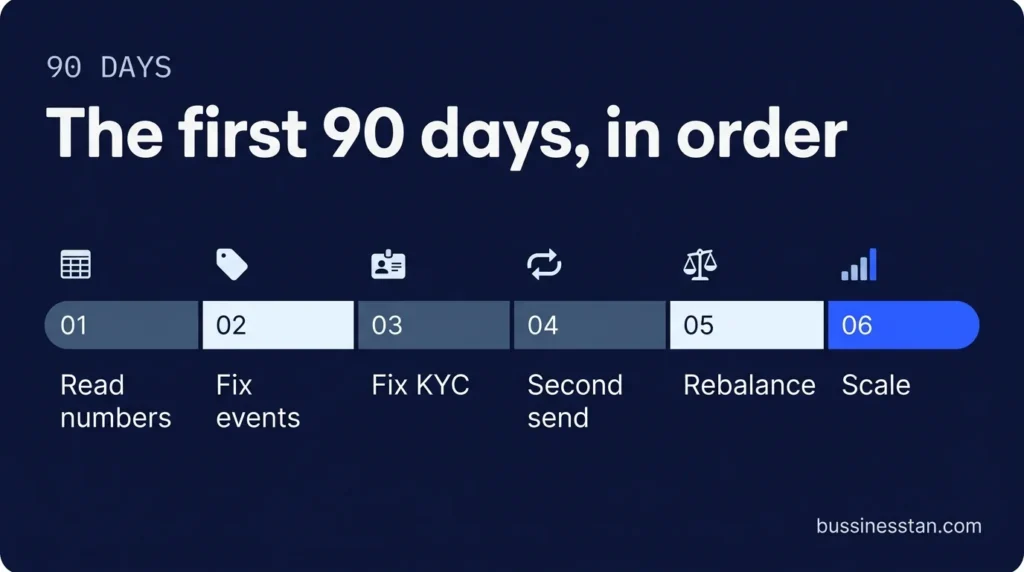
The order matters more than the budget. This is the sequence I would run for an app with at least 1 live corridor.
- Days 1 to 14: read the numbers. Pull 90 days of transfer records. Calculate cost per first send, verified to first transfer rate and second-send rate by corridor.
- Days 15 to 30: fix the events. Name every funnel step once. Pass post-KYC events to each platform. Rebuild SKAdNetwork values around first transfer.
- Days 31 to 45: fix the KYC screens. Watch 10 real sessions on a mid-range Android phone. Rewrite rejection messages, add retry paths and switch on recovery messages for abandoners.
- Days 46 to 60: build the second send. Trigger a message when a first transfer completes, and again when a sender passes their usual interval. Tell senders when the rate on their corridor moves.
- Days 61 to 75: rebalance by corridor. Move budget toward corridors with the best margin per sender, not the cheapest install.
- Days 76 to 90: scale what holds. Raise spend only where cost per first send stayed stable for 4 weeks of clean data. Decide what to stop.
Frequently asked questions
What is fintech marketing?
Fintech marketing is the acquisition, activation and retention of users for software-led financial products, such as payment apps, digital banks and remittance platforms. It differs from general digital marketing in 2 ways: financial services ad policy limits what can be claimed, and a verification step sits between interest and first use. It should be measured on the model's revenue event, not on installs.
How is a remittance marketing strategy different from general fintech marketing?
A remittance marketing strategy plans by corridor and measures on first transfer, send frequency and corridor margin. General fintech marketing plans by country or segment and often stops measuring at signup. Remittance senders also send on their own cycle, tied to paydays, family needs and occasions, so lifecycle timing matters more than in most financial products.
Which channels work best for money transfer marketing?
It depends on the corridor. Search captures senders who already know they need to send. Social and creators reach diaspora communities city by city. WhatsApp groups and agent counters matter where word of mouth rules. Email, SMS and push drive the second transfer. Run 2 or 3 channels per corridor properly before adding more.
How much should a remittance company spend on marketing?
There is no honest universal figure. Start with enough to run 1 corridor properly rather than several thinly, once tracking can report cost per first send. Increase spend only where cost per first send and second-send rate hold steady. Until you can read those numbers, the next budget belongs to measurement.
What should a fintech marketing strategy report every month?
For a remittance business, one page is enough: first transfers by corridor, cost per first send, KYC completion, verified to first transfer rate, second-send rate by cohort, and the gap between platform-claimed conversions and your own transfer records. Impressions, clicks and cost per install can sit in an appendix.
Where to start
A fintech marketing strategy for a remittance company comes down to 3 numbers: first transfers, send frequency and corridor margin. Map your funnel on the 6 stages, choose channels corridor by corridor, and put measurement before media. Most operators find their biggest gain sits between install and first transfer, not in a new channel.
If you want an outside read first, Book a Growth Audit. It takes 2 weeks for a fixed fee, covers paid media, tracking, conversion and corridor economics, and you keep the roadmap whether or not we work together.

Written by
Founder & CEO, Bussinesstan
Owns the commercial side of every engagement: fixed-fee scoping, corridor economics, and the reporting that ties spend to completed first transfers rather than to installs.
Meet the team
UGC for financial services: creator marketing for money transfer brands without compliance risk
UGC for financial services, done safely: diaspora creators, 6 restricted claim areas, disclosure by market and a brief compliance can sign off.
Activation emails for remittance apps: a sequence for senders who verified and never sent
Activation emails for remittance apps: a 6-message trigger sequence, subject line patterns, channel rules and measurement on funded first transfers.
Fintech customer retention for remittance apps: earning the second transfer
Fintech customer retention for remittance apps: lifecycle stages, 3 retention levers, corridor-based dormancy and reactivation without discount habits.