

Marketing 9 min read
Activation emails for remittance apps: a sequence for senders who verified and never sent
Activation emails for remittance apps: a 6-message trigger sequence, subject line patterns, channel rules and measurement on funded first transfers.
On this page
Quick answer
Activation emails for remittance apps are automated messages sent to people who have registered or passed verification but not yet funded a first transfer. They are triggered by what the sender has done, such as verifying, creating a quote, adding a beneficiary or having a payment fail, and they are judged on funded first transfers rather than opens or clicks.
Key takeaways
- Verified senders who never send are the cheapest cohort to recover, because acquisition and verification costs are already spent.
- A 6-message sequence tied to 4 system triggers does more work than a calendar of generic reminders.
- Subject lines work best when they name the corridor, the beneficiary or the next step, and never promise a rate that may change.
- Pick one channel per message, cap marketing frequency across channels, and let transfer updates always go through.
- Measure each message on funded first transfers against a holdout, not on open rates.
Verified accounts sit there and never fund a transfer. You paid to acquire them, your KYC provider charged for the check, and some went through manual review. Then nothing. In many remittance apps nobody owns this cohort, and it only surfaces when someone asks why registrations and first transfers moved in different directions.
Activation emails for remittance apps are the cheapest route back to these senders. Not a newsletter, not a monthly blast: a short sequence that reacts to what each sender has done and removes the specific thing stopping the first transfer.
This guide sets out the sequence we build, the triggers behind it, the subject line patterns, channel rules, what never to put in a message, and how to measure it on money.
Why the verified-never-sent cohort deserves its own sequence
A verified sender has cleared the hardest step in the funnel. Document capture, liveness and any manual review are done. What is left is usually one of a short list of blockers:
- They were checking the rate and it was not good enough that day.
- They did not know what details they needed for the beneficiary.
- Their payment method failed and nobody told them why.
- They were not sure how long the money would take or how it would be collected.
- They verified for a future need, such as school fees or an occasion.
Each blocker needs a different message. A generic "Complete your first transfer" email answers none of them. If your drop-off is earlier, at the KYC screen itself, the fix sits in the funnel, which our KYC drop-off audit covers.
Activation emails for remittance apps: the 6-message sequence
We call this the 6-message activation sequence. Each message has a trigger, a job and an exit rule: the moment a sender funds a transfer, they leave the sequence and move to second-transfer messaging.
| # | Trigger | Timing | Job | Default channel |
|---|---|---|---|---|
| 1 | Verified | Within minutes | Confirm they are ready to send; show the 3 steps to a first transfer | Email and push |
| 2 | Verified, no quote | Day 1 | Show how to check the rate and fee for their corridor | |
| 3 | Quote created, not funded | A few hours after the quote | Explain rate validity and what the total cost includes | Push or email |
| 4 | Beneficiary added, not funded | Day 1 after adding | Confirm what the beneficiary needs to collect or receive | |
| 5 | Payment failed | Immediately | Say what failed and what to try next, with a support route | SMS or push, plus email |
| 6 | Verified, no transfer | Day 7 to 10 | Answer the top questions: speed, safety, pickup, limits |
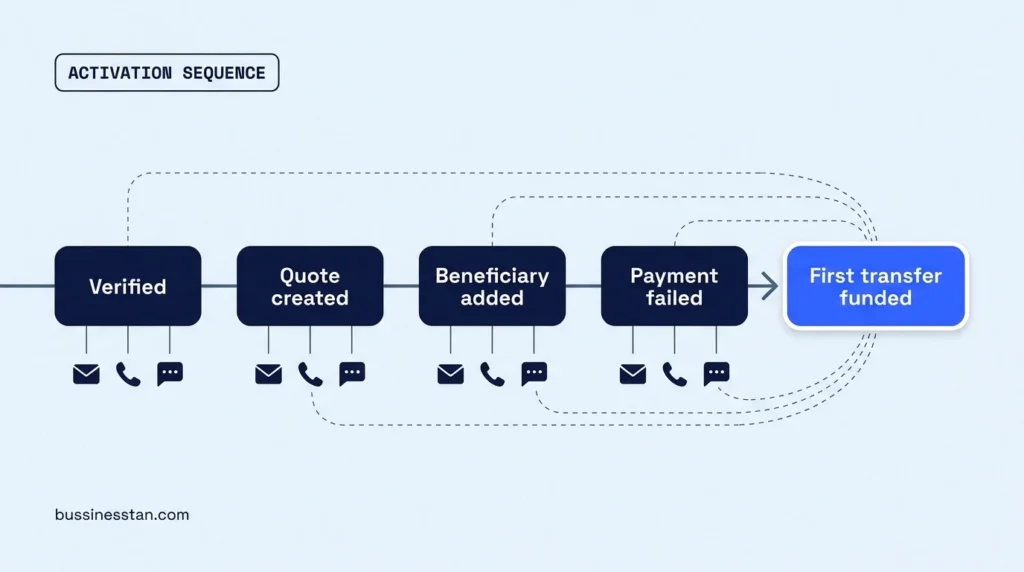
Message 5 is a service message as much as a marketing one. It should fire whatever the sender's marketing preferences, and it should read like a status update, not a promotion. Check with your advisers where the line sits in each market.
How to build it, step by step
- List the states your platform records. Registered, verified, quote created, beneficiary added, payment attempted, payment failed, transfer funded.
- Confirm each state reaches your messaging tool as an event with the corridor, payout method and language attached.
- Write one message per trigger with a single call to action.
- Set exit rules so anyone who funds a transfer leaves immediately.
- Set frequency caps across email, SMS, push and WhatsApp.
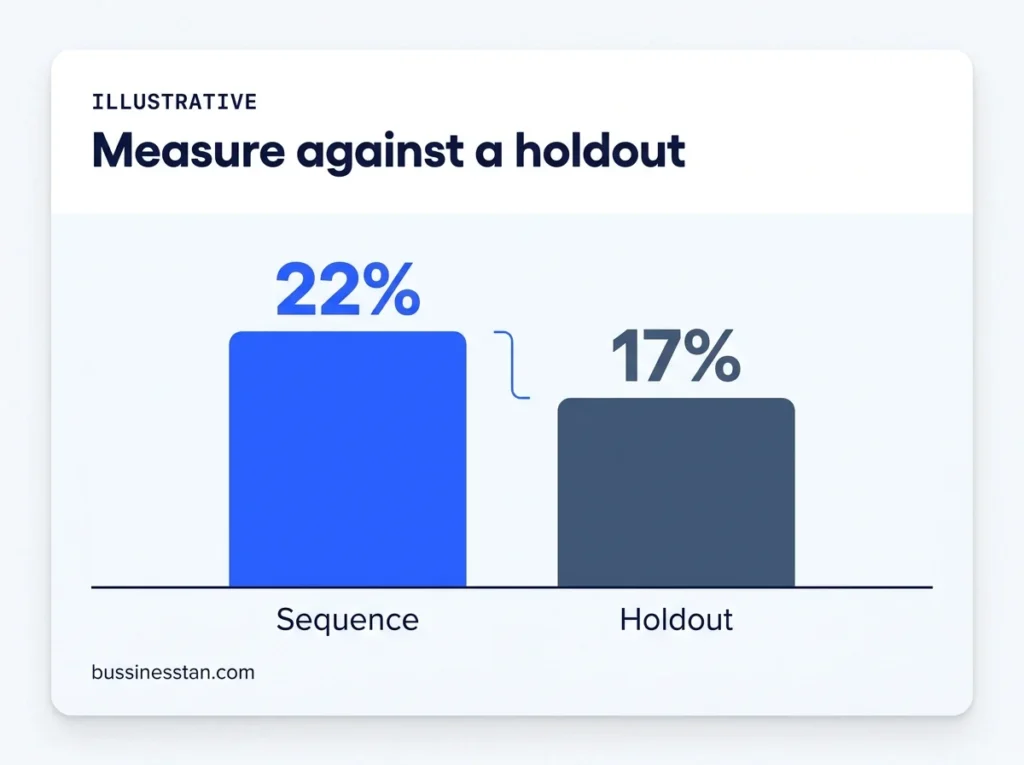
- Launch with a holdout of a small random share of verified senders who get no activation messages.
If your events are not reliable, fix that first. A trigger that fires late or twice does more harm than no trigger at all.
Subject lines and corridor personalisation
A first transaction email that says "Complete your first transfer" competes with every other app in the inbox. Subject lines that name something specific to the sender tend to do better, and they are easy to test.
| Pattern | Example | Use for |
|---|---|---|
| Next step | "Your account is ready: 3 steps to send to Ghana" | Message 1 |
| Corridor and payout | "Sending to a mobile wallet in Kenya: what you need" | Messages 2 and 4 |
| Beneficiary | "Amina's details are saved. Ready when you are" | Message 4 |
| Status | "Your payment did not go through. Here is what to try" | Message 5 |
| Question answered | "How long does cash pickup in Lahore take?" | Message 6 |
Avoid subject lines that promise a rate ("Best rate today only") unless the rate is pulled live and the claim is approved. Rates move, and a subject line cannot be updated after it lands.
Onboarding email sequence fintech teams can personalise without overreach
The fields that earn their place are corridor, payout method, currency, language and beneficiary first name where the sender entered it. Leave out anything that feels like surveillance, such as account balances or document details. The sequence should feel informed, not watched.
Choosing email, SMS or WhatsApp
Email carries explanation. SMS carries urgency. WhatsApp carries conversation, where the sender has opted in.
| Channel | Best for | Watch out for |
|---|---|---|
| Steps, guidance, corridor detail | Slow to be seen; not every agent-led sender has an address | |
| SMS | Payment failed, time-sensitive status | Character limits, cost per message, no sensitive details |
| Push | Quote reminders, app-based next steps | Only works if notifications are enabled |
| Questions and replies, where opted in | Template approval, opt-in rules, per-market policies |
Give each message one channel by default and a fallback only when the first is unavailable. Cap marketing messages across all channels combined, for example no more than a set number per week per sender, and let transfer updates always go through. For the WhatsApp side, see our WhatsApp Business API guide for money transfer operators.
What never to put in an activation message
Senders in this category are frequent targets for scams, so your messages have to look unlike a phishing attempt.
- No requests for passwords, one-time codes or card details, ever, in any channel.
- No document requests by reply or attachment. Send people into the app.
- No full transfer amounts or account details in SMS.
- No link shorteners that hide the destination domain.
- No rate or fee promises that may not hold when the sender opens the app.
- No urgency tricks such as fake countdowns.
Consent rules also apply. In the UK, the ICO's guidance on PECR says marketing emails and texts sent under the soft opt-in, to people who have bought or discussed buying a similar service, need a clear chance to opt out when details were collected and in every message. Other markets have different rules. Licensing and AML questions go to a qualified adviser. We handle advertising and marketing compliance.
Measuring lifecycle email on funded first transfers
Opens and clicks are diagnostics. The report that matters shows funded first transfers.
- Verified-to-first-transfer rate within 7, 14 and 30 days, by corridor.
- Funded first transfers per message, attributed within a fixed window.
- Lift against the holdout, which tells you what the sequence caused rather than what would have happened anyway.
- Time to first transfer for senders who received the sequence versus the holdout.
- Unsubscribes and complaints per message, as a guardrail.
Once a sender has funded a first transfer, the job changes to the second. That is covered in earning the second transfer, and the arithmetic sits in send frequency, not signups.
This is the work our email marketing team does for remittance operators, with the triggers wired through SMS and email automation and the later stages handled by retention and reactivation. Most operators need one activation sequence before they need a newsletter.
Frequently asked questions
What should email marketing for remittance companies focus on first?
Activation. Verified senders who have not funded a transfer are the cheapest cohort to recover, because acquisition and verification are already paid for. Build a short trigger-based sequence for them before a newsletter or promotional calendar, measure it on funded first transfers against a holdout, then move on to second transfer and reactivation messages.
What goes in a first transaction email?
Confirmation that the account is ready, the 3 steps to send, how to check the rate and total cost for the sender's corridor, and what the beneficiary needs to receive or collect the money. Keep one call to action that opens the app. Leave out rate promises, requests for personal data and anything that could be mistaken for phishing.
How many emails should an onboarding email sequence in fintech include?
For remittance activation, 5 to 7 messages over roughly 10 days is a practical range, with most of them triggered by behaviour rather than sent on a fixed schedule. Every sender should exit the moment they fund a transfer. Beyond that, frequency caps across all channels matter more than the exact number of emails.
Should activation messages go by email, SMS or WhatsApp?
Use email for explanation, SMS or push for time-sensitive status such as a failed payment, and WhatsApp for conversation where the sender has opted in. Give each message one default channel, add a fallback only when that channel is unavailable, and cap marketing frequency across all channels combined so senders are not contacted 3 ways about the same thing.
How do you measure lifecycle email in a remittance app?
Measure funded first transfers, not opens. Keep a random holdout that receives no activation messages, compare verified-to-first-transfer rates between the 2 groups by corridor, and attribute transfers to messages within a fixed window. Track unsubscribes and complaints as guardrails. Opens and clicks help diagnose a weak message but should not be the headline number.
Where to start
Start by counting verified senders who have not funded a transfer, by corridor and by how long ago they verified. Then check whether your platform can send the 4 triggers: verified, quote created, beneficiary added and payment failed. If it can, messages 1, 3 and 5 are the place to begin.
To go further, our email marketing service builds and runs the sequence in your platform. If you want the quiet-accounts number sized alongside tracking and spend, Book a Growth Audit. It takes 2 weeks for a fixed fee, and you keep the roadmap whether or not we work together.

Written by
Founder & CEO, Bussinesstan
Owns the commercial side of every engagement: fixed-fee scoping, corridor economics, and the reporting that ties spend to completed first transfers rather than to installs.
Meet the team
UGC for financial services: creator marketing for money transfer brands without compliance risk
UGC for financial services, done safely: diaspora creators, 6 restricted claim areas, disclosure by market and a brief compliance can sign off.
Fintech customer retention for remittance apps: earning the second transfer
Fintech customer retention for remittance apps: lifecycle stages, 3 retention levers, corridor-based dormancy and reactivation without discount habits.
Fintech marketing strategy for remittance companies: the 2026 playbook
A fintech marketing strategy for remittance companies built on first transfer, send frequency and corridor mix, with a channel map and 90-day plan.