

Paid Growth 10 min read
Meta ads for remittance apps: optimise for the first transfer, not the install
Meta ads for remittance apps that optimise for first transfers: Conversions API, event ranking, diaspora targeting and retargeting for KYC abandoners.
On this page
Quick answer
Meta ads for remittance apps perform best when the account is optimised toward verified senders and funded first transfers rather than installs. That requires the pixel, app SDK and Conversions API sending deduplicated post-KYC and first transfer events, prospecting split by corridor and sending community, retargeting for senders who abandoned verification, regular creative refresh, and compliance with any special ad category rules that apply.
Key takeaways
- Meta finds more of whatever event you optimise for, so an install goal buys installs that never verify.
- Send KYC approval and first transfer from your server through the Conversions API, deduplicated against the pixel and SDK.
- Rank first transfer at the top of your event list and use a post-KYC event where volume is thin.
- Split prospecting by corridor and sending community, and let creative carry more of the targeting.
- Check special ad category and financial services rules for every market before you build audiences.
"Meta optimises for installs that never verify." It is a common complaint from heads of growth running paid social for a money transfer app. Cost per install is low and stable. The verification queue fills with applicants who stop at document capture. First transfers do not follow.
Meta is doing exactly what it was asked. The account was set up to buy installs, and the algorithm has become very good at finding people who install. Meta ads for remittance apps need a different instruction, and the plumbing to deliver it.
This guide covers the 5 layers we set up before budget scales: ownership, signals, event ranking, audiences and creative.
Why Meta ads for remittance apps drift toward installs
The drift has 3 causes, and all of them are set-up choices.
- The optimisation event is too early. Install or registration campaigns train delivery on people who complete those steps, not people who fund.
- Money events never reach Meta. Verification and first transfers happen on your backend. If only the app SDK and pixel report, Meta never sees who became a sender.
- Every corridor shares one audience. A campaign serving UK to Nigeria and UK to India together lets the algorithm spend where installs are cheapest, regardless of corridor margin.
Facebook ads for money transfer used to be judged on reach and cost per install. The operators who get paid social to pay back judge it on cost per first transfer by corridor, reconciled against their own records.
Signals: pixel, SDK and the Conversions API
Meta receives events from 3 places: the pixel on your website, the SDK or MMP in your app, and the Conversions API from your server. For a remittance app, the server is the only reliable source for the events that matter.
| Event | Best source | Why |
|---|---|---|
| Page view, landing | Pixel | Browser event, no money involved |
| Install | App SDK or MMP | Attribution needs the device |
| Registration | Server, with pixel or SDK copy | Deduplicated by shared event ID |
| KYC approved | Server via Conversions API | Only your backend knows the outcome |
| First transfer completed | Server via Conversions API | Fires when the payout is confirmed, not when a screen loads |
| Repeat transfer | Server via Conversions API | Value signal for later |
What should Meta Conversions API fintech set-ups send?
Send the event, a shared event ID for deduplication, the consent state, and the hashed identifiers your privacy notice and consent allow. Add corridor and payout method as custom parameters. Do not send document data, balances or exact transfer amounts. Where value optimisation needs a figure, send a modelled value band agreed with your data protection owner.
Browser and server copies of the same event must carry the same event ID, or Meta counts one registration twice and reports a conversion rate your ledger will not recognise. Our Meta business account and tracking setup work puts the assets in your name, wires the Conversions API and proves deduplication before launch.
App event optimisation: rank the first transfer at the top
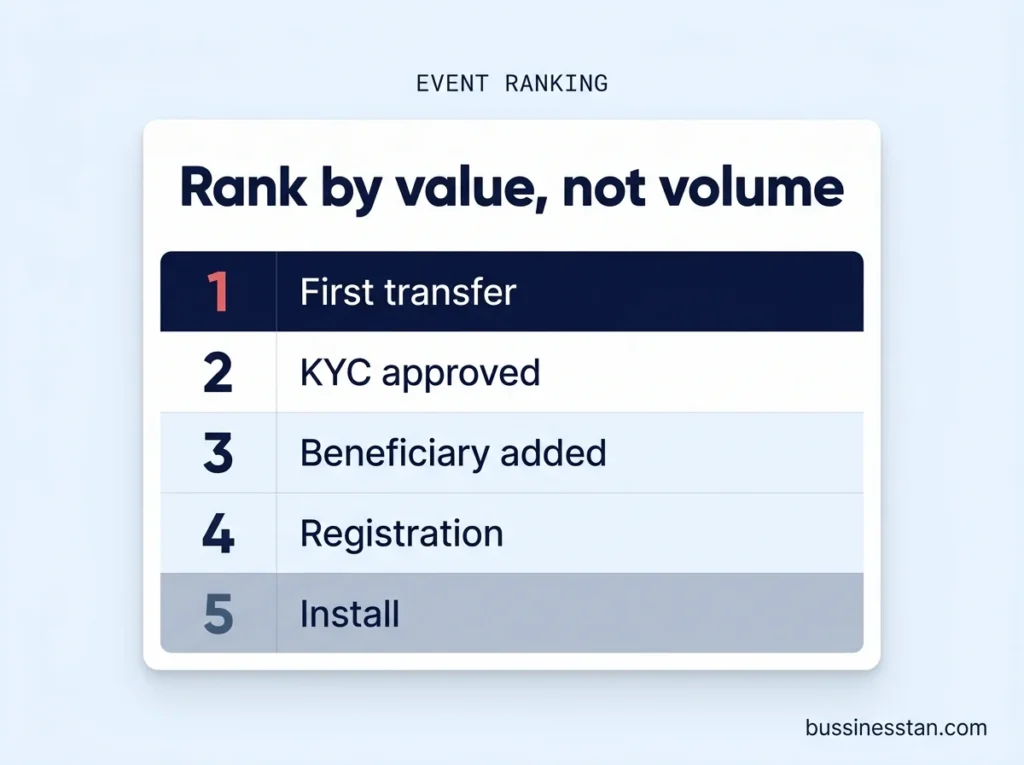
App event optimisation means telling Meta which in-app event a campaign should find more of. For a remittance app, that ranking should follow value, not frequency.
| Rank | Event | Role |
|---|---|---|
| 1 | First transfer completed | Primary goal once weekly volume per corridor allows |
| 2 | KYC approved | Primary goal for low-volume corridors |
| 3 | Beneficiary added | Diagnostic, strong intent signal |
| 4 | Registration completed | Secondary, observation only |
| 5 | Install | Reporting only |
Keep this ranking written down and apply it wherever the platform asks you to choose or order conversion events. The exact controls change over time, so check Events Manager for the current options in your account.
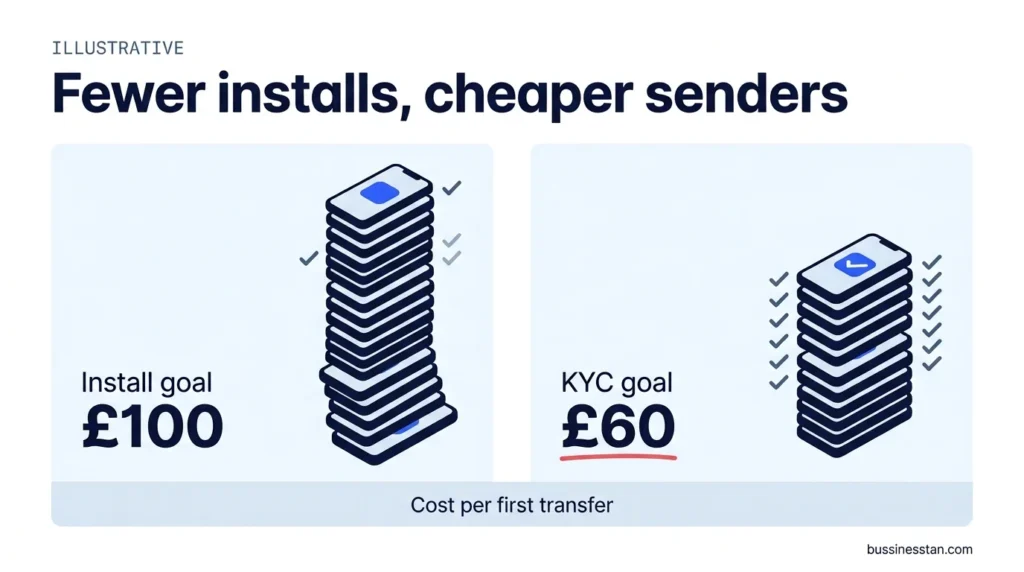
The trade-off is volume. An event deep in the funnel may fire too rarely in a small corridor for delivery to learn. Start with KYC approved, move to first transfer when the corridor produces enough, and expect cost per install to rise when you do. That rise is the point. Our guide to analytics event tracking for remittance apps sets out the event names to use.
Diaspora targeting by corridor and sending community
Diaspora targeting means reaching people in a send country who have ties to a receive country, and who are likely to send money there. On Meta, how you do it depends on the rules that apply to your ads.
According to Meta's advertising standards, advertisers in or targeting the United States, Canada or certain parts of Europe who run financial products and services ads must declare a special ad category and use only approved targeting options. Where that applies, the targeting options narrow, so creative, language and placement have to carry more of the targeting.
A structure that works under either set of rules:
- One campaign per corridor, so budget and reporting follow margin.
- Broad or approved audiences inside the send country, with location at city level where diaspora communities concentrate, such as London, Birmingham, Houston or Toronto, and where the rules permit it.
- Creative that self-selects the sender: the receive country's currency, payout method, language and sending occasions such as Eid, school fees or paydays. Our diaspora sending calendar maps those occasions.
- Lookalikes from verified senders, not from installers, where lookalikes are permitted.
This is the prospecting work our Meta Ads team runs, with corridors kept apart from day one.
Retargeting verification abandoners and refreshing creative
Retargeting in a remittance app is mostly recovery. The highest-value audiences sit inside your own funnel.
Which retargeting audiences matter most?
- KYC started, not approved, within the last 14 days. The message is reassurance: which documents, how long it takes, where to get help.
- Approved, not funded. The message is the rate, the fee and the payout method for their corridor.
- First transfer, no second within 30 days. Hand this to email, push and WhatsApp first, because lifecycle channels move send frequency at lower cost than paid social.
Build these audiences from server events, within consent and privacy requirements and platform capabilities. Exclude approved and funded senders from prospecting.
How often should creative be refreshed?
Every few weeks for prospecting, sooner when frequency climbs and click-through falls. Change one variable at a time: hook, sender story, rate message or format. Diaspora creators from the sending community usually outlast studio work, provided every claim about speed, fees or rates is checked before it runs.
Special ad category and financial services rules
Meta's advertising standards say advertisers may need to verify their business identity and show authorisation from the relevant regulator where the law requires it. Requirements differ by market and change over time. Check the current rules for every send market before you write creative or build audiences, because a rejected account after 2 weeks of production is an expensive way to find out.
Prepare the verification pack, landing pages and disclosures first. Our article on financial services ad verification sets out the order of work. Approval stays with Meta, and nobody can promise a date.
Licensing and AML questions go to a qualified adviser. We handle advertising and marketing compliance.
Frequently asked questions
Do Facebook ads for money transfer still work?
Yes, when they are judged on cost per first transfer rather than cost per install. Facebook and Instagram reach diaspora senders at scale, and video from the sending community performs well. They work poorly when the account optimises toward installs, mixes corridors, or cannot see which installs became senders.
What does Meta Conversions API fintech tracking need?
A server integration that sends registration, KYC approval and first transfer events with a shared event ID, consent state and permitted hashed identifiers. It needs deduplication against the pixel and SDK, and a rule that document data and exact balances never leave your systems. Most teams implement it through their backend or a server-side tag manager.
How does diaspora targeting work under a special ad category?
Where a special ad category applies, targeting is limited to the options Meta approves for that category. Targeting then relies more on location where permitted, broad audiences and creative that speaks to one sending community through currency, language, payout method and occasions. The creative does the sorting that interests used to do.
Which event should app event optimisation use?
The deepest event that fires often enough per corridor for delivery to learn. For most remittance apps that is KYC approved at first, then first transfer completed once volume allows. Install and registration goals are cheaper per event but usually produce more expensive first transfers.
How long before a Meta account shows reliable cost per first transfer?
Allow about 2 weeks to fix tracking and build the account, then a full month of spend before reading cost per first transfer by corridor. Changing the optimisation event resets learning, so avoid switching goals mid-test. Reconcile against your ledger rather than relying on the platform column alone.
Where to start
Put the assets in your name, send money events from the server, rank the first transfer at the top, split corridors, recover verification abandoners, and check the rules before you build. Budget comes after.
Most operators should fix the verification screen before adding Meta budget, and that costs less. For the full cost picture, read why blended CAC misleads, and see how our app install and user acquisition team reports on verified senders. When you want to know where your paid social spend leaks, Book a Growth Audit: 2 weeks, a fixed fee, and a roadmap you keep.

Written by
Founder & CEO, Bussinesstan
Owns the commercial side of every engagement: fixed-fee scoping, corridor economics, and the reporting that ties spend to completed first transfers rather than to installs.
Meet the team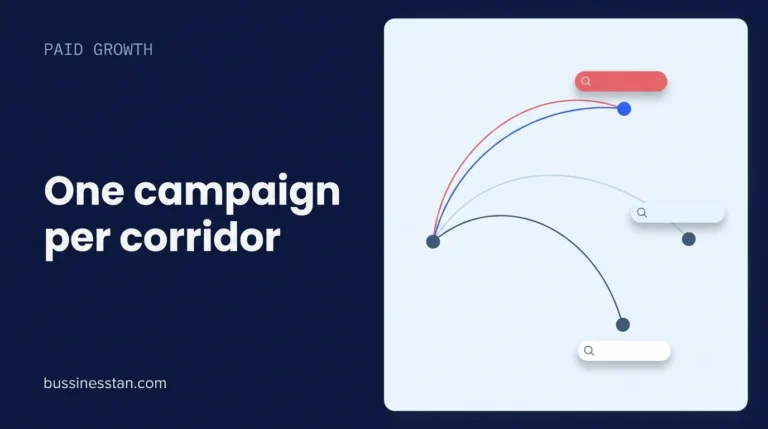
Google Ads for money transfer companies: structure the account by corridor
Google Ads for money transfer companies, structured by corridor: brand defence, intent groups, post-KYC imports and a sample account you can copy.
Fintech customer acquisition cost for remittance apps: why blended CAC misleads
Fintech customer acquisition cost for remittance apps: measure cost per first transfer, split blended CAC by corridor and calculate CAC payback properly.
CRM for money transfer companies: design the data model first
CRM for money transfer companies, built on the data model: one record per sender, 9 lifecycle stages, B2B pipelines, consent rules and a 10-week rollout.