

Marketing 9 min read
Remittance seasonality: the diaspora sending calendar for Q4 and Ramadan 2027
Remittance seasonality explained: a diaspora sending calendar for Diwali, Christmas, school fees, paydays and Ramadan 2027, with lead times and channels.

On this page
Quick answer
Remittance seasonality is the recurring rise and fall in transfer activity tied to diaspora occasions and money cycles: festivals such as Diwali, Christmas, Ramadan and Eid, school-fee periods and monthly paydays. Many senders decide on these transfers before the occasion itself, so campaigns need to reach them early. The pattern differs by corridor, so each operator should read it from its own transfer records.
Key takeaways
- Seasonality is corridor-specific, so read it from your own weekly transfer data before planning any campaign.
- The decision to send often comes weeks before the send, which is why campaigns timed to the occasion itself arrive late.
- Diwali falls on 8 November 2026, and Ramadan 2027 is expected to begin around 8 February, subject to moon sighting.
- A T-minus plan, working back from each occasion, keeps creative, verification, paid, lifecycle and support in step.
- The best seasonal result is not the peak week; it is how many seasonal senders send again afterwards.
"Our campaigns land after the send has already happened." A marketing manager at an agent-led operator put it to me that way, and it describes remittance seasonality better than most definitions. The diaspora calendar is predictable. The mistake is planning around the day of the occasion, when many senders decided days or weeks earlier.
This guide sets out the sending calendar from October 2026 to May 2027 across UK, US and Gulf send markets. For each occasion it gives a lead time, a message, channels and example corridors. It deliberately contains no market volume figures. Your own records will tell you more about your corridors than any industry average.
What remittance seasonality is, and why campaigns land late
Seasonality in remittance comes from 3 sources: occasions (religious and cultural festivals), obligations (school fees, rent, family events) and cycles (paydays and salary dates in the send country).
Each has 2 moments that matter:
- The decision moment, when the sender plans how much to send and which provider to use.
- The send moment, when the transfer happens.
Campaigns that aim at the send moment reach senders who have already chosen. Campaigns that aim at the decision moment can still change the choice.
When is remittance peak season?
It depends on the corridor. On many routes, several occasions stack up in Q4, which is why operators often call it their remittance peak season. On corridors to Muslim-majority receive countries, Ramadan and the 2 Eids can matter as much or more. Pull your own data before accepting either assumption.
Read your own seasonality first
Before the calendar, a 4-step method. It takes an analyst about a day if transfer records are clean.
- Pull 24 months of completed transfers by corridor, by week.
- Index each week against that corridor's average week (average = 100).
- Mark the occasions, remembering that lunar festivals move by roughly 10 to 11 days each year in the Gregorian calendar.
- Look before the peak. Check when registrations, rate checks and quote views start rising. That is the decision window.
Also split new senders from existing ones. A seasonal peak made mostly of existing senders calls for lifecycle messages. A peak with many first-time senders calls for acquisition and a verification queue ready to cope.
The diaspora sending calendar, October 2026 to May 2027
Dates for lunar festivals are expected dates and may shift by a day or so with local moon sighting. School terms vary by country and school, so check local calendars.
| Occasion | Date | Example corridors | Start planning | Campaign live |
|---|---|---|---|---|
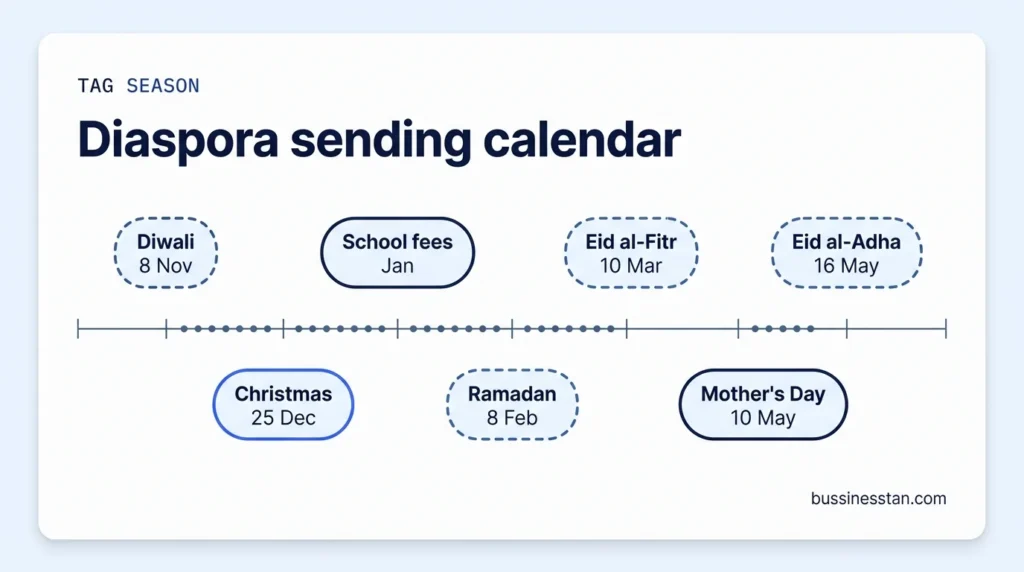
| Diwali | Sun 8 Nov 2026 (festival 6 to 10 Nov) | UK, US and UAE to India | Early September | Mid October |
| Christmas and year-end | Fri 25 Dec 2026 | UK to Nigeria, UK to Ghana, US to Mexico, Australia to Philippines | Early October | Mid to late November |
| New school term and fees | January, varies by country | UK to Nigeria, UK to Ghana, Gulf to South Asia | Late November | Mid December |
| Paydays | Monthly, by send-country pay cycle | All corridors | Once, then automated | 2 to 3 days before payday |
| Ramadan | Expected to begin around 8 Feb 2027 | UK to Pakistan, UK to Somalia, UAE to Pakistan, Europe to Morocco | Early December | Mid January |
| Eid al-Fitr | Expected 9 or 10 Mar 2027 | As Ramadan | With Ramadan plan | Last 2 weeks of Ramadan |
| Mexican Mother's Day | Mon 10 May 2027 (fixed date) | US to Mexico | Early March | Mid April |
| Eid al-Adha | Expected 16 or 17 May 2027 | As Ramadan, plus Gulf to South Asia | Early March | Late April |
The planning and go-live columns are our working lead times, not rules. Adjust them to the decision window your own data shows. If you are reading this in October, Diwali is already inside its campaign window, so go straight to the T-4 weeks row below.
Diwali remittance
Diwali remittance campaigns work best as gifting and family messages, live well before the festival week. Lead with rate clarity and speed only where both are substantiated. Creators from the Indian diaspora in London, Leicester, Houston or Dubai tend to carry more trust than studio creative.
Christmas remittance campaign
A Christmas remittance campaign usually serves several corridors at once, so resist one generic message. School fees, family gatherings and year-end travel sit alongside gifts. If your payout partners change hours over the holidays, say so early and plainly.
School fees and paydays
School-fee sends are obligations, not gifts. The message is reliability and timing, not celebration. Paydays are the most frequent cycle of all: a reminder 2 to 3 days before payday, sent to senders who have opted in, often does more than a monthly newsletter.
Ramadan remittance and Eid
Ramadan remittance can combine family support, Eid preparations and charitable giving, so check in your own data where in the month activity rises. Keep the tone respectful and avoid urgency framing. Plan Eid al-Adha in the same brief, since it follows about 10 weeks later.
Diaspora marketing on a T-minus plan
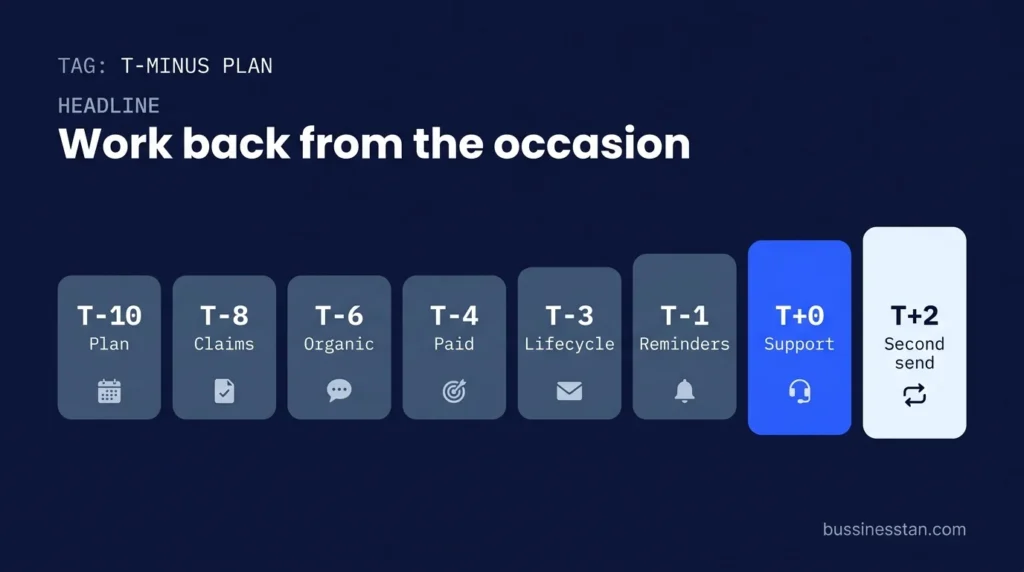
Diaspora marketing works community by community, so each occasion needs its own plan. We work backwards from the occasion date. We call this the T-minus sending plan.
| When | What happens | Owner |
|---|---|---|
| T-10 weeks | Pick corridors from last year's data; brief creative; check ad account verification status | Growth lead |
| T-8 weeks | Claims agreed with compliance; creator briefs out; landing pages updated | Marketing and compliance |
| T-6 weeks | Organic and community content starts; WhatsApp and group posts scheduled with opt-in | Social |
| T-4 weeks | Paid prospecting live by city and community | Paid |
| T-3 weeks | Lifecycle messages to lapsed senders on that corridor | Retention |
| T-1 week | Payday and rate reminders; support scripts updated | Retention and support |
| T+0 | Support staffed for "where is my money"; payout partner contacts on standby | Operations |
| T+2 weeks | Second-send prompt to new seasonal senders | Retention |
Social campaigns for a single corridor usually need about 6 weeks from brief to market, which is how our social media marketing team plans them. Paid media sits with our paid growth services and runs from the same brief, so the city targeting and the creative match.
The operations side campaigns forget
A seasonal campaign that works creates load. Plan for it in the same meeting.
- Verification queue. New senders arrive before occasions. If manual review slows down, the campaign pays for senders who give up. Our guide to the KYC onboarding process covers where they drop.
- Payout partners. Holidays in the receive country can change payout hours and cash pickup availability. Confirm before any delivery-time wording goes live.
- Rate board. If you advertise a rate, the app, website and agent counter must show the same one.
- Support. Expect more "where is my money" contacts after the peak. Update scripts and status messages beforehand.
- Agent counters. For agent-led operators, counter posters, opening hours and staff briefings belong in the T-minus plan too.
Licensing and AML questions go to a qualified adviser. We handle advertising and marketing compliance.
After the peak: turning seasonal senders into repeat senders
The peak week is the easy part to report. The harder question is what happens next.
Create a cohort of senders whose first transfer came in the seasonal window. Track their second transfer at 30, 60 and 90 days. Send a second-send prompt at their likely next need, such as payday, rather than a discount. Then add them to the reminder list for the same occasion next year, with consent.
This is the work of our retention and reactivation service, and the maths behind it is in send frequency, not signups. It also feeds corridor mix, one of the 3 levers in our fintech marketing strategy for remittance companies.
Frequently asked questions
When is remittance peak season?
There is no single remittance peak season for every operator. Many corridors see several occasions in Q4, including Diwali, Christmas and year-end. Corridors to Muslim-majority receive countries often see strong periods around Ramadan and the 2 Eids, which move earlier each year. Remittance seasonality differs by corridor, so index your own weekly transfers over 24 months to find your peaks.
When should Diwali remittance campaigns start?
For Diwali on 8 November 2026, we would plan from early September and go live in mid October. The aim is to reach senders when they decide how much to send and with whom, which is often weeks before the festival. Check when quote views rise on your India corridors and adjust.
When does Ramadan 2027 start?
Ramadan 2027 is expected to begin around 8 February 2027, subject to moon sighting, with Eid al-Fitr expected on 9 or 10 March 2027. Dates can differ by a day between countries. Plan campaigns from early December and confirm exact dates with local announcements closer to the time.
How far ahead should a Christmas remittance campaign be planned?
Around 10 to 12 weeks ahead works for most operators: planning in early October, paid media live from mid to late November. That leaves time for claims review, creator content and any ad account checks. Confirm payout partner holiday hours before promising delivery times.
What is diaspora marketing?
Diaspora marketing is marketing aimed at communities living outside their country of origin, planned by community, language and city rather than by nationality alone. In remittance, it means reaching senders through the channels, creators, occasions and groups their community already uses, with messages timed to their sending cycle.
Where to start
Remittance seasonality rewards the operators who plan from the decision moment, not the send moment. Read your own weekly data, mark the occasions on the calendar above, and run each one on a T-minus plan that includes verification, payout partners and support.
Start with the social media corridor checklist for your busiest route. If you want an outside view of which corridors deserve the Q4 and Ramadan budget, Book a Growth Audit: 2 weeks, a fixed fee, and a roadmap you keep either way.

Written by
Founder & CEO, Bussinesstan
Owns the commercial side of every engagement: fixed-fee scoping, corridor economics, and the reporting that ties spend to completed first transfers rather than to installs.
Meet the team
UGC for financial services: creator marketing for money transfer brands without compliance risk
UGC for financial services, done safely: diaspora creators, 6 restricted claim areas, disclosure by market and a brief compliance can sign off.
Activation emails for remittance apps: a sequence for senders who verified and never sent
Activation emails for remittance apps: a 6-message trigger sequence, subject line patterns, channel rules and measurement on funded first transfers.
Fintech customer retention for remittance apps: earning the second transfer
Fintech customer retention for remittance apps: lifecycle stages, 3 retention levers, corridor-based dormancy and reactivation without discount habits.