

Consulting 10 min read
Stablecoin cross border payments: what money transfer operators should plan for
Stablecoin cross border payments explained for remittance operators: what the rails change, what they do not, and the questions to ask a payout partner.
On this page
Quick answer
Stablecoin cross border payments use tokens designed to hold a steady value against a currency, often the US dollar, to move value between countries on a blockchain. For a money transfer operator, they mainly affect the middle of a transfer: settlement, prefunding and treasury. The sender's experience, KYC, payout in the receive country and the rules that apply still depend on each market.
Key takeaways
- Stablecoin rails sit mostly in the settlement layer, between collecting the sender's money and paying the beneficiary.
- They can change prefunding, settlement timing and treasury work, depending on partners and corridors.
- They do not remove sender trust, KYC, sanctions screening, last-mile payout or marketing.
- Regulation differs by market and is still being finalised in several, so legal questions belong with qualified advisers.
- The practical step now is a corridor-by-corridor assessment and a clear set of questions for any partner.
Everyone is talking about stablecoins, and most operators we speak to ask the same thing: does this change our plan? Board members forward articles. Payout partners mention new options. A competitor announces a pilot. Meanwhile, the corridor roadmap, the KYC queue and the marketing budget still need decisions this quarter.
This guide treats stablecoin cross border payments as a market signal to assess, not a prediction. It explains what the rails are, which parts of a remittance business they can touch, which parts they leave alone, where regulation stands in 4 markets at the time of writing, and the questions to ask before you commit engineering time.
We do not forecast prices or adoption. Nobody can do that reliably, and your plan should not depend on it.
What a stablecoin payout flow actually looks like
A stablecoin is a digital token that aims to keep a stable value by reference to an asset, most often a fiat currency. Legal definitions vary. The US uses the term "payment stablecoin". The EU distinguishes e-money tokens from asset-referenced tokens. The UK uses "qualifying stablecoin". The UAE regulates "payment tokens".
In a remittance context, a stablecoin payout usually follows 5 steps:
- Collect. The sender pays in local currency by card, bank transfer or at an agent counter, as today.
- Convert in. The operator or a partner converts that value into a stablecoin (the on-ramp).
- Move. The token moves on a blockchain to a partner in, or serving, the receive country.
- Convert out. That partner converts it into local currency (the off-ramp).
- Pay out. The beneficiary receives funds by bank deposit, mobile wallet or cash pickup, as today.
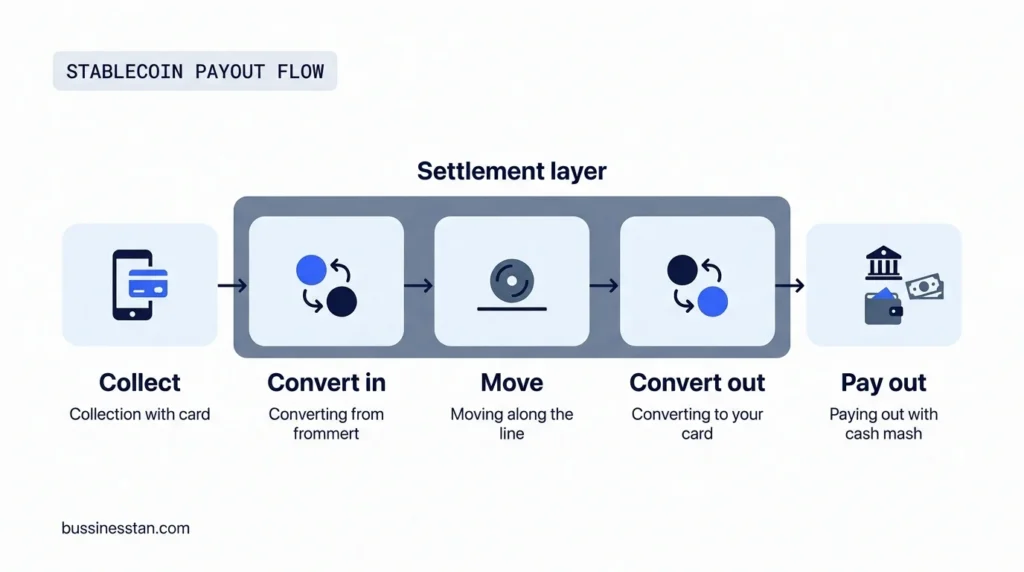
Steps 1 and 5 are what the sender and beneficiary see. Steps 2 to 4 replace, or sit beside, the correspondent banking, prefunded accounts and payout partner settlement you use now. That is why most of the change lands in treasury and operations rather than in the app.
What stablecoins for cross border payments can change
The case for stablecoins for cross border payments rests on the settlement layer. Whether any of it applies to you depends on your corridors, your partners and the rules in each market.
| Area | Typical set-up today | What stablecoin rails can change | What to check first |
|---|---|---|---|
| Settlement timing | Bank cut-offs, weekends and holidays delay partner settlement | Token transfers can run outside banking hours | Whether the off-ramp partner can convert and pay out at those times |
| Prefunding | Cash parked with payout partners in each receive country | Less capital parked in advance, if off-ramps are liquid | Off-ramp liquidity per corridor and per amount |
| Treasury | Multiple currency accounts and manual rebalancing | Fewer rebalancing steps in some corridors | Conversion costs at both ends and how FX spread is set |
| Reconciliation | Partner statements matched against transfer records | On-chain records add a data source | Whether your platform can match on-chain events to transfers |
| Partner reach | Limited by banking relationships in the receive country | Access to partners that settle in tokens | That partner's licences and payout network |
None of this is automatic. A faster middle leg does not help if the off-ramp partner pays out on the next business day, or if converting in and out costs more than the prefunding it replaces.
Where a digital dollar remittance fits
Some providers offer receivers a dollar-denominated balance instead of immediate local currency payout, often described as a digital dollar remittance. Whether that is permitted, how it must be disclosed and who may offer it varies by country. It is a product and regulatory decision, not a marketing angle, and it changes what you promise the beneficiary.
What stablecoin rails do not change
This is the half of the conversation that rarely makes the headlines, and it is where most of your growth plan still lives.
- Sender trust. A sender choosing a provider still judges rate, fee, speed, reviews and whether a friend has used you. The rail underneath is invisible to most senders.
- KYC and verification. Senders still need to be verified. Screening obligations apply to the operator and to partners. A new rail can add checks rather than remove them.
- The last mile. Beneficiaries still need a bank account, a mobile wallet or a cash pickup point. Payout partner coverage and reliability still decide whether the money arrives.
- Marketing. Cost per first send, verification drop-off and send frequency are not solved by settlement. Claims about speed or cost need evidence in every market where they run.
- Support. "Where is my money" contacts still depend on clear status updates, whatever moves the value.
For most operators, the funnel from install to first transfer to repeat send is still the larger commercial lever. We argue against spending engineering time on a new rail while verification is leaking.
Stablecoin cross border payments: regulation varies by market
Rules for stablecoins are live in some markets and still being finalised in others. The table below summarises published positions at the time of writing. It is a starting point for a conversation with your advisers, not legal guidance.
| Market | Position at the time of writing |
|---|---|
| United States | The GENIUS Act became law on 18 July 2025, setting a federal framework for payment stablecoins, including oversight of issuers and 100% reserve backing with liquid assets |
| European Union | Under MiCA, rules for asset-referenced tokens and e-money tokens have applied since 30 June 2024 |
| United Kingdom | The FCA published final rules for stablecoin issuance (PS26/10) and other crypto activities on 30 June 2026; the full regime is due to start on 25 October 2027 |
| United Arab Emirates | The Central Bank's Payment Token Services Regulation applies on the mainland (not the financial free zones); its transition period ended in June 2025, and payment token services require a licence |
Central banks also hold cautious views. In June 2025 the Bank for International Settlements said stablecoins do not deliver singleness, elasticity and integrity, the tests it applies to sound money. That does not settle how you should act. It is a reason to look at each corridor carefully rather than follow a headline.
Rules in receive countries matter as much as rules where you send from. Licensing and AML questions go to a qualified adviser. We handle advertising and marketing compliance.
Questions to ask a stablecoin payout partner
We use a 12-question partner screen before any operator spends engineering time on a stablecoin payout integration. Questions 1 and 2 are for your legal and compliance advisers to assess; the rest are commercial and operational.
| # | Question | Why it matters |
|---|---|---|
| 1 | Which licences or registrations do you hold, in which markets? | Your advisers need to confirm fit for each corridor |
| 2 | Which stablecoins do you use, and under which regime are they issued? | Treatment differs by market |
| 3 | Which receive countries can you off-ramp into, and at what amounts? | Liquidity decides whether prefunding really falls |
| 4 | Which payout methods do you support: bank, wallet, cash pickup? | The beneficiary still needs a last mile |
| 5 | What are your payout hours in each receive country? | 24/7 settlement is useless without 24/7 payout |
| 6 | How are conversion costs and FX spread set at each end? | Total cost can rise even if settlement is faster |
| 7 | How do you handle sanctions screening and wallet screening? | Obligations sit with both parties |
| 8 | What happens when a payout fails or a token transfer is delayed? | Refund paths shape support volume |
| 9 | What status events can you send us, and how? | Your app needs honest transfer tracking |
| 10 | How will we reconcile on-chain movements with transfer records? | Breaks surface in finance, weeks later |
| 11 | What are your redemption terms and timelines? | Treasury needs certainty on exit |
| 12 | Can we pilot one corridor with a volume cap? | Limits the cost of being wrong |
Question 10 is where many pilots stall. If your platform cannot match on-chain events to transfers, the finance team inherits a manual process. Our remittance management system work usually starts with reconciliation for exactly that reason, and our earlier article on build or buy: choosing an RMS covers the platform choice. For the wider platform requirements, see what your remittance software must do before marketing can scale.
How to fit stablecoins into a corridor plan
Treat a stablecoin remittance option as one input to corridor prioritisation, scored alongside demand, competition, payout coverage and acquisition cost.
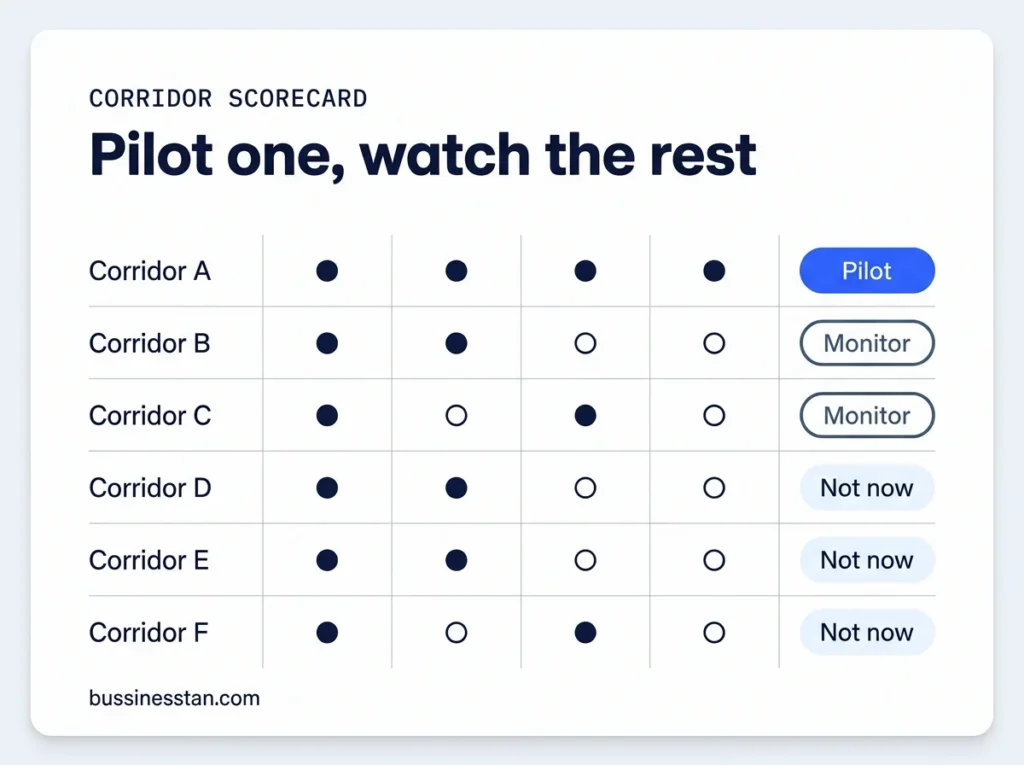
The commercial research behind that scoring is what our corridor and market research service covers, and the wider decision sequencing sits across our consulting services. Regulatory due diligence is always referred to specialists.
For background on how value moves between countries today, see what are cross-border payments.
Frequently asked questions
Are stablecoin cross border payments cheaper for remittance operators?
Not automatically. They can reduce prefunding and speed up settlement in some corridors, but conversion costs at both ends, off-ramp liquidity and partner fees can offset that. The only reliable answer is corridor by corridor, comparing total cost per transfer against your current settlement route, over a capped pilot with real volumes.
What is a stablecoin payout?
A stablecoin payout is a transfer where value moves between countries as a stablecoin and is converted into local currency before the beneficiary is paid. The beneficiary usually receives money through a bank, mobile wallet or cash pickup as normal. Some providers instead offer a balance held in a dollar-linked token, where local rules allow it.
Does a stablecoin remittance remove the need for KYC?
No. Senders still need to be verified, and screening obligations apply to operators and their partners. The exact requirements depend on each market's rules and your licences. Licensing and AML questions go to a qualified adviser. We handle advertising and marketing compliance.
Is a digital dollar remittance legal in every country?
No single answer covers every market. Some countries restrict holding or receiving dollar-linked tokens, some regulate who may offer them, and rules are still changing in several. Check each receive country with qualified legal advisers before offering or promoting a dollar-denominated balance to beneficiaries.
Should we add stablecoin rails before fixing our acquisition funnel?
Usually not. If senders are dropping at verification or sending once and stopping, those leaks cost more than slow settlement for most operators. Assess stablecoin rails alongside your corridor plan, but fix the path from install to first and repeat transfer first unless treasury costs are your binding constraint.
Where to start
Start with a corridor list, not a technology decision. For each corridor, note how much you prefund, how long partners take to settle, and whether a credible off-ramp exists. Share the 12-question screen with any partner that proposes a stablecoin option, and send questions 1 and 2 to your advisers.
Download the Corridor prioritisation scorecard to structure that work. If you want corridor economics, tracking and spend looked at together before deciding where engineering time goes, Book a Growth Audit. It takes 2 weeks for a fixed fee, and you keep the roadmap whether or not we work together.

Written by
Founder & CEO, Bussinesstan
Owns the commercial side of every engagement: fixed-fee scoping, corridor economics, and the reporting that ties spend to completed first transfers rather than to installs.
Meet the team
Remittance corridor analysis: how to score a corridor before you spend
Remittance corridor analysis with a seven-dimension scorecard: demand, competition, pricing, payout, channels, economics and fit, graded before spend.

Website audit checklist for money transfer companies
A website audit checklist for money transfer companies: technical, SEO, conversion, trust and tracking checks, scored and ranked by first transfers.

What a paid ads audit for a remittance company should find in 14 days
What a paid ads audit for a remittance company should find in 14 days: 18 areas, the timeline, the deliverables and when the answer is spend less.