

SEO 9 min read
Local SEO for exchange houses: branches, agents and corridors
Local SEO for exchange houses, explained: location pages, a locator that ranks, Business Profiles and reviews, measured on calls, directions and transfers.
On this page
Quick answer
Local SEO for exchange houses is the work of making every branch and agent counter findable when a sender searches for a nearby place to send money or collect cash. It covers three layers: physical locations, sending markets and corridors. The core parts are location pages, a crawlable store locator, accurate Business Profiles, consistent name, address and phone details, a compliant reviews policy and measurement of calls and directions.
Key takeaways
- Local SEO for exchange houses runs on three layers: the places, the cities senders live in and the corridors they send to.
- A location page earns its place only when it says something a sender cannot learn from the map pin.
- The store locator is usually the most valuable page on the site, and most operators bury it.
- Reviews are asked for evenly, never incentivised and never filtered by who seems happy.
- Measure calls, direction requests and first transfers by branch, not rankings on their own.
Walk-ins are down, and nobody finds your branches online. A sender in Birmingham types "send money to Nigeria near me" and gets a rival's counter, a comparison site and a map pin with the wrong opening hours. Your branch is 400 metres away. It does not appear.
That is the problem local SEO for exchange houses exists to fix. It is not a Maps pin and a few city pages. It is a location system: which places deserve a page, what each page says, how the locator is built, how profiles and directories agree, and how you prove any of it produced a transfer.
The structure is the same for an operator with 4 branches and one with several hundred agent counters. The scale changes the template, not the thinking.
Why local SEO for exchange houses is a three-layer problem
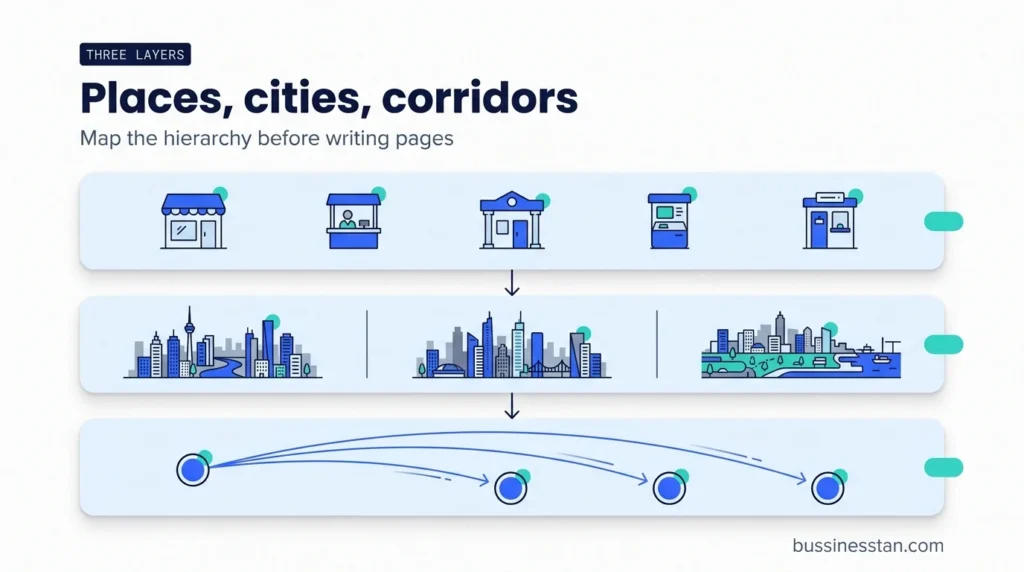
Most agent-led operators treat local search as one layer: branches on a map. Senders search in three.
| Layer | What the sender types | Page that answers it | Common mistake |
|---|---|---|---|
| Physical locations | "money transfer Southall", "cash pickup near me" | Branch page, agent location page, locator | One page per city with the address swapped |
| Sending markets | "send money from Birmingham" | City page covering every branch and agent in that city | A city page for every town, whether or not you serve it |
| Corridors | "send money London to Lagos" | Corridor page, linked to the branches that serve it | Corridor pages with no link to a physical place |
The layers connect. A corridor page for UK to Ghana should point to the branches where Ghanaian senders already go. A city page should list the corridors that branch network actually serves. A branch page should name its corridors and payout methods. This is what multi-location SEO means in this category: a hierarchy, mapped before a single page is written.
Corridor pages have their own playbook, covered in Corridor pages are the organic engine. Here the focus is the places.
Location pages that deserve to rank
A location page is worth publishing when it answers the questions a sender asks before walking in. Forty pages sharing one paragraph with the town name changed will compete with each other and help nobody.
What goes on a branch page?
Use one template, filled with facts that differ by location:
- Name, address and phone, written exactly as they appear on the storefront and the Business Profile.
- Opening hours, including holiday hours before Eid, Christmas and school-fee months.
- Corridors served from that counter, and the payout methods for each: bank deposit, cash pickup, mobile wallet.
- What to bring: the ID documents a first-time sender needs, in plain words.
- Languages spoken at the counter.
- Directions: nearest bus stop or station, parking, a landmark.
- A link to the rate board or calculator, so the sender sees today's rate before travelling.
- The regulatory status line your compliance team has approved for every page.
Items 3, 5 and 6 do most of the work. They are the facts that make one page different from the next.
Should agent locations get their own pages?
Sometimes. Agent location pages make sense when the agent counter handles meaningful volume, serves a distinct community and can be described with real detail. A counter inside a grocery shop with no confirmed hours is better listed in the locator than given a thin page of its own.
| Question | Branch page | Agent location page | Locator entry only |
|---|---|---|---|
| You control hours and staff | Yes | Rarely | Not needed |
| Distinct corridors or languages | Usually | Sometimes | No |
| Enough detail for 250+ useful words | Yes | Sometimes | No |
| Risk of duplicate content | Low | High | None |
The store locator is the page that matters
Store locator SEO is usually where agent-led operators lose the most search demand. The locator sits four clicks down, loads its results with a script search engines cannot read, and shows nothing until the sender types a postcode.
A locator that ranks has 4 properties:
- Crawlable results. Each location has its own URL, linked in plain HTML from a city index. A search box on its own is invisible to a crawler.
- Filters senders use. Corridor, payout method, open now, language. Filters that match how people search, not how the agent contract is structured.
- Fast on a mid-range Android phone on a weak connection, because that is the device many senders carry.
- A clear next step from every result: call, get directions, check today's rate, start a transfer in the app.
Senders who find a counter often want to confirm hours before travelling, and some would rather ask on WhatsApp than call. If you already run a Business API number, put it on every locator result. The setup is covered in our WhatsApp Business API guide for money transfer operators.
This is the work our multi-location SEO team does: the hierarchy first, then the locator, then the pages only where demand exists. Most operators need 20 good pages rather than 200 thin ones, and that costs less.
Google Business Profile: money transfer listings, NAP and reviews
Google Business Profile for a money transfer counter is the listing most senders see first. It carries the hours, the phone number and the reviews, often before your website does.
What Google expects from each profile
Google's guidelines for representing a business ask for one profile per location, a name that matches the real-world storefront, and categories that describe the business rather than stuff keywords. A branch named "Exchange House Southall | Cheapest Rates to Nigeria" breaks the naming rule and risks suspension.
Where an agent counter sits inside another shop, Google's guidance on businesses inside other businesses applies. Check each case against the current guidelines before creating a profile. Do not create a profile for a counter that is not staffed during its stated hours.
Keep name, address and phone identical everywhere
NAP consistency means the name, address and phone number match on the storefront, website, Business Profile, directories and partner listings. Mismatches split the signal and confuse senders. A citation audit lists every place your locations appear and fixes the ones that disagree.
How should you ask for reviews?
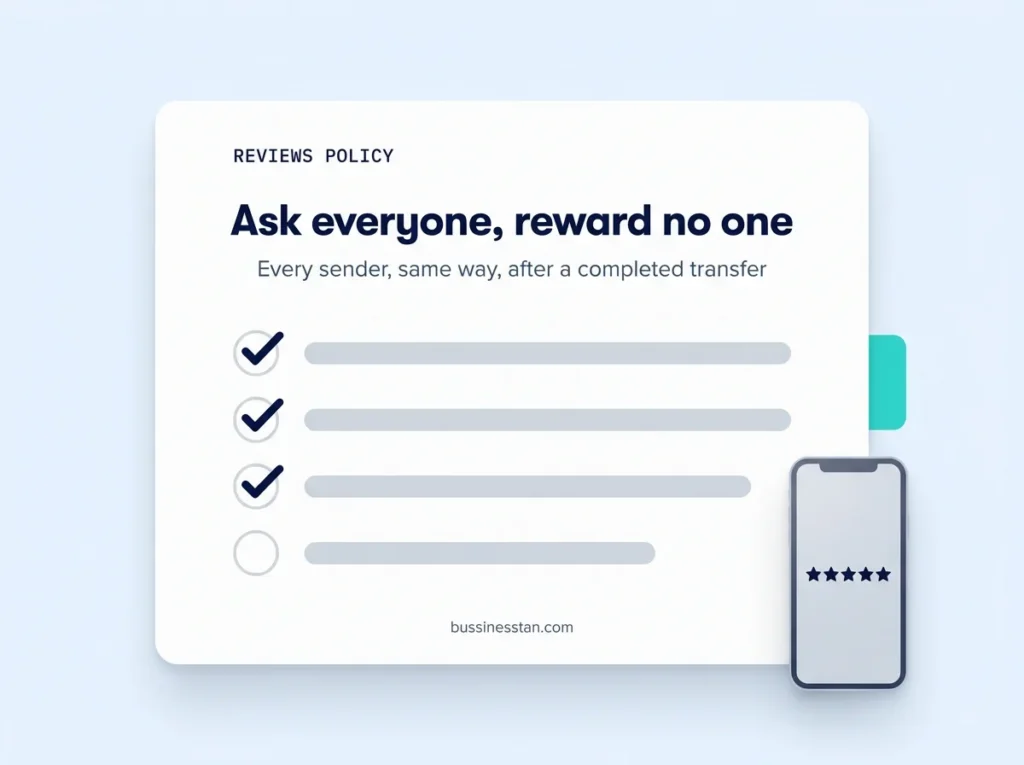
Evenly, honestly and without reward. Google's policy on reviews prohibits offering payment, discounts or free services in exchange for reviews, discouraging negative reviews, and selectively asking only happy senders. That rules out review gating, where a survey filters out unhappy senders before the review link appears. It also rules out staff quotas.
A compliant reviews policy looks like this:
- Ask every sender, the same way, after a completed transfer.
- Never offer a fee discount, better rate or prize for a review.
- Reply to every review, including the negative ones, without disclosing transfer details.
- Send verification and delay complaints to the operations team as evidence, not to marketing for damage control.
Licensing and AML questions go to a qualified adviser. We handle advertising and marketing compliance.
Duplication, cannibalisation and the five-gate location test
Half the location pages on a typical agent-led site compete with each other. Two pages target "money transfer Southall". A city page and a branch page carry the same paragraph. The corridor page for UK to Ghana and the Ghana landing page from a past campaign fight for the same search.
Run every existing and proposed page through the five-gate location test. A page must pass all five.
- Demand gate. Is there evidence that senders search for this place or this place plus corridor?
- Service gate. Does the location actually serve the corridors and payout methods the page names?
- Detail gate. Can the page carry facts no other page on the site repeats?
- Owner gate. Is there one search this page, and only this page, should win?
- Maintenance gate. Will someone update hours, corridors and staff languages when they change?
Pages that fail gate 1 or 3 are merged into a city page. Pages that fail gate 4 get a canonical rule or a redirect. Pages that fail gate 5 should not exist. Run the check monthly, because agent networks change faster than websites.
Physical visibility matters too. Storefront branding and QR codes at agent counters connect the street to the search, and they sit in our out of home advertising work. We argue against buying outdoor until one city already works online.
Measuring calls, directions and first transfers
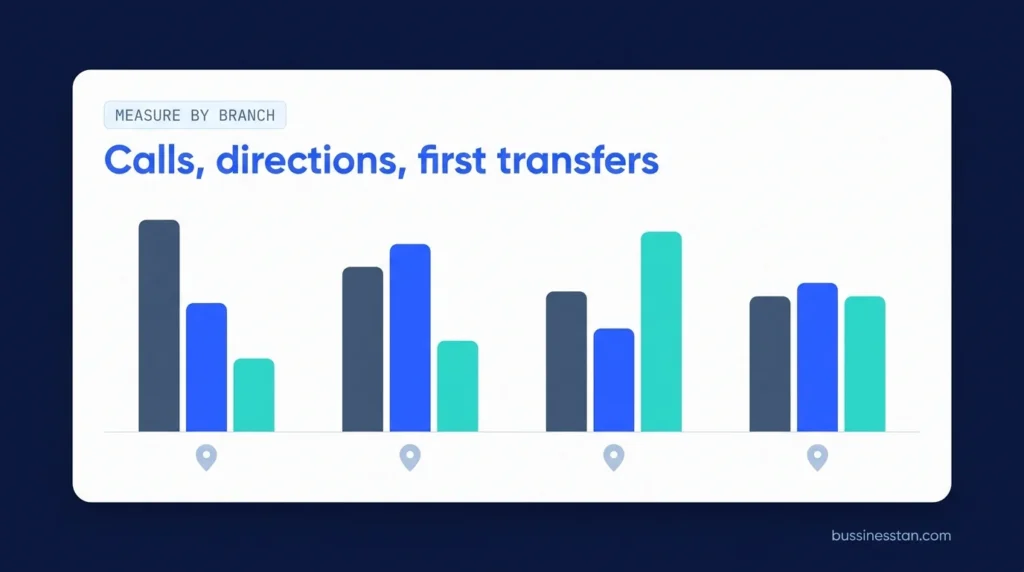
Local rankings are an input. The outcome is a sender at the counter or a first transfer in the app. Measure by branch and by corridor.
| Measure | Where it comes from | What it tells you |
|---|---|---|
| Calls from the profile | Business Profile performance | Intent to visit or ask |
| Direction requests | Business Profile performance | Intent to walk in |
| Locator searches and clicks | Analytics events on the locator | Which cities and corridors senders look for |
| Rate checks from location pages | Analytics events | Price sensitivity by area |
| QR scans at counters | Code redirects with campaign tags | Street to app handoff |
| First transfers by branch | Your transfer records | Whether any of it paid |
Clean measurement needs the Google accounts and tags set up in your own name: Search Console, Analytics and Tag Manager, with events named once. That sits in our Google account and tracking setup service.
Local rankings usually take a full quarter to settle. Anyone promising a date is guessing.
Frequently asked questions
What is multi-location SEO for a money transfer operator?
Multi-location SEO is the practice of ranking many physical locations from one website without the pages competing. For a money transfer operator, it maps 3 layers: branches and agent counters, the cities senders live in, and the corridors they send to. Each layer gets a page only where demand exists and the facts differ.
How do I set up a Google Business Profile for a money transfer branch?
Create one profile per staffed location, use the name on the storefront, pick categories that describe the service and keep hours current, including holiday hours. Add the phone number used on the branch page. Counters inside other shops need a case-by-case check against Google's guidelines before a profile is created.
Does store locator SEO matter if we already have Business Profiles?
Yes. Profiles cover staffed locations that qualify. The locator covers every agent counter, filters by corridor and payout method, and hands the sender to a rate check or the app. A locator with crawlable location URLs also ranks for searches the profiles never show up for.
Should every agent get an agent location page?
No. Agent location pages work where the counter has confirmed hours, real volume and details that differ from its neighbours. Thin agent pages create duplicate content and compete with branch pages. Most agents belong in the locator, with a page only when the five-gate test says so.
Can we offer a discount to senders who leave a review?
No. Google's review policy prohibits incentives of any kind, including fee discounts, better rates and prize draws. It also prohibits asking only happy senders or filtering them through a survey first. Ask every sender the same way after a completed transfer and reply to every review.
Where to start
Start with the hierarchy, not the pages. List every branch and agent counter, the cities they sit in and the corridors each one serves. Then run the five-gate test on what is already live. Most operators find that fixing the locator and merging thin pages does more than publishing anything new.
If you want the numbers first, Book a Growth Audit. Two weeks and a fixed fee, and you keep the roadmap whether or not we work together.

Written by
Founder & CEO, Bussinesstan
Owns the commercial side of every engagement: fixed-fee scoping, corridor economics, and the reporting that ties spend to completed first transfers rather than to installs.
Meet the team
App store optimization for fintech apps: from remittance listing to first transfer
App store optimization for fintech apps, built for remittance: keyword fields, screenshots, localised listings and reviews measured to first transfer.

Generative engine optimization for fintech: getting named when senders ask AI
Generative engine optimization for money transfer brands: how assistants pick sources, the entity fact sheet, answer-ready pages and honest monitoring.
CRM for money transfer companies: design the data model first
CRM for money transfer companies, built on the data model: one record per sender, 9 lifecycle stages, B2B pipelines, consent rules and a 10-week rollout.