

Consulting 9 min read
Go-to-market strategy for remittance startups: the first 90 days
A go-to-market strategy for remittance startups: readiness check, 1 or 2 corridors, tracking before spend, channel order and 30/60/90 milestones.
On this page
Quick answer
A go-to-market strategy for remittance startups is the sequence a new money transfer business follows from readiness to its first repeat senders. It sets the target segment, 1 or 2 launch corridors, the sender promise, a measurement plan with the first transfer as the key event, and the channel order: tracking, then site, then content, then paid, released in stages with gates.
Key takeaways
- Run a readiness check before any spend; the licence, payout partners and KYC flow must already work.
- Launch with 1 or 2 corridors chosen on evidence, not on the founders' own sending habits.
- Tracking goes live before the website, and the website before the first paid campaign.
- Pace the budget in gated stages, with each stage earning the next one.
- Judge the first 90 days on verified senders, first transfers and second transfers, not installs.
"The first budget is about to be spent and there is no sequence." Founders of new remittance businesses rarely say it that plainly, but it is the situation. The licence work has taken a year, the payout partner is signed, the app is nearly ready, and the board wants to see senders. The temptation is to switch everything on at once.
A go-to-market strategy for remittance startups exists to stop that. You get one launch. If tracking is not live when spend starts, the first quarter produces installs you cannot trace to first transfers, and nobody learns which corridor or channel worked.
This guide sets out the sequence: readiness, positioning, corridor choice, measurement, channel order, budget pacing and the 30/60/90 milestones.
What a go-to-market strategy for remittance startups has to decide
Generic "fintech go to market strategy" advice talks about product-market fit and growth loops. A remittance launch needs 5 narrower decisions, made in this order:
| # | Decision | The question it answers |
|---|---|---|
| 1 | Segment | Who sends first: diaspora families, students, small businesses or payroll clients? |
| 2 | Corridor | Which 1 or 2 send and receive country pairs launch first? |
| 3 | Promise | What the sender gets that the agent counter or the incumbent app does not give them |
| 4 | Measurement | Which events prove progress, with the first transfer as the one that counts |
| 5 | Sequence | What goes live in which week, and what has to be true before the next stage |
Everything else in the remittance launch plan follows from these 5 answers. If you are earlier than this, start with how to start a money transfer business, which covers the wider set-up before a launch plan.
The readiness check before any spend
A readiness check scores what exists before a single pound or dirham goes into media. It takes about 2 weeks and saves the first quarter.
| Area | Ready means | Not ready means |
|---|---|---|
| Licence and partners | Your advisers confirm you can operate in the launch corridor; payout partners are live | Launch date depends on approvals still pending |
| KYC flow | Tested end to end on mid-range Android phones | Tested only on the team's own devices |
| Quote | Rate, fee and total match checkout | Rate shown differs from rate charged |
| Payout | Bank, wallet or cash pickup tested with real beneficiaries | Payout tested only in a sandbox |
| Tracking | Registration, KYC and first transfer events fire and are named once | Only installs and page views recorded |
| Support | Answers ready for "where is my money" | Support inbox not staffed at launch |
| Claims | Approved wording for fees, speed and rates | Marketing will write claims as it goes |
Licensing and AML questions go to a qualified adviser. We handle advertising and marketing compliance.
What if the readiness check fails?
Move the launch date, not the gate. A missed line in the table above is cheaper to fix in a pre-launch week than in a live quarter. Fix payout and KYC first, because they break the first transfer itself. Tracking and claims come next, because they break your ability to learn from it. Support can launch lean, but someone must own the "where is my money" inbox from day one.
Positioning and choosing 1 or 2 corridors
Most new operators want to launch everywhere their founders have family. That spreads a small budget across routes with different payout habits, price sensitivity and competitors.
Pick 1 or 2 corridors on evidence: diaspora size in your send country, payout preference in the receive country, how crowded paid search already is, and whether your pricing is competitive there. Our guide to remittance corridor analysis sets out a scoring method.
Then write the promise in one sentence per segment:
For [segment] sending from [send country] to [receive country], we offer [specific benefit they can check], shown by [proof on the quote screen or at payout].
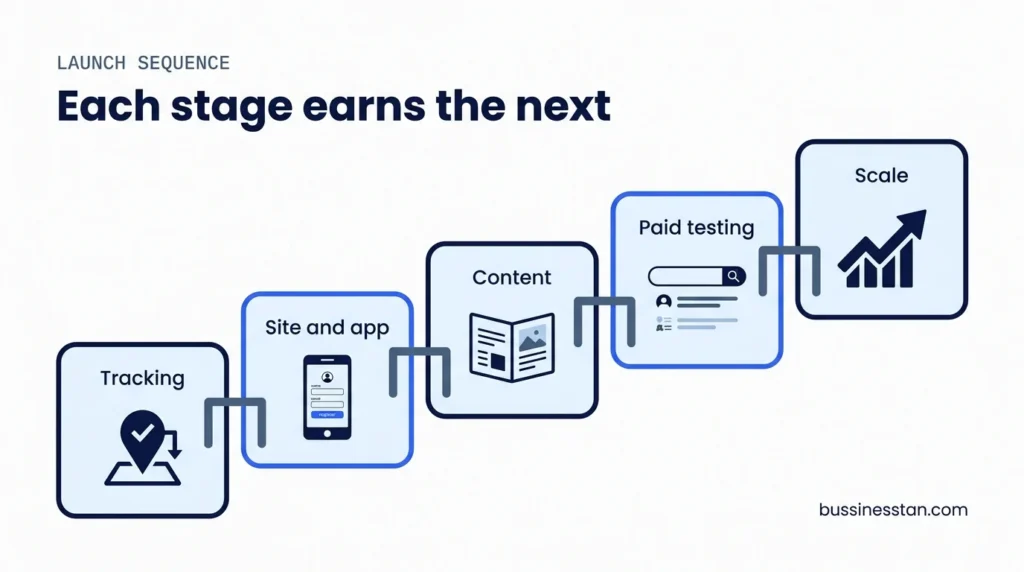
Channel order: tracking, then site, then content, then paid
The gated launch sequence
| Stage | What goes live | Gate to the next stage |
|---|---|---|
| 1. Tracking | Measurement plan, one name per event, GA4 or Firebase plus MMP, consent | Test registration, KYC and first transfer all recorded correctly |
| 2. Site and app | Corridor pages, rate calculator, registration path, store listing | A test sender completes the full path on a phone |
| 3. Content and community | Corridor guides, fee explainers, diaspora groups, agent or partner referrals | First organic and referral senders recorded end to end |
| 4. Paid testing | Search on corridor intent, then social in 1 or 2 diaspora cities | Cost per first send visible by campaign |
| 5. Scale | More budget on what produced first transfers | Second-transfer rate holding for the first cohorts |
Tracking comes first because every later decision depends on it. Our app and web analytics setup work agrees the plan before any tag is placed, typically 2 weeks to plan and name the events, then 2 to 4 weeks to implement and test.
The site comes before spend because paid traffic sent to an unfinished registration path is wasted twice: once on the click, and again on the retargeting to recover it. The website audit checklist for money transfer companies is a useful pre-launch pass.
Budget pacing
Split the first budget into stages and release each stage only when its gate is met. Keep test budgets per corridor, so one route cannot hide the cost of another. Hold part of the budget back for the second transfer, because a sender who sends once and disappears costs the same to acquire as one who stays.
| Budget stage | Released when | Spent on |
|---|---|---|
| Foundation | Plan signed | Tracking, site fixes, content for the first corridor |
| Test | Tracking gate passed | Search and social tests in 1 corridor |
| Prove | Cost per first send visible by campaign | More budget on campaigns that produced first transfers |
| Expand | Second-transfer rate holding | Second corridor or second city |
Each row is a decision point, not a date. If a gate slips, the money waits.
A one-page GTM plan template
A usable GTM plan template fits on one page: segment, corridors, promise, the 5 events you measure, the stage you are in, the gate for the next stage, budget released so far, and the owner of each line. If it runs to 30 slides, nobody will update it.
This is the sequence our go-to-market for new businesses service builds: about 6 weeks to a finished plan, with a 2-week launch readiness check available on its own. When a second corridor follows, new corridor launch applies the same gates route by route.
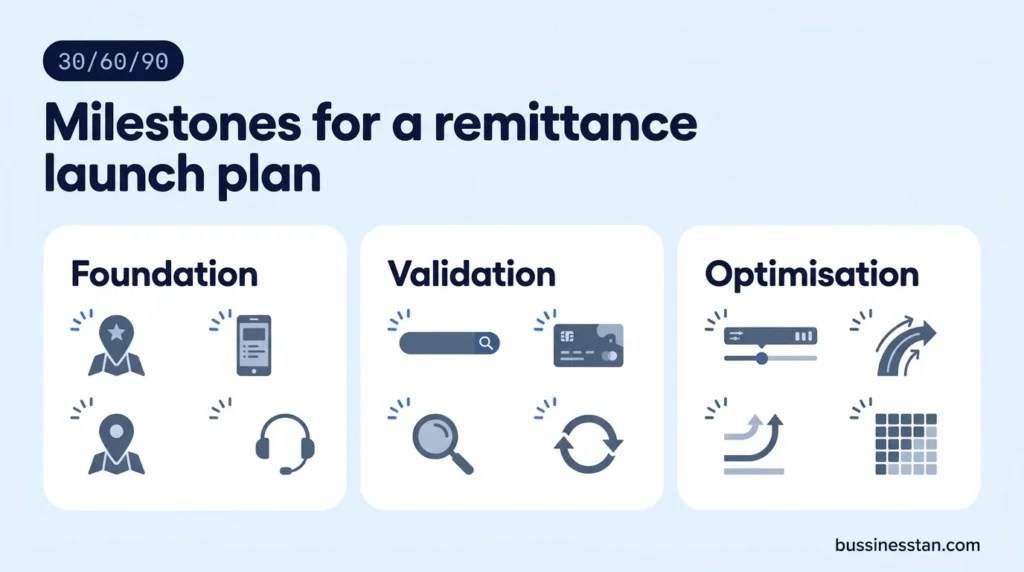
30/60/90 milestones and KPIs
| Period | Focus | Milestones | KPIs to read |
|---|---|---|---|
| Days 1 to 30 | Foundation | Tracking verified, site and app live, support ready, first organic and referral senders | Registrations, KYC completion rate, first transfers |
| Days 31 to 60 | Validation | Paid testing in 1 corridor, first creative and keyword learnings, second-transfer flow live | Cost per verified sender, cost per first send, average transfer value |
| Days 61 to 90 | Optimisation | Budget moved to what produced first transfers, second corridor decision made | Second-transfer rate, repeat transfers, early lifetime value by cohort |
The full KPI set for a launch has 9 lines: traffic, registration, KYC completion, first transfer, acquisition cost, transfer value, retention, repeat transfer and lifetime value. Read them by corridor, never blended.
Search for "first 1000 customers fintech" and most advice is about viral loops and waitlists. In remittance, the first 1,000 senders usually come from narrower places: a diaspora community, an agent or partner referral, a corridor page that answers the fee question. Count them as verified senders with a first transfer, not as signups.
For the corridor-by-corridor version of this plan, see launch a new remittance corridor in 90 days.
Frequently asked questions
What is a go-to-market strategy for a remittance startup?
It is the ordered plan that takes a new money transfer business from readiness to its first repeat senders. It fixes the segment, launch corridors, sender promise, measurement plan and channel sequence, with a gate between each stage so budget is released only when the previous stage works.
How many corridors should a new remittance business launch with?
Usually 1, at most 2. Each corridor has its own payout habits, pricing pressure and diaspora channels, and a small launch budget split across many routes teaches you little about any of them. Add the next corridor once the first shows first transfers and repeat sends at a cost you can sustain.
When should a remittance startup start paid advertising?
After tracking records registration, KYC and first transfer correctly, and after the site and app pass an end-to-end test on a real phone. In practice, the first paid campaign often starts around 2 months after planning begins. Starting earlier buys installs you cannot connect to transfers.
Is there a GTM plan template for a remittance launch?
Yes. Keep it to one page: segment, corridors, promise, measured events, current stage, next gate, budget released and owners. Our 90-day go-to-market plan download gives you that structure with milestones for days 1 to 30, 31 to 60 and 61 to 90.
Does "first 1000 customers" fintech advice apply to remittance?
Only partly. Waitlists and referral loops can help, but remittance senders trust people who already send on the same corridor. Diaspora communities, agent and partner referrals and corridor content usually matter more. Count progress in verified senders with a completed first transfer.
Where to start
Run the readiness check, choose 1 or 2 corridors on evidence and get tracking live before anything else. Then release the budget stage by stage.
A note on fit: our Growth Audit needs at least a month of live tracking and some traffic to read. If you have not launched yet, a launch readiness check is the better first step. Either way, tell us where you are: Book a Growth Audit, and choose "Not launched yet" if that is the honest answer. We reply with scope and a fixed price in writing.

Written by
Founder & CEO, Bussinesstan
Owns the commercial side of every engagement: fixed-fee scoping, corridor economics, and the reporting that ties spend to completed first transfers rather than to installs.
Meet the team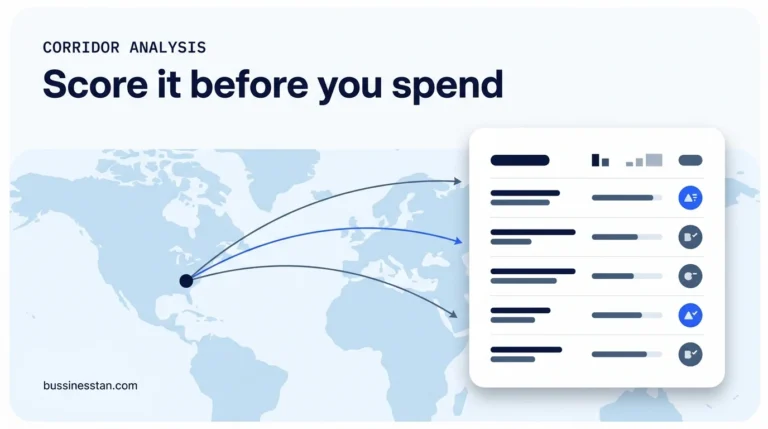
Remittance corridor analysis: how to score a corridor before you spend
Remittance corridor analysis with a seven-dimension scorecard: demand, competition, pricing, payout, channels, economics and fit, graded before spend.

Website audit checklist for money transfer companies
A website audit checklist for money transfer companies: technical, SEO, conversion, trust and tracking checks, scored and ranked by first transfers.
Stablecoin cross border payments: what money transfer operators should plan for
Stablecoin cross border payments explained for remittance operators: what the rails change, what they do not, and the questions to ask a payout partner.