

Consulting 10 min read
How to start a money transfer business: the growth plan nobody writes
How to start a money transfer business: a 10-step commercial plan covering corridor choice, payout partners, platform, tracking and your first senders.

On this page
Quick answer
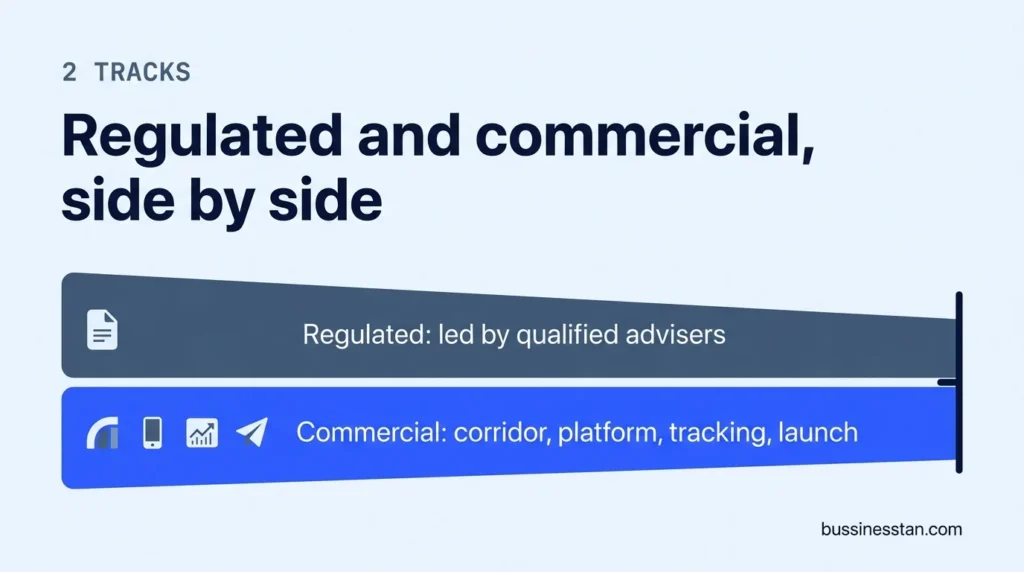
Starting a money transfer business runs on 2 parallel tracks. The regulated track covers licensing or registration, AML controls and banking relationships, and is handled with qualified legal and compliance advisers. The commercial track covers corridor choice, positioning, payout partners, platform, tracking, website and app, launch sequence and winning the first senders. Both need to be ready before the first transfer.
Key takeaways
- Treat the launch as 2 tracks: regulated work led by qualified advisers, and commercial work led by your team.
- Choose the first corridor on evidence, not on a partner's enthusiasm or a boardroom hunch.
- Design tracking before the website and app, with the first completed transfer as the key event.
- Start ad account verification and claims review early, because both can hold up launch day.
- Launch 1 corridor properly, read the numbers at day 90, then choose corridor 2.
"We are launching soon and do not know where to start." Most founders who say this have already read plenty about how to start a money transfer business. Nearly all of it is about licences. Very little covers the other half: how a new remittance business finds its senders, earns a first transfer and gets a second one.
That other half is where launch budgets are won or lost. A licence lets you operate. It does not bring a single sender through the door.
This guide is the commercial and growth plan for a new money transfer business, in 10 steps. It names the regulated steps where they belong, and leaves them to the people qualified to handle them.
The 2 tracks of a new money transfer business
A money transfer business launches on 2 tracks that depend on each other.
| Track | What it covers | Who leads | Why growth depends on it |
|---|---|---|---|
| Regulated | Licensing or registration, AML controls, banking relationships, contracts | Qualified legal and compliance advisers, with your compliance lead | It sets the launch date and what marketing can say |
| Commercial | Corridor, positioning, payout partners, platform, tracking, website, app, launch, acquisition | Founders and the growth team | It decides whether anyone sends once the doors open |
Run them in parallel. A common failure is finishing the regulated track and only then starting the commercial one, which leaves a licensed business with no tracking, no corridor pages and ad accounts that have not been verified.
Licensing and AML questions go to a qualified adviser. We handle advertising and marketing compliance.
How to start a money transfer business in 10 steps
The steps below cover the commercial track. Several run at the same time.
Step 1: Choose your first corridor on evidence
Score each candidate corridor on the same dimensions: diaspora concentration in your send country, search demand, competitors and their visible pricing, payout options, likely send frequency and the cost of reaching senders. Grade them priority, test, monitor or low. The most common mistake is choosing a corridor because a payout partner is keen on it. This is the work of our corridor and market research service.
Step 2: Define the sender and the position
Name who you serve first: families supporting home, students, small businesses paying suppliers. Then write one sentence on why they should choose you on this corridor. Every claim about rate, fee, speed or security must be substantiated before it appears anywhere.
Step 3: Line up payout partners and methods
Decide which payout methods the corridor needs: bank deposit, mobile wallet, cash pickup or a mix. Commercially, ask each partner about coverage, operating hours, holiday cover, failed payout handling and whether they send status updates your app can show. Contracts and due diligence go through your advisers.
Step 4: Choose the platform: build, buy or extend
Your remittance business platform decides how fast you can add a corridor or partner later. We set out the trade-offs in build or buy: choosing an RMS. For the sender-facing app, map the transfer states first: registration, KYC, quote, beneficiary, funding, transfer, tracking and repeat transfer. Our mobile app development team builds to that map.
Step 5: Design measurement before launch
Write the event map before the website and app are built. Use one event name per step, from registration through KYC to first and repeat transfer, shared across analytics, app and MMP. Define the first completed transfer as the key conversion. Adding tracking after launch means your first months of data cannot be trusted.
Step 6: Build the website and app for the first transfer
Put the rate and fee calculator above the fold. Build corridor pages for the routes you serve. Test the KYC screens on older and mid-range Android phones before launch, because document capture is a common point where new senders drop. Our guide to the KYC onboarding process covers each step.
Step 7: Prepare ad accounts and claims early
Financial services advertisers usually need to complete platform verification before campaigns can run, and the evidence must match your legal entity and landing pages. Prepare that pack early. Agree approved claims with your compliance lead at the same time, so launch creative is not stuck in review.
Step 8: Plan the launch sequence
Start with a soft launch to a small group from the sending community, fix what breaks, then open the corridor. Choose 2 or 3 channels for that corridor rather than every platform at once. Our fintech marketing strategy for remittance companies explains how to pick them.
Step 9: Win the first 1,000 senders
Early senders usually come from community groups, creators from the diaspora, referrals, corridor search terms and, where you have them, agent partners. Time launch activity to the sending calendar where you can; our diaspora sending calendar lists the key dates. Send a second-send prompt from the first week.
Step 10: Read, decide and choose corridor 2
At day 90, read cost per first send, KYC completion, second-send rate and corridor margin. Decide to scale, hold or exit. Only then choose corridor 2, and reuse what worked. The detailed method is in launch a new remittance corridor in 90 days.
A 90-day commercial timeline
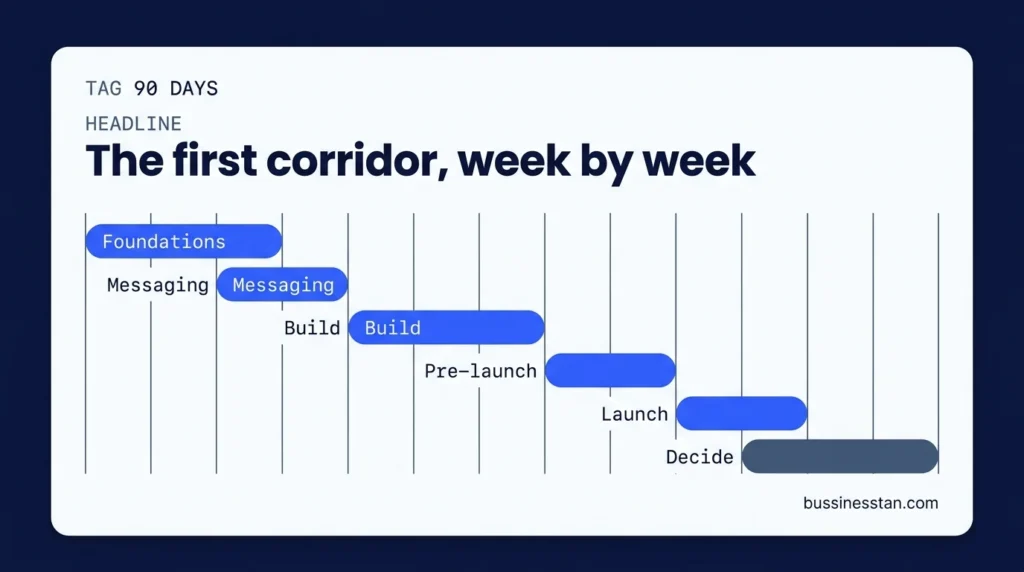
This is how the 10 steps usually fit around a first corridor, once a launch date is realistic. The regulated track sets that date.
| Weeks | Phase | Main steps |
|---|---|---|
| 1 to 2 | Foundations | Corridor decision, measurement design, ad account verification started |
| 3 to 4 | Messaging and identity | Positioning, claims agreed, payout methods confirmed |
| 5 to 7 | Build | Website, app flows, event tracking, KYC tested on older Android phones |
| 8 to 9 | Pre-launch | Soft launch to a small community group; fixes |
| 10 to 11 | Launch | Paid and organic live on 2 or 3 channels; lifecycle messages on |
| 12 to 13 | Read and decide | Day-90 review; scale, hold or exit; corridor 2 shortlist |
That arithmetic is why steps 5 and 6 come before any large media budget. This planning is what our go-to-market for new businesses service produces in 6 weeks, with licensing left to your advisers.
Mistakes that cost new operators their first quarter
| Mistake | What it costs | Do this instead |
|---|---|---|
| Ad account verification started a week before launch | Launch creative sits unused | Start in week 1, alongside the corridor decision |
| Campaigns optimised to installs | Cheap installs that never verify | Optimise toward a post-KYC event or first transfer |
| No event tracking at launch | No reliable cost per first send | Event map before the build |
| Corridor chosen by a partner | Demand that is not there | Score corridors on the same dimensions |
| 4 corridors at once | Budget spread too thin to read | 1 corridor properly, then the next |
| Loose wording about licences in ads | Rejected ads and compliance risk | Only claims your compliance lead has approved |
Who does what at launch
| Area | Led by |
|---|---|
| Licensing, registration, AML programme, legal contracts | Qualified legal and compliance advisers |
| Banking and payout partner agreements | Founders, with advisers |
| Corridor choice, positioning, launch plan | Founders and growth lead |
| Platform, app and tracking | Product and engineering |
| Claims, ad accounts, creative, acquisition | Marketing, with compliance sign-off |
A clear split stops the regulated track and the commercial track from waiting on each other.
Frequently asked questions
How do I start a money transfer business?
Run 2 tracks in parallel. Work with qualified legal and compliance advisers on licensing or registration, AML controls and banking. At the same time, build the commercial side: choose a corridor on evidence, define your sender, line up payout partners, choose a platform, design tracking, build the website and app, prepare ad accounts, launch 1 corridor and review at day 90.
How much does it cost to start a remittance business?
There is no honest single figure. Costs depend on your corridors, whether you build or buy the platform, your payout partners and the regulated requirements where you operate, which your advisers can scope. On the commercial side, budget for website and tracking, creative, paid media, content, community work and a contingency, and plan to run 1 corridor properly.
Do I need a licence for an international money transfer business?
Licensing and registration requirements depend on where you operate and how the business is structured, so this is a question for a qualified legal and compliance adviser. We do not advise on it. What we can say is that the timing of that work sets your launch date, so the commercial plan should run alongside it.
How long does it take to launch a money transfer business?
The regulated timeline varies and sits outside marketing's control. The commercial preparation for a first corridor fits into about 90 days: foundations, messaging, build, soft launch, launch and a day-90 review. A focused go-to-market plan can be written in about 6 weeks, before any media is bought.
How do you get the first 1,000 senders?
Start in 1 corridor with the community you understand best. Use diaspora creators, community groups, referral prompts and corridor search terms, and time activity to occasions and paydays. Make sure KYC completion is tracked from day 1, because early senders lost at verification are the most expensive ones.
Where to start
Knowing how to start a money transfer business comes down to running 2 tracks at once: the regulated work with your advisers, and a commercial plan that picks the right corridor, measures the first transfer and wins senders who come back.
Start with the 90-day go-to-market plan. If you already have a live corridor and want an outside read of what is working, Book a Growth Audit: 2 weeks, a fixed fee, and a roadmap you keep either way.

Written by
Founder & CEO, Bussinesstan
Owns the commercial side of every engagement: fixed-fee scoping, corridor economics, and the reporting that ties spend to completed first transfers rather than to installs.
Meet the team
Remittance corridor analysis: how to score a corridor before you spend
Remittance corridor analysis with a seven-dimension scorecard: demand, competition, pricing, payout, channels, economics and fit, graded before spend.
Website audit checklist for money transfer companies
A website audit checklist for money transfer companies: technical, SEO, conversion, trust and tracking checks, scored and ranked by first transfers.
Stablecoin cross border payments: what money transfer operators should plan for
Stablecoin cross border payments explained for remittance operators: what the rails change, what they do not, and the questions to ask a payout partner.