

Brand 9 min read
Fintech marketing agency or remittance specialist: how to choose
Choosing a fintech marketing agency for a remittance business: 10 questions to ask, a fair comparison of 4 options, and when a generalist is fine.
On this page
Quick answer
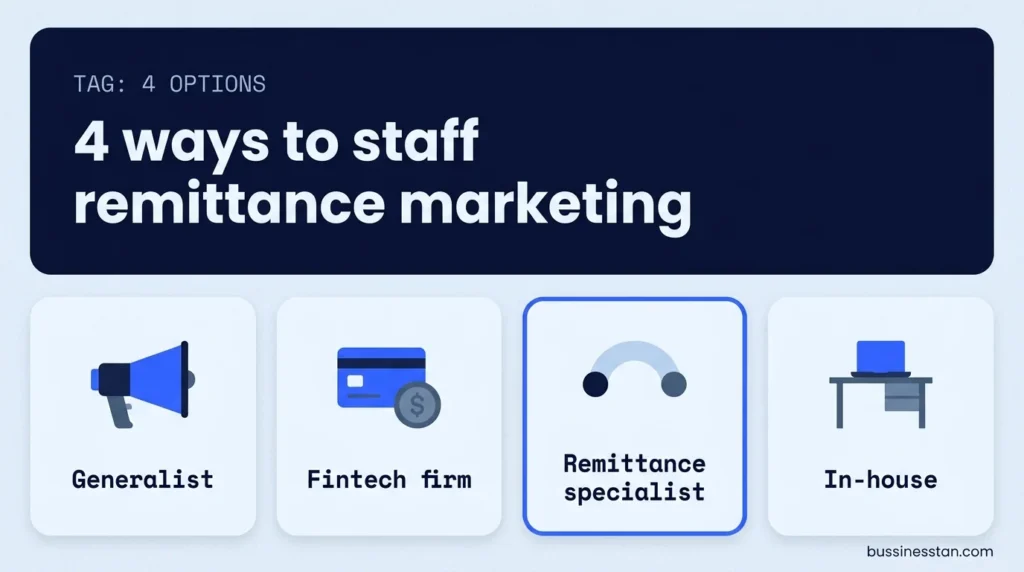
A fintech marketing agency plans and runs acquisition, content and lifecycle marketing for financial technology businesses. For a remittance company, the choice is usually between a generalist agency, a fintech marketing firm, a remittance specialist and an in-house team. The right option depends on the pricing model, what gets reported, corridor knowledge, how compliance is handled, and who owns the accounts and code.
Key takeaways
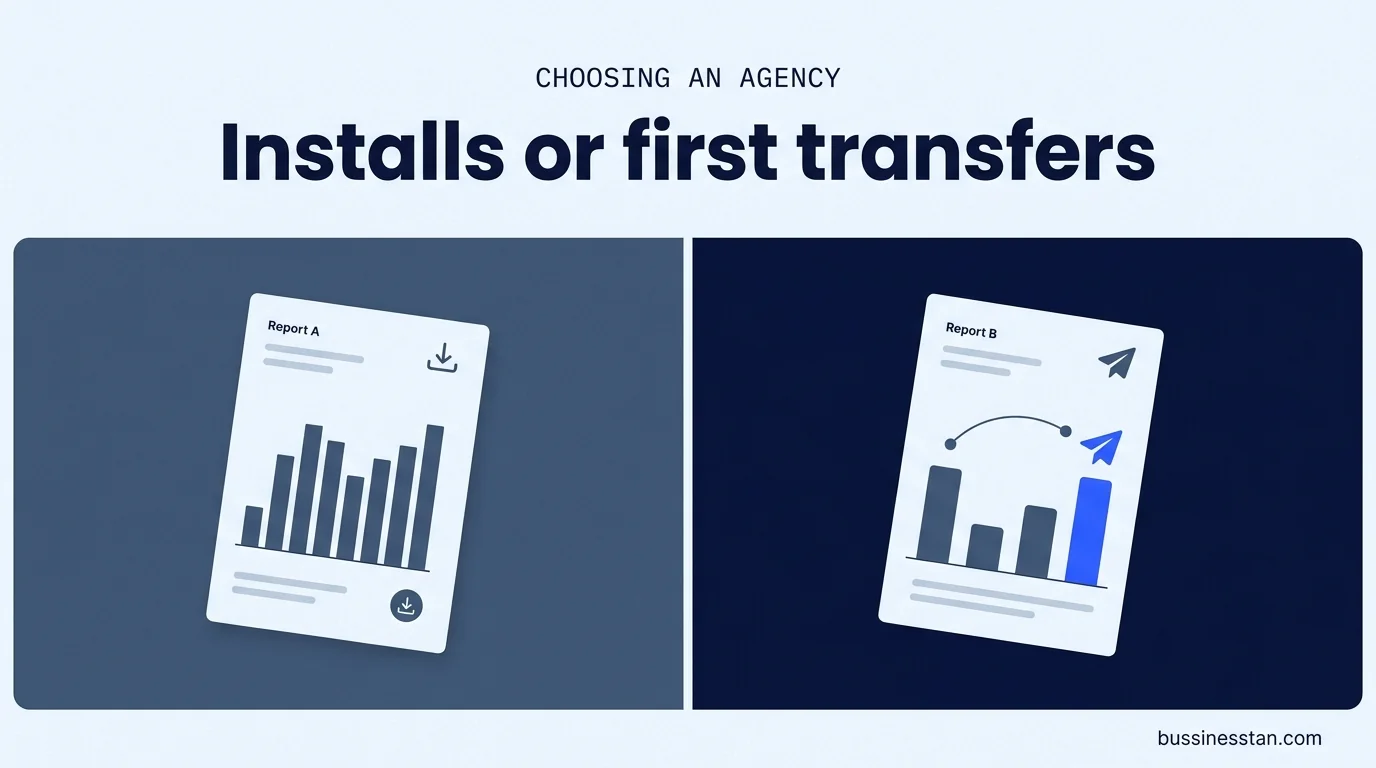
- The most useful test of any agency is what it reports: installs, or first transfers by corridor.
- Pricing models shape behaviour, and a fee tied to media spend rewards spending more.
- A generalist or broad fintech agency is the right call for some jobs, such as a brand launch or large creative production.
- A remittance specialist earns its fee where the problem is the KYC funnel, corridor economics or ad account verification.
- 10 questions, asked the same way to every shortlisted agency, will separate them faster than any credentials deck.
"The last agency spent 4 months learning our business." Founders of remittance apps say it with a particular tiredness. The agency was not bad. It was capable, well staffed and fluent in fintech. It simply started from zero on corridors, KYC drop-off and financial services ad policy, and the learning happened on the client's budget.
This guide is for choosing a fintech marketing agency, or deciding not to hire one. A disclosure first: I run a remittance specialist, so I have a view. I have tried to write the version I would want to read even if you never speak to us, including the cases where a generalist is the better choice.
What a fintech marketing agency does, and what remittance adds
What do fintech marketing services usually include?
Most fintech marketing services cover paid search and social, app install campaigns, content and SEO, email and lifecycle, brand and creative, and analytics. A good fintech marketing firm also knows financial services ad policy and works with a compliance approver in the loop.
Remittance adds 6 things that general fintech experience does not always cover:
- Corridor economics. FX spread, payout cost and send frequency differ by route, so budget is set per corridor.
- The KYC funnel. Most paid money is lost between install and first transfer. We cover the steps in the KYC onboarding process.
- Financial services ad verification. Accounts need approval before campaigns run, and rejections stall launches.
- Diaspora audiences. Senders are reached community by community and city by city.
- Agents and cash pickup. Many operators still run agent counters that digital plans ignore.
- Measurement to first transfer. Platforms stop counting at install unless you pass post-KYC events back.
4 options compared
These are common patterns, not rules. Individual firms vary, so use the table to frame questions rather than to judge anyone in advance.
| Generalist agency | Fintech marketing firm | Remittance marketing agency | In-house team | |
|---|---|---|---|---|
| Category knowledge on day 1 | Low | Medium: financial ad policy, fintech funnels | High: corridors, KYC, verification, diaspora | Grows with tenure |
| Common pricing models | Retainer or % of media spend | Retainer or % of media spend | Varies; ask (we use fixed fees) | Salaries plus tools |
| What they tend to report | Impressions, clicks, installs | Signups, installs, CAC | First transfers, cost per first send, corridor margin | Whatever leadership asks for |
| Compliance handling | Often at the end | Claims reviewed with your approver | Claims agreed before writing; licensing referred out | Close to your compliance team |
| Production capacity | High | Medium to high | Often smaller teams | Limited by headcount |
| Best fit | Brand launches, large creative, PR | Broad fintech with several products | Funnel leaks, corridor growth, measurement | Stable, well-understood channels |
| Main risk | Learning the category on your budget | Remittance treated as generic payments | Capacity limits; narrower bench | Slow to hire, hard to cover gaps |
When a generalist or fintech marketing company is the right call
A specialist is not always the answer. A generalist or broad fintech marketing company is often the better choice when:
- You need a brand launch or rebrand with film, OOH and PR at scale.
- Remittance is one feature inside a wider financial product, and the main revenue sits elsewhere.
- You already have a strong head of growth who knows corridors and needs production hands, not strategy.
- Your problem is creative volume, and the funnel below install already works.
A remittance specialist tends to earn its fee when:
- Registrations look healthy but first transfers do not.
- Nobody can produce cost per first send by corridor.
- Ad accounts keep getting rejected.
- A corridor launch is coming and the plan is a copy of the last one.
An in-house team makes sense once the channels are stable and the playbook is written down. Many operators end up with a mix: in-house ownership of the numbers, outside help for specific leaks.
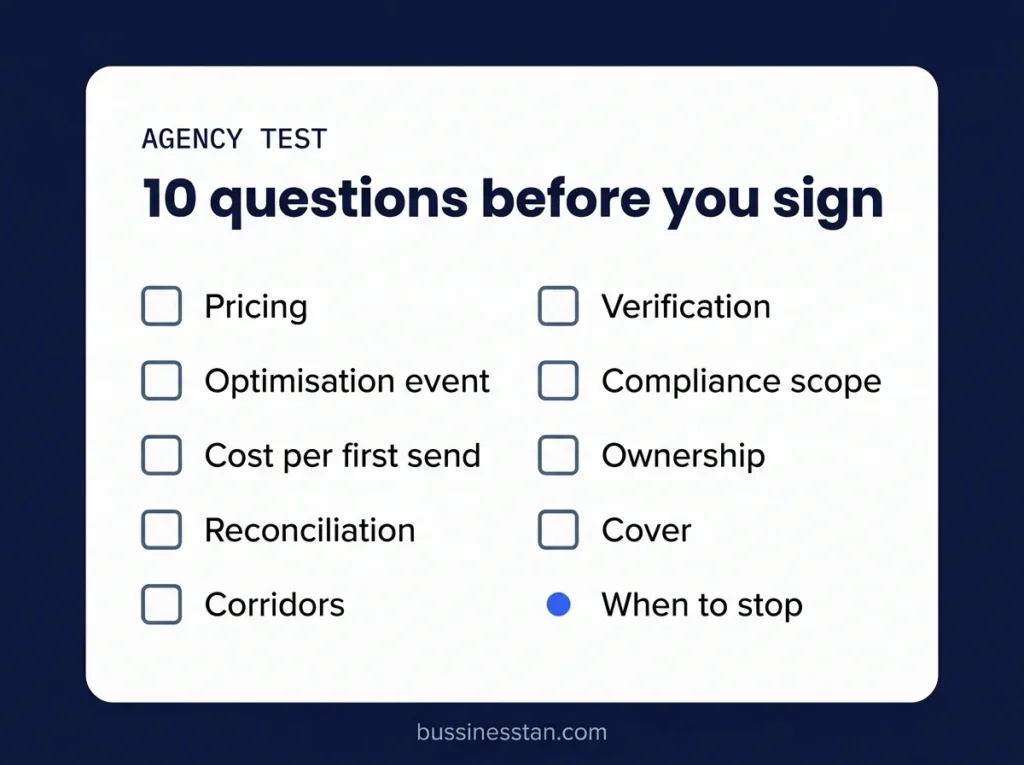
The 10-question agency test
Ask every shortlisted agency the same 10 questions, in writing. The answers matter less than how specific they are.
| # | Question | What a good answer sounds like |
|---|---|---|
| 1 | How do you price, and does your fee rise when our media spend rises? | A clear model, stated upfront, with the incentive explained |
| 2 | Which event will campaigns be optimised toward? | A post-KYC event or first transfer, not install |
| 3 | How will you report cost per first send by corridor? | A named report, built from your transfer records |
| 4 | How do you reconcile platform conversions with our data? | Monthly reconciliation, with the gap written down |
| 5 | What changes between 2 of our corridors? | Specifics: payout method, documents, community, send cycle |
| 6 | How do you handle financial services ad verification? | Evidence pack prepared before filing, landing pages locked |
| 7 | Where does your compliance scope stop? | A clear boundary, stated without hesitation |
| 8 | Who owns the ad accounts, pixels, data and code? | You do, from day 1 |
| 9 | Who does the work, and who covers when they are away? | Named people and a named backup |
| 10 | What would make you tell us not to spend more? | A funnel condition, such as KYC completion or tracking gaps |
Question 7 deserves a note. A marketing partner should know where its competence ends. Our own line is this: Licensing and AML questions go to a qualified adviser. We handle advertising and marketing compliance.
Question 10 is the one most agencies find hardest. Any partner paid more when you spend more has a reason to avoid it. We do not price on a percentage of spend, so we earn less as budgets grow. That is deliberate, and the reasoning is on our why us page.
Red flags and green flags
| Red flag | Green flag |
|---|---|
| The proposal leads with cost per install | The proposal leads with cost per first send |
| Case studies with no scope, period or source | Numbers with scope, or an honest "none yet" |
| "We will get your accounts approved" | "Here is the evidence pack we prepare first" |
| Compliance mentioned only in the terms | Claims agreed with your approver before writing |
| Accounts opened in the agency's name | Accounts, pixels and code owned by you |
| A plan that adds channels in month 1 | A plan that fixes tracking in month 1 |
| Guaranteed rankings or cost per acquisition | "No, and nobody credible does" |
If the first row sounds familiar, read your cost per install is lying to you before the next pitch meeting.
One practical test: give each agency an existing ad and landing page, and ask how they would review the claims. Their process tells you how many weeks your compliance approver will lose.
How to run the decision without losing a quarter
- Write down the leak. One sentence: where money is lost today, in your numbers.
- Shortlist 3. Include one option you would not normally consider.
- Send the 10 questions. Same wording, same deadline.
- Buy a small, fixed-scope piece of work before any retainer: an audit or one corridor.
- Judge the output on specificity, not polish.
Often you should not switch at all. If your current agency answers questions 2, 3 and 4 well, a specialist audit can sit alongside them, with findings shared with both. The overall case for planning around first transfer, send frequency and corridor mix is in our fintech marketing strategy for remittance companies.
If you want to know where we sit on that table, Bussinesstan works only with remittance and money transfer businesses, on fixed fees. We are a small team, so capacity is capped rather than sold twice.
Frequently asked questions
What does a fintech marketing agency do?
It plans and runs marketing for financial technology businesses: paid acquisition, app install campaigns, content, SEO, lifecycle messaging and creative. The better ones understand financial services ad policy and work with your compliance approver. For a remittance business, the key question is whether the agency measures success on first transfers and corridor margin or stops at installs.
How much do fintech marketing services cost?
There is no standard price. The common models are a monthly retainer, a percentage of media spend, fixed project fees and, occasionally, performance-based fees. Ask each agency how its fee changes when your spend changes, and what is included. Compare total cost against the outcome you care about, such as cost per first send, not against the hourly rate.
What is the difference between a fintech marketing firm and a remittance marketing agency?
A fintech marketing firm works across financial products such as banking, lending, cards and payments. A remittance marketing agency works only with money transfer businesses, so it starts with corridor economics, KYC funnels, diaspora audiences and financial ad verification. The trade-off is breadth and production capacity against category depth on day 1.
Should we switch agency or keep our current one?
Often you should keep them. If your current agency optimises toward post-KYC events, reports cost per first send by corridor and reconciles platform numbers with your records, the gap may be narrow. Commission a fixed-scope audit first and share the findings with the incumbent before deciding.
Can a fintech marketing company handle compliance?
A marketing partner can handle advertising and marketing compliance: claim substantiation, disclosures, platform ad policy and approval workflows with your team. It should not advise on licensing, AML or regulatory authorisation. Those questions belong with qualified legal and compliance advisers, and a credible agency will say so plainly.
Where to start
Choosing an agency for a remittance business comes down to incentives, measurement and category depth. Ask the 10 questions, weigh the 4 options fairly, and buy a small piece of fixed-scope work before committing to a retainer.
If you would like that piece of work to be ours, Book a Growth Audit. It runs for 2 weeks at a fixed fee, covers paid media, tracking, conversion and corridor economics, and you keep the roadmap whether or not we work together.

Written by
Founder & CEO, Bussinesstan
Owns the commercial side of every engagement: fixed-fee scoping, corridor economics, and the reporting that ties spend to completed first transfers rather than to installs.
Meet the team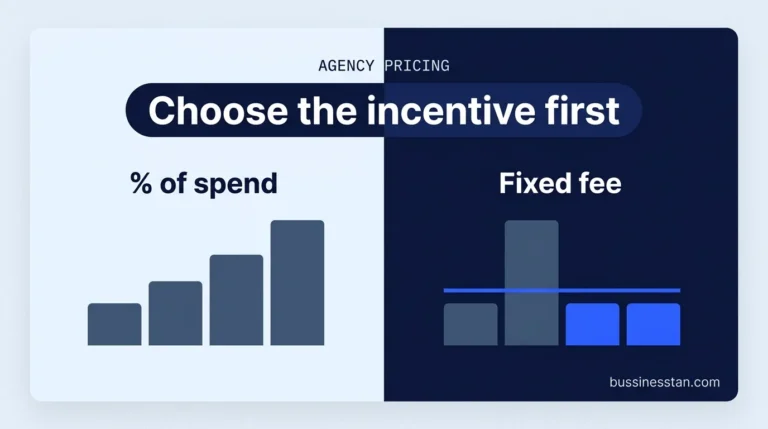
Agency fee percentage of ad spend vs fixed fee: how to pay a growth agency
Agency fee percentage of ad spend, fixed fee, retainer or performance pricing: how each model shapes incentives for a remittance business, and how to choose.

CRM for money transfer companies: design the data model first
CRM for money transfer companies, built on the data model: one record per sender, 9 lifecycle stages, B2B pipelines, consent rules and a 10-week rollout.
UGC for financial services: creator marketing for money transfer brands without compliance risk
UGC for financial services, done safely: diaspora creators, 6 restricted claim areas, disclosure by market and a brief compliance can sign off.