

Consulting 9 min read
What a paid ads audit for a remittance company should find in 14 days
What a paid ads audit for a remittance company should find in 14 days: 18 areas, the timeline, the deliverables and when the answer is spend less.
On this page
Quick answer
A paid ads audit for a remittance company is a fixed-length review of Google, Meta and TikTok accounts that judges spend against funded first transfers rather than clicks or registrations. It checks account structure, tracking, bidding, creative, claim risk and waste, joins platform data to the operator's own transfer records, and ends with costed findings and a prioritised plan, which sometimes says spend less.
Key takeaways
- A paid ads audit should judge every campaign by cost per first send, not by cost per install or cost per registration.
- The 18 audit areas fall into 6 groups: structure, tracking, bidding, creative, claim risk and waste.
- The most important step is joining platform conversions to your own transfer records and reporting the gap.
- 14 days is enough when read-only access arrives on day 1 and the findings are sized in money.
- A good audit is allowed to conclude that the budget should shrink until the funnel holds.
Spend is rising and nobody trusts the numbers. Google says one thing, Meta says another, the MMP says a third, and finance can only see transfers. Your head of growth is defending a cost per install that looks fine while the corridor margin quietly erodes.
That is when a paid ads audit earns its fee: an independent read of the accounts against the one record that matters. Who verified, who funded a first transfer, and in which corridor.
Why a remittance paid ads audit is different from a generic PPC review
A generic PPC audit checklist stops at the conversion the platform can see. For a money transfer business, that conversion is usually a registration or an install, and both sit before the two steps where most senders are lost: the KYC screen and the first funded transfer.
So the audit looks further down the funnel than the platform does. A campaign with a cheap registration can be the most expensive campaign in the account once you divide its spend by verified senders who actually sent. We covered why in Your cost per install is lying to you.
What does a paid ads audit judge spend against?
It judges spend against 3 numbers, in this order:
| Level | What it measures | Why it matters |
|---|---|---|
| Cost per verified sender | Spend divided by senders who passed KYC | Shows which campaigns bring people who can actually send |
| Cost per first send | Spend divided by senders who funded a first transfer | The first point where revenue exists |
| Corridor margin after acquisition | Corridor revenue from fees and FX spread, minus acquisition cost | Shows whether a corridor is worth scaling at all |
Everything above those 3 lines (CPM, CTR, CPC, cost per install) is diagnostic, never a verdict.
The 18 audit areas, grouped into 6
Our paid ads audit covers 18 areas across Google, Meta and TikTok. Grouped, they become 6 questions a founder can follow.
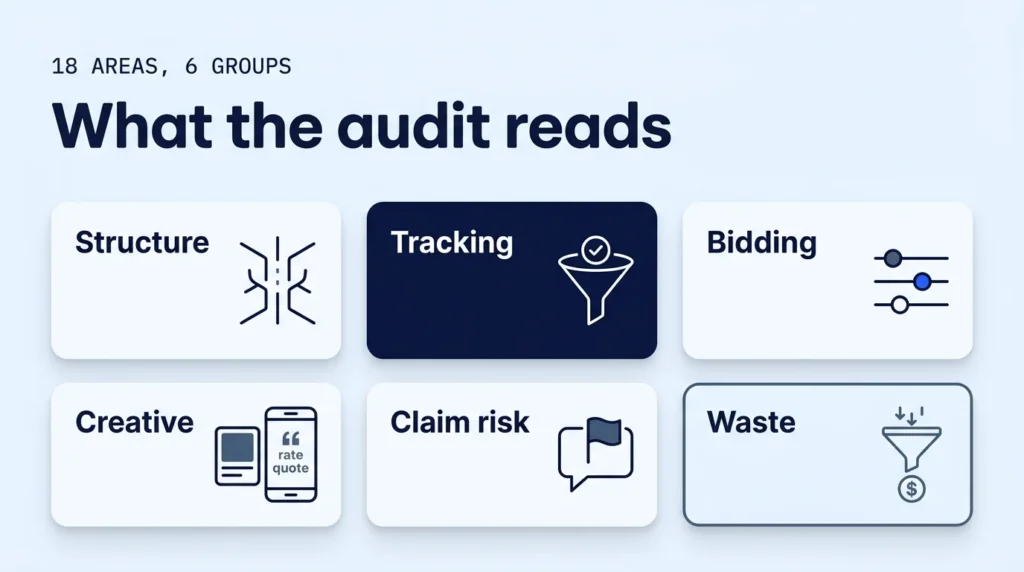
The 6-group audit map: 18 areas
| Group | The 3 areas | What good looks like |
|---|---|---|
| 1. Structure | Account hierarchy; corridor separation; budget allocation | One campaign per corridor or corridor group, so budget follows corridor value instead of national averages |
| 2. Tracking | Event validation; attribution review; KYC quality check | Registration, KYC started, KYC passed, first transfer and repeat transfer all fire once, with one name each, and reach the ad platforms as post-KYC events |
| 3. Bidding | Bidding review; conversion goal choice; audience overlap | Bidding optimises toward verified senders or first transfers, and Meta audiences are not competing with each other |
| 4. Creative | Creative fatigue; landing page match; message match by corridor | The ad, the landing page and the rate shown at checkout say the same thing for the same corridor |
| 5. Claim risk | Ad policy risk; fee and rate wording; financial services verification status | No "cheapest", "instant" or "guaranteed" claim that the product cannot support, and verification is in order before it becomes urgent |
| 6. Waste | Search term waste; corridor economics; competitive review | Every pound or dollar that never produced a verified sender is listed, sized and assigned an action |
Tracking sits second because every later judgement depends on it. If the first transfer event is broken, everything after it is guesswork.
What a Google Ads audit for fintech should check first
For Google, the first two checks are corridor structure and search terms. A single national campaign bidding on "send money abroad" mixes a UK to Nigeria sender with a UK to India sender, and the two corridors rarely have the same margin. Search term reports usually show spend on queries with no sending intent: exchange rate lookups, job searches, competitor login pages. The detail on corridor structure is in Google Ads for money transfer companies, and it is the structure our Google Ads team rebuilds when the audit calls for it.
What a Meta ads audit should check first
For Meta, check whether the Conversions API is sending server-side events deduplicated against the pixel, and whether campaigns optimise for installs or for a post-KYC event. Then check audience overlap and creative fatigue: diaspora audiences in one city are smaller than they look, and overlapping ad sets bid against each other.
The 14-day timeline, day by day
A paid ads audit runs on a fixed clock, so access comes first.
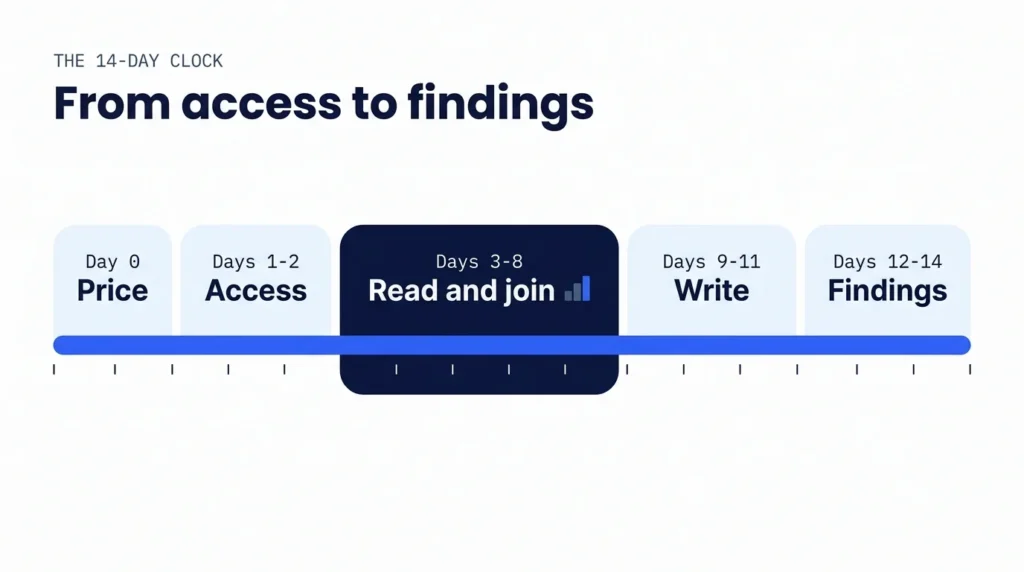
| Days | What happens | What you provide |
|---|---|---|
| Day 0 | Written scope and fixed price within 1 business day | Monthly spend, channels, live corridors |
| Days 1 to 2 | Read-only access to ad accounts, analytics, MMP and tag manager | Access grants, one named contact |
| Days 3 to 8 | Accounts read against the 18 areas; platform data joined to transfer records | Aggregate export of registrations, KYC passes and first transfers by source and corridor |
| Days 9 to 11 | Findings written and sized in money; roadmap drafted | Answers to open questions |
| Days 12 to 14 | 90-minute findings session; documents handed over | The people who will act on it |
Nothing is paused during the audit. Campaigns keep running. The access is read-only, and KYC and transfer data is used at aggregate level.
Joining the records: the step most audits skip
Days 3 to 8 contain the step that separates a paid ads audit from a platform health check. Platform-reported conversions are laid next to your own transfer records, by source and by corridor, and the difference is reported rather than explained away.
When 3 platforms each claim the same first transfer, the sum of their conversions will exceed the transfers in your database. That gap is not a rounding error. It is the size of the budget currently being allocated on claims nobody has checked.
What you should be handed at the end
The deliverables show whether it was an audit or a sales meeting. You should keep 6 documents, whether or not work follows.
- Full paid media audit. The 18 areas, each with a finding, the evidence and a severity.
- Conversion tracking audit. The 9 transfer events from registration to repeat transfer, with which fire correctly, which fire twice and which are missing.
- Creative analysis. Which ads and landing pages carry the verified senders, and which carry only clicks.
- Paid media waste report. Spend that produced no verified sender, sized in money per month.
- Priority action plan. Fixes ranked by monthly cost and effort.
- 30/60/90-day roadmap. Who does what, in which order.
What a good ad spend waste report looks like
A useful ad spend waste report names the line item, the monthly amount and the action. "Improve targeting" is not a finding. "£3,200 a month on search terms with no sending intent across 2 corridors: add 140 negatives, review weekly" is.
| Waste type | Where it hides | Typical action |
|---|---|---|
| Non-sending search terms | Broad match and Performance Max | Negative lists by corridor, weekly review |
| Install-optimised Meta spend | App campaigns bidding for installs | Move the goal to a post-KYC event |
| Corridor misallocation | One national budget | Split by corridor, fund by margin |
| Duplicate attribution | 3 platforms claiming one transfer | Report on reconciled first sends only |
| Verification abandoners ignored | No retargeting after document capture fails | Retarget, and fix the capture step |
How claim risk is handled
Claim risk sits in the audit because rejected ads and paused accounts are a cost too. The audit flags wording such as "cheapest", "fastest" or "guaranteed" that the product may not support, and checks the state of financial services verification. The path through verification is in Financial services ad verification: the 14-day path. Ad approval itself stays with the platforms. Nobody can promise it.
Licensing and AML questions go to a qualified adviser. We handle advertising and marketing compliance.
When a paid ads audit ends with "spend less"
Some audits end with a recommendation to spend less. That is a legitimate result, not a failure of the audit.
It usually happens in 1 of 3 situations:
- The funnel leaks after the ad. Verification completion is low, so every extra pound buys more abandoned document capture. More spend makes the number worse.
- The tracking cannot be trusted. Until first transfer events reach the platforms reliably, bidding algorithms optimise toward the wrong people. Scaling now scales the error.
- One corridor carries the account. A corridor with thin margin is absorbing budget that a stronger corridor could use at a lower cost per first send.
We argue against more spend until the funnel holds. That costs us follow-on work in month one. It is still the right call, and the reason a fixed-fee audit is worth more than a free review from someone paid on media volume.
A clean account is a finding too. It means the constraint is elsewhere: the KYC screen, the second transfer, or blended CAC hiding weak corridors.
Frequently asked questions
How long does a paid ads audit take?
14 days from access to the findings session for a full audit across Google, Meta and TikTok. The clock depends on read-only access arriving on day 1. A single-channel audit, for example Google alone, can run inside a week. Campaigns keep running throughout, and nothing in the accounts is changed during the audit.
What should a PPC audit checklist for a remittance business include?
It should include corridor structure, event tracking through KYC and first transfer, bidding goals, search term waste, landing page match, audience overlap, creative fatigue, claim wording and corridor economics. The difference from a generic PPC audit checklist is the finish line: every item is judged by cost per first send, not cost per click or cost per registration.
Is a Google Ads audit for fintech different from one for ecommerce?
Yes. Ecommerce conversions happen on the same site the ad sends traffic to. A remittance first transfer happens after identity checks, often in an app, sometimes days later. The audit has to check that those later events reach Google through offline import or enhanced conversions, and that the account is structured by corridor rather than by country.
What access does the audit need?
Read-only access to the ad accounts, analytics, tag manager and MMP, plus an aggregate export of registrations, KYC passes and first transfers by source and corridor. No sender-level personal data is needed. If the export is hard to produce, that is a finding.
How much ad spend waste does an audit usually find?
There is no honest general figure, and anyone quoting one before seeing your accounts is guessing. The audit sizes waste in money per month for your accounts. If it finds little, it says so and points to the constraint actually costing you first transfers.
Where to start
A paid ads audit is worth doing when spend is rising, cost per first send is unknown, or two teams report different numbers for the same month. It is not worth doing if tracking has been live for under a month or there is no paid spend yet.
Grant read-only access, send the aggregate transfer export, and within 14 days you will know which campaigns produce verified senders and which produce only reports. Book a Growth Audit. You keep the roadmap whether or not we work together.

Written by
Founder & CEO, Bussinesstan
Owns the commercial side of every engagement: fixed-fee scoping, corridor economics, and the reporting that ties spend to completed first transfers rather than to installs.
Meet the team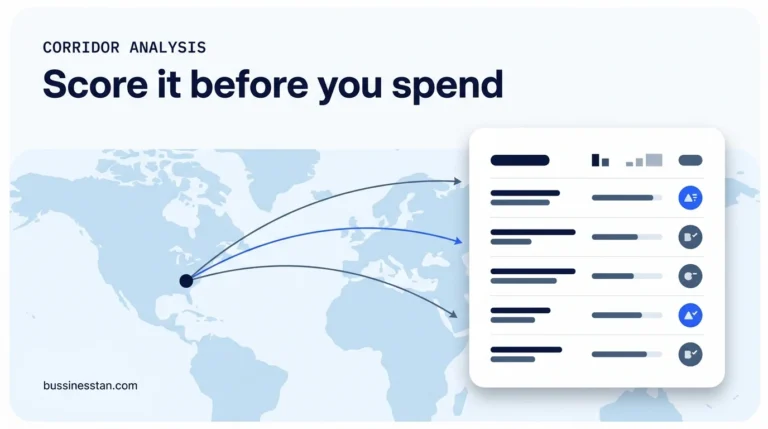
Remittance corridor analysis: how to score a corridor before you spend
Remittance corridor analysis with a seven-dimension scorecard: demand, competition, pricing, payout, channels, economics and fit, graded before spend.

Website audit checklist for money transfer companies
A website audit checklist for money transfer companies: technical, SEO, conversion, trust and tracking checks, scored and ranked by first transfers.

Stablecoin cross border payments: what money transfer operators should plan for
Stablecoin cross border payments explained for remittance operators: what the rails change, what they do not, and the questions to ask a payout partner.