

Marketing 9 min read
Fintech customer retention for remittance apps: earning the second transfer
Fintech customer retention for remittance apps: lifecycle stages, 3 retention levers, corridor-based dormancy and reactivation without discount habits.
On this page
Quick answer
Fintech customer retention is the work of keeping people active after their first use of a financial product. In a remittance app, it means earning the second transfer and then a steady send frequency, using lifecycle messages timed to each sender's corridor and sending pattern, such as rate alerts, saved beneficiary prompts and clear guidance, rather than relying on repeated discounts.
Key takeaways
- The second transfer is the point where acquisition cost starts to pay back, so it deserves its own programme.
- Map senders to 8 lifecycle stages and give each stage one job, one channel and one message.
- Rate alerts, beneficiary prompts and education are the 3 levers that move repeat transfers without eroding margin.
- Define dormancy by corridor and sending pattern, not by a single 90-day rule.
- Treat discounts as the last rung of a reactivation ladder, and measure every campaign against a holdout.
They send once and disappear. Every operator we talk to recognises that sentence. Acquisition budgets go on the first transfer, and almost nothing is planned for the second. The sender who cleared KYC, funded a transfer to Lagos and never came back cost the full acquisition price and returned a single margin.
Fintech customer retention in remittance is not a loyalty scheme. It is a programme that notices when a sender's usual rhythm is due, gives them a reason to open the app, and makes the repeat send take seconds.
Our earlier article, send frequency, not signups, sets out the arithmetic. This one is the programme: the stages, the levers, the dormancy rules and the reactivation ladder.
Why fintech customer retention starts with the second transfer, not the install
An install is a cost. A first transfer usually returns less than it cost to acquire the sender. The second transfer is often where the account starts to pay back, and every send after that is where corridor margin is earned.
That is why remittance app retention sits beside acquisition in the plan, not after it. It also changes what you ask of paid media. Campaigns tuned for installs bring in people who were never going to send twice, a point we cover in optimising Meta Ads for the first transfer.
The remittance lifecycle: 8 stages, one job each
Most retention problems start with a single list and a single message. The fix is to group senders by where they are, using the states your transfer system already records.
| Stage | How you know | The job of the next message | Default channel |
|---|---|---|---|
| Registered | Account created, KYC not started | Explain what verification needs | Email, push |
| Verified | KYC passed, no transfer | Get the first transfer quoted | Email, push |
| First transfer | 1 completed transfer | Confirm payout, save the beneficiary | Push, email |
| Second transfer | 2 completed transfers | Set the rhythm (rate alert, reminder) | Push |
| Repeat sender | Regular cadence established | Keep it quick, say nothing unnecessary | In-app |
| High frequency | Well above corridor norm | Service quality, limits, early notice of changes | Email, in-app |
| Declining | Gap longer than personal cadence | Find the reason, fix the friction | Email, SMS |
| Dormant | No send beyond corridor window | Reactivate with value, then offer | Email, SMS, WhatsApp |
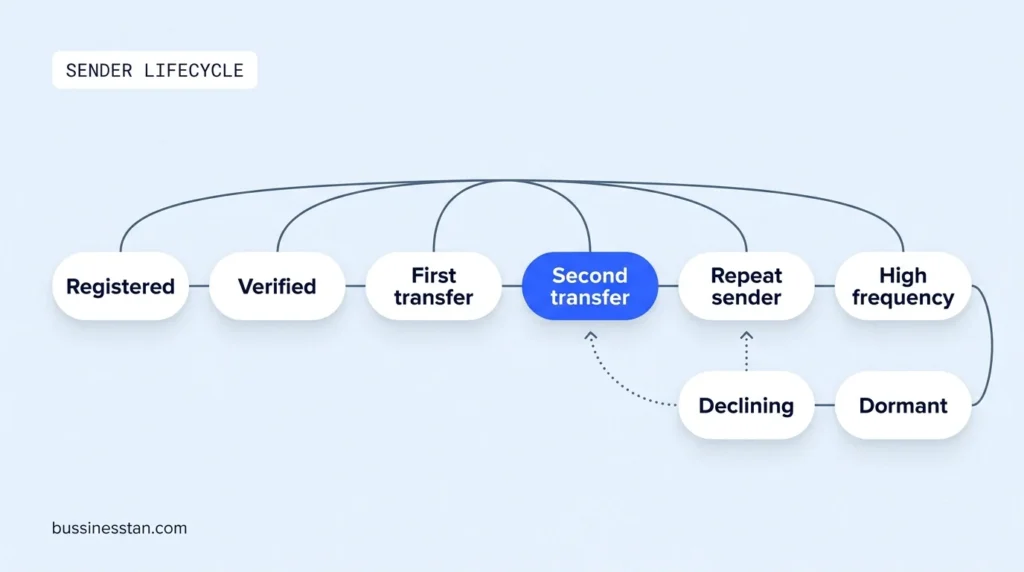
The declining stage is the one most operators never build. It is also the cheapest to act on. A sender who usually sends every 30 days and is now at day 40 is still reachable. A sender at day 180 mostly is not.
The 3 levers of remittance app retention
We call these the 3 retention levers. They work because they are useful to the sender, not because they are clever.
Lever 1: rate alerts
Senders watch the rate, especially on corridors where they send a fixed amount in local currency. A rate alert set by the sender (notify me when GBP to NGN passes a threshold) is opt-in, timely and repeatable. It creates a reason to open the app that you do not have to invent. Pull rates from the live system; never type them into a template.
Lever 2: beneficiary prompts
The repeat send is mostly about the beneficiary: the mother in Accra, the school in Lahore, the sibling with a mobile wallet in Nairobi. Prompts that reference a saved beneficiary and a known pattern ("Time for your usual transfer to Amina?") make the second send a 2-tap action. The app work behind this, saved beneficiaries and one-tap repeat, often matters more than the message.
Lever 3: education
First-time senders often do not know how long cash pickup takes, what the receiver needs to bring, or why a transfer was held for checks. Short, plain explanations after the first transfer remove the doubt that stops a second. They also cut "where is my money" contacts.
Which lever fits which stage
| Stage | Rate alert | Beneficiary prompt | Education |
|---|---|---|---|
| First transfer | Offer to set one | Save the beneficiary | Payout and pickup guidance |
| Second transfer | Primary lever | Primary lever | Light touch |
| Declining | Useful | Primary lever | Check for a service issue |
| Dormant | Useful | Useful if data is recent | Changes since they left |
Dormancy is a corridor definition, not a calendar rule
A fixed 90-day rule treats every sender the same. Remittance send frequency does not work that way. Payday senders to Pakistan might send monthly. School fee senders to Ghana might send each term. Some diaspora senders send mainly around Eid, Ramadan or Christmas.
Set dormancy windows from your own transfer records, per corridor and per sender where you have enough history.
| Sending pattern | Typical cadence to check | Declining trigger | Dormant trigger |
|---|---|---|---|
| Payday sender | Monthly | 1.5x personal cadence | 3x personal cadence |
| School fee sender | Termly | 2 to 3 weeks past the usual term date | Missed a full term |
| Seasonal sender | Occasion-led | Occasion approaching with no send | Missed 2 occasions |
| Irregular sender | No clear cadence | Corridor median gap passed | 2x corridor median gap |
The multipliers above are starting points to test, not rules. The point is that the trigger comes from behaviour, not from a calendar.
Reactivation campaigns without discount dependence
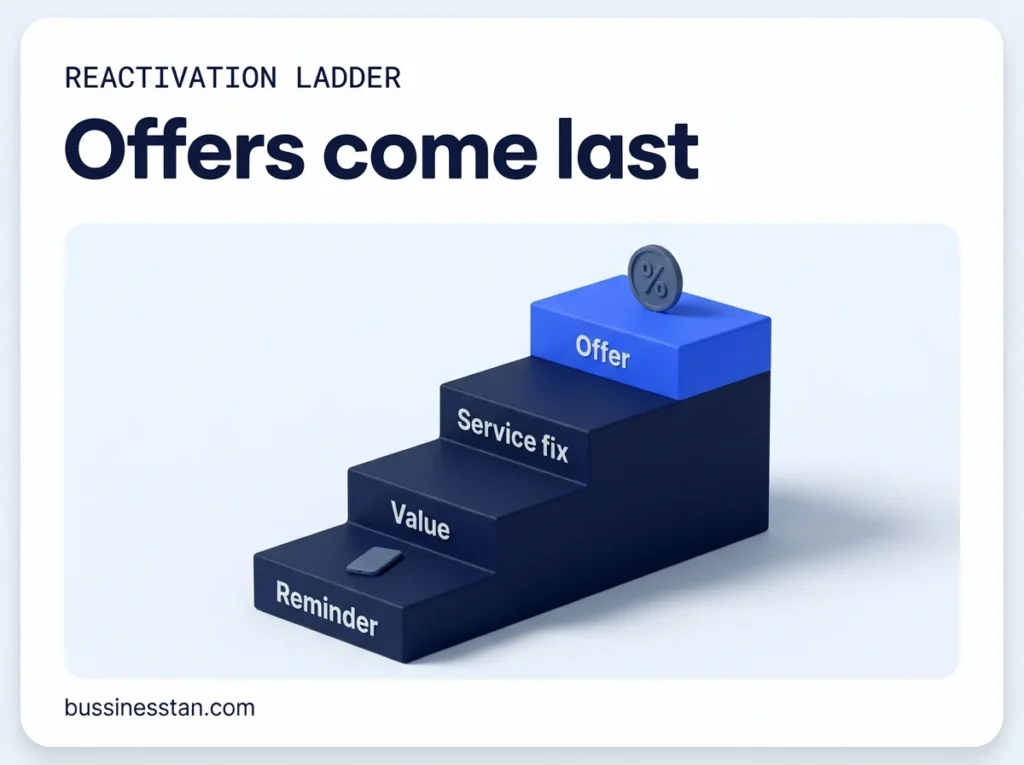
Discounts bring dormant senders back for one transfer and teach them to wait for the next discount. Reactivation campaigns work better as a ladder, where each rung costs more than the last.
- Reminder. A beneficiary-led nudge at the sender's usual time. No offer.
- Value. What has changed: a new payout method, a faster corridor, an improved rate display. Only claims you can evidence.
- Service fix. If the last transfer had a problem (a hold, a failed payment, a slow payout), acknowledge it and explain what changed.
- Offer. A fee waiver or rate offer, limited to one transfer, only for senders the first 3 rungs did not move.
Cap frequency across channels, so a sender gets no more than an agreed number of marketing messages a week, whichever team sends them. Transfer updates always go through. WhatsApp can carry reminders well where senders have opted in, as our WhatsApp Business API guide explains.
This is the work of our retention and reactivation team, usually alongside email marketing for the content and SMS and email automation for the triggers.
Fee and rate offers are advertising claims, and consent rules differ by market. Licensing and AML questions go to a qualified adviser. We handle advertising and marketing compliance.
Measuring repeat transfers honestly
Report retention on money, not opens.
- Second transfer rate within 30, 60 and 90 days of the first, by corridor and acquisition source.
- Send frequency per active sender per month, by cohort.
- Reactivated senders who send again within a set window, and whether they send a second time after that.
- Revenue per sender over 12 months, by cohort.
- Holdouts: keep a small random group out of each campaign, so you can see what would have happened anyway.
Without a holdout, a reactivation campaign sent in the week before Eid will look like a triumph. Many of those senders were coming back regardless.
Frequently asked questions
What does fintech customer retention mean for a remittance app?
It means keeping verified senders active after their first transfer. The core measures are second transfer rate, send frequency and revenue per sender by cohort. The work is a lifecycle programme: messages triggered by sender state and corridor rhythm, a quick repeat send in the app, and reactivation that starts with reminders and value before any offer.
How do you increase repeat transfers?
Save the beneficiary at the first transfer, make repeat send a 2-tap action, offer rate alerts the sender sets, and time reminders to each sender's usual cadence. Explain payout and pickup clearly after the first transfer so doubt does not stop the second. Measure against a holdout so you know which change actually moved repeat transfers.
When should reactivation campaigns start?
Start before dormancy, at the declining stage, when a sender's gap is noticeably longer than their usual cadence. That is when they are cheapest to bring back. Full reactivation campaigns follow at the corridor-based dormant trigger. Order the ladder as reminder, value, service fix, then offer, and cap frequency across all channels.
What is a good send frequency for a remittance app?
It depends on the corridor and the reason for sending. Payday senders often send monthly, school fee senders by term and seasonal senders around key occasions. Benchmark against your own corridor medians rather than a generic figure, and track whether each cohort's frequency is rising or falling over its first 12 months.
How is remittance app retention different from retention in other fintech apps?
Remittance has a natural rhythm tied to paydays, school terms and religious or family occasions, and the real relationship is often with the beneficiary. Retention works best when it follows that rhythm and the saved beneficiary, rather than generic engagement tactics. The unit that matters is the repeat transfer, not app opens or session length.
Where to start
Start with the senders who sent once. Count them by corridor, check how many had a problem on that first transfer, and build one second-transfer sequence before you touch the dormant base. It usually costs less and pays back sooner.
Download the Send frequency LTV model to size what that is worth. If you want the retention numbers read alongside acquisition and tracking, Book a Growth Audit. It takes 2 weeks for a fixed fee, and you keep the roadmap whether or not we work together.

Written by
Founder & CEO, Bussinesstan
Owns the commercial side of every engagement: fixed-fee scoping, corridor economics, and the reporting that ties spend to completed first transfers rather than to installs.
Meet the team
UGC for financial services: creator marketing for money transfer brands without compliance risk
UGC for financial services, done safely: diaspora creators, 6 restricted claim areas, disclosure by market and a brief compliance can sign off.
Activation emails for remittance apps: a sequence for senders who verified and never sent
Activation emails for remittance apps: a 6-message trigger sequence, subject line patterns, channel rules and measurement on funded first transfers.
Fintech marketing strategy for remittance companies: the 2026 playbook
A fintech marketing strategy for remittance companies built on first transfer, send frequency and corridor mix, with a channel map and 90-day plan.